

All That's Left of You
Directed by Cherien Dabis (2026)
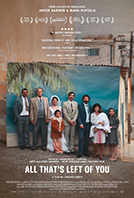
| With | Saleh Bakri, Cherien Dabis, Mohammad Bakri, Adam Bakri, Maria Zreik, Muhammad Abed Elrahman, Sanad Alkabareti, Salah El Din |
| Runtime | 146 minutes |
| Release | 2026-01-05 |
| Original title | Allly baqi mink |
| Rating | 9/10 |
From 1948 to the present day, three generations of a Palestinian family carry the hopes and wounds of a people. A sweeping epic where history and intimacy meet.
The review
By Mulder 2026-03-06
There are films that attempt to tell history, and then there are films that attempt to carry it, to bear its weight in their bodies, in their silences, in the tremor of a father's voice as he remembers the oranges that once fed a queen. All That's Left of You, written, directed, and starring Cherien Dabis, definitely belongs to the latter category. Spanning more than seven decades, from the Nakba of 1948 to the troubled present, the film follows a Palestinian family across three generations, not to summarize the Israeli-Palestinian conflict in the manner of a school textbook, but to dramatize the way political violence seeps into the private sphere, reshaping masculinity, parenthood, memory, and even the moral vocabulary of survival. It is an ambitious, often heartbreaking saga that understands something essential: history is not an abstract force, it is a series of humiliations, compromises, acts of love, and unbearable choices made around a kitchen table or at a checkpoint.
The film opens in 1988, during the first Intifada, with teenager Noor running through the West Bank before getting caught in a shootout. The shock of this moment is immediately reframed by Noor's mother, Hanan, played with grave calm by Cherien Dabis, who addresses the camera directly. To understand her son, she insists, you have to understand his grandfather. What follows is a temporal exploration that begins in 1948, where Sharif, played in his youth by Adam Bakri, is a wealthy orange grower in Jaffa, clinging to his land as Zionist militias advance. Cherien Dabis wisely resists the spectacular; bombs fall, but the camera lingers instead on domestic rituals: a poem recited to a frightened child, a dinner interrupted by shelling. The loss of his home is not staged as a great tragedy, but as a slow disbelief. When Sharif finally loses everything (his land, his livelihood, his dignity), it is not just a displacement, but the first break in a line of paternity.
In 1978, Sharif reappears, now played by the late Mohammad Bakri, whose weathered face bears the marks of three decades of exile. Living in precarious conditions in the occupied West Bank with his son Salim, played with poignant restraint by Saleh Bakri, the film delves into more emotionally complex territory. Salim is a literature professor, a man who believes that survival requires a lowered gaze and measured silence. His father believes that memory itself is a form of resistance. The generational tension between pride and pragmatism is not abstract: it erupts in one of the film's most harrowing scenes, when Israeli soldiers arrest Salim and his young son Noor on their way home. Forced to humiliate himself at gunpoint, Salim chooses humiliation over martyrdom, convinced that this is how he can protect his child. But through Noor's eyes, we witness something else: the collapse of his father's invincibility. It is a scene that sums up the film's central question: what does resistance look like when your child is watching you?
Cherien Dabis structures the narrative in a deliberately non-linear way, but the emotional architecture remains clear: trauma is passed down from generation to generation. Noor, played as a child by Sanad Alkabareti and as a teenager by Muhammad Abed Elrahman, grows up torn between his grandfather's defiance and his father's caution. When the film returns to 1988 and Noor is seriously injured during a protest, the story shifts from a political chronicle to a moral test. Bureaucratic delays, hospital corridors, and hushed consultations replace street clashes. What could have become controversial instead becomes deeply human: Salim and Hanan are faced with a heart-wrenching decision about organ donation, a gesture that could save Israeli lives. The irony is almost unbearable. Yet here, Cherien Dabis refuses easy catharsis. She wonders whether humanity can survive hatred without becoming naive, whether compassion is capitulation or the most radical form of resistance.
Technically, the film is sober rather than flamboyant. Director of photography Christopher Aoun favors composed wide shots and intimate close-ups that highlight the geography of faces as much as that of the territory. The orange groves of Jaffa glow with golden light, while the refugee neighborhoods seem stifling without resorting to visual excess. If there is a weakness, it lies in the passages at the beginning of 1948, where the exposition sometimes tends toward didacticism, as if the film feared that its audience did not know enough about history. But as the decades pass, the characters gain depth, becoming less symbolic and more painfully real. Saleh Bakri, in particular, delivers an extraordinarily nuanced performance (his shoulders perpetually tense, his gaze darkened by compromise) as a man who believes that endurance is a heroic act, even if his son calls it cowardice.
The film's final act, set in 2022, risks veering into sentimentality when Salim and Hanan return to a transformed Jaffa, entering a landscape that no longer recognizes them. Yet even here, Cherien Dabis anchors the emotion in lived experience rather than rhetoric. The final moments do not promise justice; they offer something more discreet: continuity. Identity persists. Memory persists. The land may have been renamed, but grief has its own cartography. The title, All That's Left of You, ultimately refers not to property or politics, but to the remnants of humanity that cannot be confiscated.
While the film sometimes veers toward melodrama and exceeds its ideal length, this is an excess of conviction rather than calculation. Cherien Dabis has created a work whose perspective is resolutely partisan, but whose emotional quest is universal. This is not a neutral film, but it is deeply committed to complexity, resisting caricature even as it condemns systemic violence. Above all, it understands that the most profound battles are not fought with weapons, but within families: between fathers and sons, between memory and survival, between rage and grace.
All That's Left of You
Written and directed by Cherien Dabis
Produced by Thanassis Karathanos, Cherien Dabis, Martin Hampel, Karim Amer
Starring Saleh Bakri, Cherien Dabis, Mohammad Bakri, Adam Bakri, Maria Zreik, Muhammad Abed Elrahman, Sanad Alkabareti, Salah El Din
Cinematography: Christopher Aoun
Edited by Tina Baz
Music by Amine Bouhafa
Production companies: Pallas Film, Displaced Pictures, Nooraluna Productions, Twenty Twenty Vision, AMP Filmworks, ZDF, Arte
Distributed by Watermelon Pictures (United States), Nour Films (France)
Release dates: January 25, 2025 (Sundance), January 5, 2026 (United States), March 11, 2026 (France)
Running time: 146 minutes
Seen on March 5, 2026 at UGC Ciné-cité Les Halles, theater 6