

Wuthering Heights
Directed by Emerald Fennell (2026)
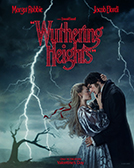
| With | Margot Robbie, Jacob Elordi, Hong Chau, Shazad Latif, Alison Oliver, Martin Clunes, Ewan Mitchell |
| Runtime | 136 minutes |
| Release | 2026-02-13 |
| Rating | 7/10 |
A modern take on the absolute passion between Heathcliff and Catherine, a legendary romance that defies time and reason.
The review
By Mulder 2026-02-10
The film Wuthering Heights, written and directed by Emerald Fennell, arrives surrounded by controversy, curiosity, and an undeniable touch of provocation. It is a film that makes its intentions clear before a single word is spoken. This is not a respectful adaptation of Emily Brontë's novel, and the film does not pretend to be. On the contrary, Emerald Fennell offers a feverish reinterpretation that treats the source material less as sacred text and more as raw emotional fuel. From its bold opening, a sequence that immediately blends eroticism and morbidity, the film displays its attachment to sensation, excess, and destabilization. What follows is a work that oscillates between gothic melodrama, black comedy, and stylized psychosexual fantasy, at once intoxicating and exasperating, but rarely boring. Fennell's cinema has always thrived on discomfort and contradiction, and here she pushes this signature approach into literary territory, removing the second generation and reducing the narrative field almost entirely to obsession, desire, and emotional cruelty.
At the center of this storm are Margot Robbie as Catherine Earnshaw and Jacob Elordi as Heathcliff, a duo whose chemistry proves to be the film's most compelling argument. Margot Robbie plays Catherine not as a fragile romantic heroine, but as an unstable, self-aware narcissist torn between social ambition and wild desire, while Jacob Elordi's Heathcliff seethes with wounded pride and dark menace. Their relationship is rendered as a cycle of attraction and destruction, where love manifests itself less as tenderness than as addiction. Fennell brings to the fore the carnal tension that previous adaptations often left simmering beneath the surface, transforming languid glances into tactile, sweat-drenched encounters, staged in rain-swept moors, cramped cars, and dark bedrooms. And yet, curiously, the explicitness sometimes detracts from the mystery: the tragedy of Brontë's lovers traditionally lies in repression and impossibility, whereas here, gratification sometimes diminishes the emotional stakes. Still, Robbie's ability to reveal vulnerability beneath Catherine's manipulative bravado, and Jacob Elordi's imposing physicality, coupled with a palpable undercurrent of bitterness, create a dynamic that remains irresistibly captivating.
Visually, the film is simply extravagant. Director of photography Linus Sandgren captures the landscapes of Yorkshire with lush, dreamlike grandeur, letting the mist, wind, and storm light reflect the characters' inner turmoil. Production designer Suzie Davies constructs environments that lean joyfully toward artificiality: Wuthering Heights becomes a jagged, mineral nightmare of stone and shadow, while Thrushcross Grange explodes into a delirious rococo fantasy of lacquered reds, flesh-colored walls, and strange textures. The contrast is unsubtle but effective, transforming class divisions into architectural and chromatic violence. Costume designer Jacqueline Durran contributes to the creation of clothing that borders on couture surrealism, with translucent fabrics and aggressive touches of crimson red symbolism, transforming Catherine into a walking canvas of erotic and psychological signifiers. The film's aesthetic often teeters on the edge of kitsch, but Fennell's commitment to maximalism gives the imagery a hypnotic coherence, even if it is sometimes overwhelming.
The supporting performances provide both grounding and tonal disruption. Nelly, played by Hong Chau, is reimagined with a seething resentment that subtly redefines the emotional dynamic, her watchful presence suggesting a character who is both participant and judge. Shazad Latif imbues Edgar Linton with a quiet decency that contrasts sharply with Heathcliff's volatility, making him less of a rival than a tragic and inevitable figure. As for Alison Oliver, she steals the show as Isabella, transforming what is often a thankless role into a strangely fascinating blend of comic eccentricity and disturbing action. Oliver's Isabella, by turns naive, obsessive, and disturbingly limber, embodies the film's tonal audacity, shifting from dark humor to erotic unease with fearless elasticity. Martin Clunes, as Mr. Earnshaw, embodies a grotesque and tragicomic patriarch whose alcoholism and cruelty set the tone for the story's hereditary trauma, even if the script sometimes pushes the character toward caricature.
Musically, Emerald Fennell continues her fascination with anachronism. Anthony Willis' score overflows with operatic intensity, amplifying both grief and hysteria, while the inclusion of tracks by Charli XCX injects a discordant but deliberate modern pulse. These sound choices shatter any illusion of period purity, framing the drama instead as something closer to a pop-tinged gothic opera. At times, the clash is electrifying, underscoring the timeless nature of teenage obsession; at others, it risks breaking the emotional immersion. Yet this tension between sincerity and stylization is at the heart of Emerald Fennell's approach: Wuthering Heights is conceived less as a historical narrative than as an exaggerated emotional hallucination.
The film's greatest strength and weakness are one and the same: its refusal to hold back. Emerald Fennell's interpretation embraces melodrama, erotic symbolism, and visual flamboyance with such abandon that subtlety rarely comes into play. For some viewers, this maximalist strategy will be seen as a thrilling liberation from the orthodoxy of historical dramas; for others, it will be seen as an indulgent spectacle lacking the psychological depth that characterizes Brontë's novel. What is undeniable, however, is the film's visceral impact. This film may not satisfy purists in search of fidelity, but as a cinematic experience in its own right, it commands attention. Emerald Fennell creates a world where love is toxic, desire is destabilizing, and tragedy is staged with operatic grandeur, leaving behind a film as controversial as it is unforgettable.
Wuthering Heights
Written and directed by Emerald Fennell
Based on Wuthering Heights by Emily Brontë
Produced by Emerald Fennell, Josey McNamara, Margot Robbie
Starring Margot Robbie, Jacob Elordi, Hong Chau, Shazad Latif, Alison Oliver, Martin Clunes, Ewan Mitchell
Cinematography: Linus Sandgren
Edited by Victoria Boydell
Music by Anthony Willis (score), Charli XCX (songs)
Production companies: MRC, Lie Still, LuckyChap Entertainment
Distributed by Warner Bros. Pictures
Release dates: January 28, 2026 (TCL Chinese Theatre), February 11, 2026 (France), February 13, 2026 (United States)
Running time: 136 minutes
Seen on February 2, 2026 at Le Grand Rex cinema