

EPiC: Elvis Presley in Concert
Directed by Baz Luhrmann (2026)
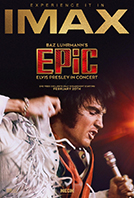
| With | Elvis Presley |
| Runtime | 97 minutes |
| Release | 2026-02-20 |
| Rating | 10/10 |
EPiC presents long-lost footage from Presley's legendary Las Vegas residency in the 1970s, mixed with rare 16mm footage of Elvis Presley on tour, precious 8mm footage from the Graceland archives, and recordings of Elvis Presley telling his side of the story, rediscovered during Baz Luhrmann's research for his film ELVIS.
The review
By Mulder 2026-02-10
"We can't go on together
With suspicious minds
And we can't build our dreams
On suspicious minds" Elvis Presley – Suspicious Minds
If the film EPiC: Elvis Presley in Concert has a mission, it is undoubtedly to bring Elvis Presley back to the forefront, not as a museum piece or an iconic figure of pop culture, but as a true living force. And for once, the result perfectly lives up to expectations. After Baz Luhrmann's maximalist love letter in Elvis (2022), this new feature film seems to be a backdoor to reality for the director: a séance constructed from bloopers, rehearsals, fragments of amateur films, and confessional audio recordings that allow Elvis Presley to tell his own myth. The structure refuses to politely confine itself to a single category (concert film, documentary, visual essay), and this refusal becomes the central point: the film evolves like a memory, like the adrenaline of backstage, like a setlist that keeps changing while you catch your breath.
The film draws on the precious archives of Elvis: That's the Way It Is and Elvis on Tour, and it is refreshingly candid about what makes it special: not only the material, but also the work that went into bringing it to life. Baz Luhrmann's team delves into the mythology of the Warner archives, but the real feat is technical: restoration, remastering, and the brutal puzzle of synchronizing sound and image when so many images were not originally associated with clear sound. You can feel the influence of modern gold standards in restoration associated with Peter Jackson's orbit, not because it's about perfectly imitating the documentary series on the Beatles, but because the clarity has that same unsettling quality: sweat, fabric texture, the sparkle in the eyes... The past is no longer archived, it is present. And that presence changes everything. The Vegas era, which was previously considered kitsch in old popular culture, becomes something else entirely when it is so sharp and loud: less glittery nostalgia, more punchy performance art.
What is strikingly surprising about this film is how well it understands that the most revealing plot in musical cinema is often repetition. On stage, Elvis Presley is a controlled storm; in rehearsal, he is funny, meticulous, relaxed, and constantly listening. Baz Luhrmann and editor Jonathan Redmond give these moments a real breath of fresh air, and it is here that the film begins to appear as an antidote to the lazy caricature of Elvis Presley's late career. We see him jamming with musicians capable of changing direction in the blink of an eye, we discover his playful conductor side, his quick decisions, his way of testing the room and adapting, and this reframes the whole performer versus songwriter debate in his favor: he may not have written like Bob Dylan, Paul McCartney, or John Lennon, but he arranged with his body, he composed with phrasing, timing, tone, and risk. The interaction between the band and the audience becomes a drama in its own right, with a musical discipline that makes the legend seem earned rather than inherited. And when the film assembles complete performances from multiple sources without feeling like a Frankenstein's monster of a montage, it results in the ideal version of what people remember about the concerts, even when their memories fail them.
The setlist is essentially a guided tour through Elvis Presley as a physical phenomenon. Polk Salad Annie is obviously the standout track, as it shows him as a comedian, predator, seducer, athlete, and preacher, all in a matter of minutes; Burning Love explodes with an inevitability that has everyone on the verge of getting up; Suspicious Minds plays like a finale worthy of a crown jewel that challenges the audience not to explode. But the real sophistication lies in how EPiC sprinkles moments of respite throughout the film so that it doesn't become a monotonous adrenaline loop. When In the Ghetto arrives, it's not just a change of tempo; it's Baz Luhrmann attempting to frame the emotional image Elvis Presley had of himself, the story he wanted to tell about himself as an artist with a conscience. And yes, the film also includes comedy and crowd frenzy: those vintage shots of the audience are almost anthropological, with the screaming, fainting, and chaos of cigarettes and champagne that now seem to come from another planet, with Cary Grant, Sammy Davis Jr., and George Hamilton appearing like glamorous Easter eggs from a parallel Hollywood timeline.
EPiC is, by design, a celebration, and it sometimes shows its bias. The film largely avoids the more complicated ethical and personal terrain that other works have tackled more directly, notably what Sofia Coppola explored in Priscilla. Priscilla Presley and Lisa Marie Presley make cameo appearances, and there is a strategically moving duet with Always on My Mind that aims for tenderness. Sometimes it works, sometimes it feels like the sentimental editing is trying a little too hard. There's also that press conference sequence where Elvis Presley says he's just an artist, with Colonel Tom Parker looming like a shadow in the frame; Baz Luhrmann insists on the implication of coercion, and depending on your tolerance for Luhrmann's protective framing, you'll interpret it as either a human context or a blurred mythification. The film is not there to judge cultural appropriation, power dynamics, or the darker costs of the machine. EPiC's argument is simpler: before judging the mythology, remember the craft; before reducing the man to headlines, look at what he could do on stage.
EPiC stands out as a phenomenal film because it knows that the quickest way to understand Elvis Presley is not through his biography, but through his impact. When the film stops overdoing it on screen and lets Elvis Presley's voice carry the transitions, it becomes almost intimate, as if you were hearing thoughts he never intended for a stage. Baz Luhrmann, usually the king of visual exclamation points, shows surprising restraint when necessary, using his kaleidoscopic instinct more as a rhythm than a jumble. It's also a clever correction to the idea that the Las Vegas residency was a late-career compromise: in a world where residencies are now prestigious appointments, Elvis Presley suddenly seems ahead of his time, not behind it. Watching him in this form, it's easy to see why comparisons to other great performers keep coming up, why people think of Freddie Mercury, why the modern charisma of stadiums seems to echo a model that Elvis Presley helped invent.
EPiC is not the final word on Elvis Presley, nor does it try to be, and if you want all the complexity, you'll have to bring your own context to the cinema. But as a cinematic experience, it's close to ideal: a technically stunning restoration, the editing talent of Jonathan Redmond, and a director, Baz Luhrmann, who understands that sometimes the most radical thing you can do with an icon is to shut up, start the movie, and let the artist remind everyone why the crown existed in the first place. A huge favorite of our editorial team, Elvis Presley's music is like his eternal legend.
EPiC: Elvis Presley in Concert
Directed by Baz Luhrmann
Starring Elvis Presley
Edited by Jonathan Redmond
Music by Elvis Presley
Production companies: Sony Music Vision, Bazmark Films, Authentic Studios
Distributed by Neon (United States), Universal Pictures (France)
Release dates: September 6, 2025 (TIFF), February 20, 2026 (United States), February 25, 2026 (France)
Running time: 97 minutes
Seen on February 10, 2026 at Le Grand Rex cinema