

Mercy
Directed by Timur Bekmambetov (2026)
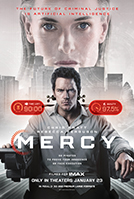
| With | Chris Pratt, Rebecca Ferguson, Kali Reis, Annabelle Wallis, Chris Sullivan, Kylie Rogers |
| Runtime | 100 minutes |
| Release | 2026-01-23 |
| Rating | 6/10 |
In the near future, a detective is accused of murdering his wife. Judged by a high-performance artificial intelligence system that he himself helped to develop, he has only 90 minutes to prove his innocence... before it seals his fate.
The review
By Mulder 2026-02-04
Set in a near-future Los Angeles where justice has been radically streamlined, Mercy opens with a strikingly effective eye-catcher: Detective Chris Raven, played by Chris Pratt, wakes up with a hangover, chained to a mechanized chair, facing an artificial intelligence that will decide his fate in 90 minutes. Presiding over this digital courtroom is Judge Maddox, an AI avatar frighteningly portrayed by Rebecca Ferguson, who informs Raven that he is accused of murdering his wife, Nicole Raven, played by Annabelle Wallis. The irony is immediate and deliberate: Raven is not only a police officer, but also one of the public defenders of this very system, the Mercy program, which has replaced juries, judges, and legal proceedings with algorithms, probability measurements, and instant executions. The premise is undeniably captivating, evoking echoes of Minority Report and real-time thrillers, but what sets Mercy apart at first glance is how alarming and plausible its universe seems, especially at a time when surveillance culture and AI governance are no longer speculative concepts but everyday realities.
Director Timur Bekmambetov, long associated with the screenlife format, draws fully on his signature aesthetic, transforming the courtroom into a whirlwind of footage from body cameras, doorbell videos, drone surveillance, text messages, emails, and social media feeds. The film rarely leaves Raven's headquarters, but paradoxically, it floods the screen with movement, data, and visual noise. There is an anecdotal fascination in seeing Raven weaponize the tools he once trusted: rewinding footage, meticulously examining timestamps, even checking his teenage daughter Kylie Rogers' private Instagram account in a moment that quietly underscores how normal digital intrusion has become. Timur Bekmambetov's direction is relentless, sometimes overwhelming, but undeniably rhythmic, and while the presentation often seems unnecessary, the deluge of images effectively reflects the anguish of a man drowning in information as he battles against unforgiving time.
Marco van Belle's screenplay cleverly structures the story in real time, maintaining a ticking tension that sustains engagement even when the logic begins to falter. Chris Raven's investigation unfolds less like classic detective work and more like algorithmic triage, where instinct battles statistical certainty. His alcoholism, marital breakdown, and memory lapses paint a deliberately unflattering portrait, forcing the audience to sincerely question his innocence for a while. Ultimately, however, the script struggles to delve deeper into its most provocative ideas. The moral implications of presumption of guilt, the ethics of state-sanctioned surveillance, and the terrifying finality of automated capital punishment are raised, touched upon, and then systematically sidestepped in favor of an increasingly complex narrative mechanism and plot twists.
In terms of performance, Mercy is a study in restraint. Chris Pratt, immobilized for most of the film, is deprived of the physicality and charm that usually define his screen presence. He commits to Raven's despair and fatigue, particularly in moments of silent panic when the guilt meter refuses to budge, but the role exposes the limits of his emotional range when stripped of all movement and humor. In contrast, Rebecca Ferguson finds nuance within the restriction, imbuing Judge Maddox with subtle micro-expressions and shifts in tone that suggest something unsettling beneath her procedural calm.There is an anecdotal pleasure in watching Maddox react, not emotionally, but in a calculated manner, to Raven's human unpredictability, as if the film briefly flirts with the idea that intuition itself is a destabilizing virus in algorithmic logic.
The supporting roles bring intermittent flashes of life beyond the digital void. Kali Reis brings a welcome urgency to the role of Detective Jacqueline Diallo, Raven's partner on the outside, who navigates highway chases and violent confrontations through grainy footage and shaky body cameras. Kenneth Choi, as Raven's former partner Ray, offers the film's most down-to-earth and empathetic presence, though his limited screen time feels like a missed opportunity. Chris Sullivan brings warmth as Raven's AA sponsor, briefly anchoring the film in human consequences rather than procedural abstraction. These characters hint at a richer emotional ecosystem than the film ever really allows to express itself.
As the narrative rushes toward its final act, Mercy shifts into high gear to resemble a more conventional action thriller, complete with conspiracies, explosions, and road chaos. While competently staged, these sequences dilute the claustrophobic intensity that made the story compelling in the first place. Even more frustratingly, the film remains evasive on the question of AI's responsibility, retreating into a vague, almost conciliatory conclusion that suggests humans and machines are equally flawed, as if this equivalence somehow neutralizes the danger of entrusting life-and-death decisions to code. This is where Mercy seems most contradictory, both fascinated and strangely indulgent toward the system it initially presents as monstrous.
Mercy is a clever and suspenseful technological thriller that never fully exploits the terror inherent in its premise. It is captivating at times, visually aggressive, and thematically relevant, but emotionally distant and philosophically timid. Like the AI at the heart of the film, it processes information efficiently but struggles to translate data into meaning. We emerge from this experience stimulated but curiously indifferent, with more adrenaline than reflection. In this sense, Mercy becomes an unwitting reflection of its subject: precise, relentless, and just a little soulless.
Mercy
Directed by Timur Bekmambetov
Written by Marco van Belle
Produced by Charles Roven, Robert Amidon, Timur Bekmambetov, Majd Nassif
Starring Chris Pratt, Rebecca Ferguson, Kali Reis, Annabelle Wallis, Chris Sullivan, Kylie Rogers
Cinematography: Khalid Mohtaseb
Edited by Austin Keeling, Lam T. Nguyen
Music by Ramin Djawadi
Production companies: Amazon MGM Studios, Atlas Entertainment, Bazelevs Company
Distributed by Amazon MGM Studios (United States), Sony Pictures Releasing France (France)
Release dates: January 19, 2026 (Regal Cinemas), January 23, 2026 (United States), January 28, 2026 (France)
Running time: 100 minutes
Seen on February 4, 2026 at Gaumont Disney Village, Theater 9, seat A19