

Charlie the Wonderdog
Directed by Shea Wageman (2026)
| With | Owen Wilson, Dawson Littman, Ruairi MacDonald, Tabitha St. Germain, Zac Bennett-McPhee, Rhona Rees, Caitlynne Medrek, Sebastian Billingsley-Rodriguez, Anthony Bolognese, Lindsay Gibson, Mela Pietropaolo, Elishia Perosa, Artus, Philippe Allard, Cécile Florin, Nicolas Matthys, Monia Douieb, Marie Du Bled |
| Runtime | 95 minutes |
| Release | 2026-01-16 |
| Rating | 7/10 |
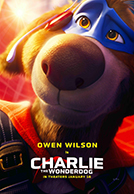
Danny and his little dog Biscuit are best friends. One day, a mysterious magic gives Biscuit incredible powers: he can now talk and fly. Whenever someone needs him, he puts on his mask, dons his cape, and soars into the sky to help: he has become a fantastic dog! Biscuit now has two passions: eating tacos and saving the world. But Pudding, the neighbor's cat, who also has superpowers, dreams of making cats rule the universe. Danny and Biscuit will have to prove that together, nothing can stop them!
The review
By Mulder 2026-01-09
To Neron, I will miss you forever
From the very first minutes, Charlie the Wonderdog tackles a surprisingly poignant idea: the silent and inevitable sadness of seeing a beloved pet grow old alongside a child who does not yet know how to deal with loss. These opening scenes, centered on young Danny Littman and his aging dog Charlie, are undoubtedly the most honest and moving in the film, and they briefly suggest a story ready to tackle much more mature themes than its initial premise—that of a brightly colored superhero dog—would suggest. The bond between the boy and the dog is established with genuine tenderness, which involuntarily reminded me of my own childhood pets and that subtle anxiety children feel when they first realize that animals don't age like humans do. For a moment, director Shea Wageman seems ready to let this emotional foundation define the film. Unfortunately, that promise is almost immediately compromised when aliens enter the picture and the film abruptly shifts into familiar, market-tested territory.
The triggering incident, the abduction of Charlie by a spoiled alien prince, voiced by Sebastian Billingsley-Rodriguez, alongside a menagerie of pets from across the galaxy, functions less as a narrative necessity than as a transition from sweet character piece to standard animated superhero fare. When Charlie returns to Earth with the gift of speech, the ability to fly, and superhuman strength, voiced in a relaxed and affable manner by Owen Wilson (in the original version), the film settles into a rhythm that seems aggressively confident. Owen Wilson's performance is pleasant and warm, but it's also undeniably low-risk, as if the character had been specifically designed to fit into this familiar, laid-back cadence rather than challenge it. Charlie becomes a canine Superman in all but name, instinctively responding to calls for help, and while there is something touching about a hero motivated solely by kindness, the script rarely explores what this means emotionally for Charlie or Danny once fame, spectacle, and danger come into play.
Opposite Charlie is Puddy, a genetically enhanced cat voiced by Ruairi MacDonald, whose villainy is as predictable as it is exaggerated. The evil cat versus heroic dog dynamic is nothing new, and here it's rendered with little nuance, leaning heavily on clichés about the cruelty of felines and the virtue of canines. Puddy's plan, which shifts from petty resentment to full-blown world domination, feels less like a natural character development and more like a mechanical requirement of the genre. The film further muddies its message by interweaving this plot with a thin layer of political satire involving the President of the United States, voiced by Tabitha St. Germain (in the original version), whose obsession with branding, social media, and monetizing Wonderdog's image seems strangely outdated and misjudged in tone. These jokes seem intended for adults, but they land with all the subtlety of a blunt instrument, distracting from the emotional core without offering much insight or wit in return.
Visually, Charlie the Wonderdog is competent but rarely inspired. The animation, produced outside the major studio system, avoids the glaring technical flaws that once plagued low-budget CGI, and the color palette is pleasantly bold. Nevertheless, the environments lack personality and feel more like temporary spaces than living places. The character design, particularly Charlie's shifting anatomy between “dog” and “humanoid superhero,” is inconsistent enough to be distracting, suggesting compromise rather than creative intent. There are moments—Charlie flying through the clouds, his cape billowing in the wind—where the film briefly taps into the joy of flight and freedom that defines the superhero fantasy, but these flashes are isolated and never fully integrate into a cohesive visual identity.
In terms of tone, the film struggles to find a balance with its audience. It clearly caters to very young viewers, relying on slapstick gags, loud dialogue, and constant movement to maintain attention, but it sometimes references adult sensibilities with topical references and satirical jabs that seem out of place in such a simple narrative. Even scenes that could have explored moral ambiguity or consequences, such as the one where Charlie prioritizes food over an impending disaster, played as a gag, end up undermining the character's integrity rather than deepening it. These moments seem to be the remnants of abandoned ideas, clues to drafts where Charlie's powers had clearer limits or costs, now reduced to disposable jokes that raise questions the film has no interest in answering.
What ultimately holds Charlie the Wonderdog together, even in a rough way, is its central message: kindness itself is a superpower. When the film strips away its excessive plot, loud villains, and clumsy satire, it finds brief clarity in Charlie's instinctive desire to help simply because he can. This simplicity may resonate with younger audiences, who are less concerned with originality than sincerity, and there is undeniable value in presenting heroism as something rooted in empathy rather than ego. Yet for adult viewers, or even older children, the film's reluctance to develop its themes beyond superficial platitudes makes for a hollow experience, as if it constantly circles around something meaningful without ever committing to it.
Ultimately, Charlie the Wonderdog comes across as a film that begins with the emotional weight of a farewell and ends with the sound of a formula conscientiously executed. For families with very young children, it is harmless, colorful, and at times charming. For everyone else, it serves as a reminder of how animated films often underestimate the power of simply sticking with a good idea long enough to let it breathe.
Charlie the Wonderdog
Directed by Shea Wageman
Written by Shea Wageman, Steve Ball
Produced by Shea Wageman, Carson Loveday
Starring Owen Wilson, Dawson Littman, Ruairi MacDonald, Tabitha St. Germain, Zac Bennett-McPhee, Rhona Rees, Caitlynne Medrek, Sebastian Billingsley-Rodriguez, Anthony Bolognese, Lindsay Gibson, Mela Pietropaolo, Elishia Perosa, Artus, Philippe Allard, Cécile Florin, Nicolas Matthys, Monia Douieb, Marie Du Bled
Edited by Danielle Altura
Music by Petteri Saario
Production companies: Icon Creative Studio
Distributed by KMBO (France), ICON Creative Studio / Viva Kids (United States)
Release dates: January 16, 2026 (United States), February 6, 2026 (France)
Running time: 95 minutes
Seen on January 8, 2026 at Club 13