

28 Years Later: The Bone Temple
Directed by Nia DaCosta (2026)
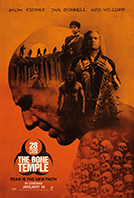
| With | Ralph Fiennes, Jack O'Connell, Alfie Williams, Erin Kellyman, Chi Lewis-Parry |
| Runtime | 109 minutes |
| Release | 2026-01-16 |
| Rating | 5/10 |
In this new installment of the saga, Dr. Kelson enters into a relationship that is as disturbing as it is unexpected, with repercussions that could shake our world to its core. Meanwhile, Spike and Jimmy Crystal's encounter turns into a nightmare. In this film, it is no longer the infected who pose the greatest threat to the survival of the human race—it is the lack of humanity among the survivors that proves to be the most terrifying danger...
The review
By Mulder 2026-01-14
The promise of director Nia DaCosta taking the reins of this saga should have been a thunderclap, but 28 Years Later: The Bone Temple arrives instead as a muffled echo of ideas that once screamed with urgency. Written once again by Alex Garland and produced under the watchful eye of Danny Boyle, the film picks up seconds after its predecessor, but emotionally, it seems light years away from the wild poetry that made the series unmissable. I walked into the theater remembering how the previous chapters treated the apocalypse like a wound that never stopped bleeding; here, the wound is still open, but the camera often seems afraid to look at it directly. Instead of expanding the mythology, the film circles around it, decorating familiar bones rather than uncovering new flesh, and the result is a sequel that feels more like a haunted museum tour than a living nightmare.
At the center is actor Ralph Fiennes as Dr. Ian Kelson, who is, without exaggeration, the beating heart of the film and at times its only pulse. Ralph Fiennes embodies Kelson as a man steeped in loneliness, his skin stained orange by iodine, his mind clinging to fragments of a civilized world that may never have existed as kindly as he remembers it. One of the film's most disarming images is that of Kelson swaying to a Duran Duran record while an infected giant, Samson, played with unexpected tenderness by Chi Lewis-Parry, drifts in a morphine haze beside him. It's absurd, moving, bordering on comical, and for a few luminous minutes, the film hints at the radical strangeness it could have embraced. I found myself wishing that the whole story had the courage of this scene, the willingness to let beauty and the grotesque coexist.
In contrast to this fragile humanism, Jack O'Connell furiously embodies Sir Lord Jimmy Crystal, a guru born of childhood trauma and satanic pomp. Jack O'Connell throws himself fully into the role, with his sparkling gold chains, rotten teeth, and menacing charisma, but the character often feels more like a thesis than a person. His gang of Jimmies, including the suspicious Jimmy Ink played by Erin Kellyman, is presented with a Clockwork Orange-esque arrogance that foreshadows anarchic danger, but their cruelty quickly becomes repetitive, a hammering of flagellations and sermons that numbs rather than disturbs. The film wants to argue that humans are more terrifying than the infected, but it does so by shouting its message through a megaphone drenched in fake blood.
Young Alfie Williams returns as Spike, now trapped in the Jimmies' orbit, and his performance remains sensitive and observant, even if the script often reduces him to a frightened witness. The coming-of-age thread that gave the previous film its power is stretched to the limit here, like a memory fading in too bright a light. I regretted not feeling like I was seeing this Britain in ruins through the bewildered eyes of a child; Instead, Spike drifts from scene to scene while more boisterous characters occupy the frame. When he finally takes action, these moments owe more to Williams' innate sincerity than to the narrative momentum built around him.
Visually, the film trades the jerky immediacy of the iPhone for the smoother professionalism of cinematographer Sean Bobbitt, and while the images are beautiful—the ossuary rising like a cathedral of teeth, the fields shining under a bruised sky—they rarely feel dangerous. Hildur Guðnadóttir provides a soundtrack that hums and growls intelligently, but even her music sometimes seems to work harder than the film around it. I couldn't help thinking about how Anthony Dod Mantle once made this world feel like it was being filmed by survivors with shaky hands; here, the apocalypse has been manicured.
Thematically, the film revolves around questions of faith, memory, and the possibility that the infected may still contain a spark of themselves, ideas that Kelson explores through his difficult friendship with Samson. These are rich avenues to explore, but they are interrupted by long passages of cultish brutality that flirt uncomfortably with the spectacle of torture. A sequence on a farm, intended to illustrate the Jimmies' notion of charity, left us less horrified than exhausted, as if the film confuses endurance with impact. The collision between Kelson's rational compassion and Jimmy Crystal's demonic theater should set off fireworks; instead, it produces only sparks that quickly die out.
Yet there are flashes: Kelson staging a delirious ritual on Iron Maiden, the strange tenderness of a doctor speaking softly to a monster, the way Ralph Fiennes can turn a simple raised eyebrow into an entire monologue. These moments suggest a braver film lurking beneath the surface, one willing to risk ridicule in order to touch on revelation. We find ourselves leaning forward every time the story trusts in silence or eccentricity, and sinking back into our seats every time it reverts to the familiar muscle memory of the franchise. The sequel seems torn between honoring its heritage and escaping it, and ends up doing neither decisively.
By the time the credits rolled, we admired the individual elements more than the whole: performances that surpassed the material, craftsmanship that sometimes levitated, ideas that sparkled like candles in Kelson's ossuary. 28 Years Later: The Bone Temple is not a disaster, but it is a film that doesn't know whether to sing or scream. It left us curious about where the saga was headed, but unconvinced by the path taken here. For a saga that once seemed like a feverish prophetic dream, this chapter feels more like an ill-considered footnote.
28 Years Later: The Bone Temple
Directed by Nia DaCosta
Written by Alex Garland
Produced by Andrew Macdonald, Peter Rice, Bernie Bellew, Danny Boyle, Alex Garland
Starring Ralph Fiennes, Jack O'Connell, Alfie Williams, Erin Kellyman, Chi Lewis-Parry
Cinematography: Sean Bobbitt
Edited by Jake Roberts
Music by Hildur Guðnadóttir
Production companies: Columbia Pictures, Decibel Films, DNA Films
Distributed by Sony Pictures Releasing
Release dates: January 14, 2026 (France), January 16, 2026 (United States)
Running time: 109 minutes
Seen on January 14, 2025 at Gaumont Disney Village, Theater 5, seat A18