

Greenland 2: Migration
Directed by Ric Roman Waugh (2026)
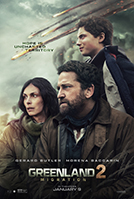
| With | Gerard Butler, Morena Baccarin, Roman Griffin Davis |
| Runtime | 98 minutes |
| Release | 2026-01-09 |
| Rating | 4/10 |
After a devastating comet strike leaves Earth in ruins, the Garrity family must leave the safety of their bunker in Greenland. They embark on a journey for survival and the future of humanity across a devastated world in search of a new home.
The review
By Mulder 2026-01-14
On paper, Greenland 2: Migration had that slight air of a sequel that might surprise, because the first Greenland, released at a time when our relationship with air, masks, and collective fear had become very real, achieved a rare feat: it made Gerard Butler seem almost human in a disaster movie, focusing less on spectacle and more on the survival instinct of an ordinary family. So when we restart the machine five years after the impact of the Clarke comet, with John Garrity and Allison Garrity still holed up underground with Nathan Garrity now a teenager (played by Roman Griffin Davis), we expected a real turning point: a world to rebuild, a bunker society falling apart, impossible choices, and above all, a film that dares to watch the dust settle. And at the beginning of the film, it works rather well: this underground life, these rituals of forced normality (school, yoga, small parties), this claustrophobia that sticks to our stomachs, and these trips to the surface where every breath seems to be a negotiation with death... There's an atmosphere, a substance, an almost sensory thing that Ric Roman Waugh knows how to film when he's not chasing after the next set piece. The problem is that Greenland 2: Migration doesn't believe enough in its own starting point: it sets up an interesting idea and instead of exploring it, it triggers the inevitable post-apocalyptic road trip button to return to a much more predictable structure.
Because once the bunker is destroyed (earthquakes, chaos, escape), the film turns into a literal migration, heading for that famous crater in the south of France, presented as a possible Eden, a pocket of life protected from the toxic atmosphere. And here, conceptually, we're pretty much on board: a European odyssey in a ravaged world is exciting, it's a scale we rarely see in these productions, and some of the images are frankly stunning. Liverpool flooded, its streets silent as the water swallows the city like a memory, London barricaded, landscapes that look like a burnt postcard... At times, we get that feeling we love to talk about: the setting speaks to us louder than the dialogue. We look at a shot and imagine what was there before, we fill in the gaps, we feel the loss. Except that the film doesn't give us enough time to breathe and let it sink in: as soon as there's a moment of calm, bang, an action scene pops up, as if the scriptwriter was afraid that the audience would get bored if someone was silent for more than twenty seconds. And the worst part is that these high-stakes sequences don't all live up to expectations: the crossing of the dry Channel, with its rickety ladders and bridges that seem to be held together by faith alone, should have us glued to our seats... but often, we see the seams, we see the mechanics, we feel the budget and the staging doing their job without creating any panic.
And that's where the film starts to lose us: it takes itself very seriously, but not necessarily in the right places. It wants emotion, it wants gravity, it wants us to feel that every step is a mourning... except that it dispatches secondary characters one after another, then asks us to cry behind them, as if the simple fact of dying in a film were enough to create a tragedy. The result is that it alternates between dry brutality and heavy melodrama, without one really feeding into the other. Gerard Butler remains a solid presence, this tired father who keeps going because he doesn't have the luxury of breaking down, but the film often locks him into a somewhat monotonous mode of sacrificial nobility, and he pulls out a dramatic device so obvious that we would almost laugh if the atmosphere weren't so heavy: the famous cough. The movie cough, the one that comes with its own neon sign saying, “Drama ahead.” Conversely, Morena Baccarin fares better because she embodies something more concrete: fear, compassion, moral fatigue, and even a form of everyday politics (welcoming migrants, sharing resources). As for Roman Griffin Davis, he has potential and obvious acting intelligence, but the script doesn't give him much to work with: we are teased with adolescence, emotions, and a glimpse of the future, only to have it abandoned by the wayside, as if the priority were solely to reach the next point on the map.
What is frustrating, in the end, is that Greenland 2: Migration seems to want to talk about the real world (the fear of flying, migration, reconstruction, the weight of collective trauma), but it backs down as soon as it could become truly uncomfortable or relevant. The masks and suits at the beginning immediately bring us back to that recent memory we all have in our bodies, but then they disappear as soon as the film decides we should see the faces, and with that, it loses some of its invisible tension. The human dangers (militias, factions, armed thugs) are often generic, and the road sometimes resembles a series of obstacles placed there to make an adventure film rather than an organic journey through a world that has truly collapsed. Above all, there is a kind of naivety throughout the story: many encounters are friendly, solidarity is there when the script needs it, and the promised hell too often resembles a scripted hike to a paradise that the film telegraphs from afar. We like optimism when it is earned, when it comes at a cost, when we feel it in our bones; here, we too often had the impression that we were being asked to believe in it because the film decrees it, not because it made us feel it.
Greenland 2: Migration
Directed by Ric Roman Waugh
Written by Mitchell LaFortune, Chris Sparling
Based on Characters by Chris Sparling
Produced by Basil Iwanyk, Erica Lee, Sébastien Raybaud, John Zois, Gerard Butler, Alan Siegel, Ric Roman Waugh, Brendon Boyea
Starring Gerard Butler, Morena Baccarin, Roman Griffin Davis
Cinematography: Martin Ahlgren
Edited by Colby Parker Jr.
Music by David Buckley
Production companies: STXfilms, Anton, Thunder Road, G-BASE Film Production
Distributed by Lionsgate (United States), Metropolitan FilmExport (France)
Release dates: January 9, 2026 (United States), January 14, 2026 (France)
Running time: 98 minutes
Seen on January 14, 2026 at Gaumont Disney Village, Theater 4, seat A18