

Orfeo
Directed by Virgilio Villoresi
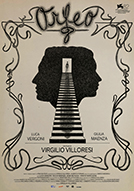
| With | Luca Vergoni, Giulia Maenza, Aomi Muyock, Vinicio Marchioni |
| Runtime | 74 minutes |
| Release | Release date unknown |
| Rating | 7/10 |
Since childhood, Orfeo has imagined fantastical stories about an abandoned villa across from his home. A solitary and visionary pianist, one evening at Polypus, the club where he regularly plays, he catches Eura's eye. A deep and absolute love blossoms between them, but she hides a secret. Then she disappears. One night, Orfeo sees her enter through a small door on Via Saterna, just opposite the villa. He follows her. Before crossing the threshold, he meets the Green Man, an enigmatic character who seems to know the mysteries of this passage. Crossing the door, Orfeo enters a dreamlike world beyond the grave, inhabited by creatures such as Melusine, the Mage of the Forest, and walking skeletons. Inside the villa, he meets the Veste, a demonic guardian who takes possession of his body to relive lost memories through music. He then reveals to him where Eura is: at the train station, about to leave on a train resting on her piano. Only a door on the music stand, which will open at noon, can bring her back. Orfeo arrives in time to say goodbye. When he wakes up, he finds her ring in his hand. He returns to the piano and plays for her, knowing that she will continue to live on in his memories, dreams, and music.
The review
By Mulder 2025-12-14
The film Orfeo, directed by Virgilio Villoresi, feels like one of those rare films born out of pure creative necessity, the kind of project that exists because its director had an urgent need to give shape to a dream that kept him awake at night. Adapted from Dino Buzzati's groundbreaking graphic novel and co-written with Alberto Fornari and Marco Missiroli, the film revisits the myth of Orpheus through a lush and hallucinatory reinterpretation set in a stylized 1960s Milan that quickly dissolves into an underground world adorned with temptation and despair. At the center of this odyssey is Luca Vergoni, whose Orpheus is both fragile and obsessive, constantly torn between beauty and agony, while Giulia Maenza imbues Eura with a disturbing magnetism that justifies her descent into darkness. Their love story is less about romance than fixation, about what happens when emotion becomes a labyrinth in which one willingly loses oneself, and this emotional turbulence becomes inseparable from the film's aesthetic delirium.
Visually, Riccardo Carelli and Federica Locatelli's art direction transforms spaces into emotional landscapes, while Sara Costantini's costumes, clearly inspired by the visionary work of Eiko Ishioka, make each character feel as if they have been sculpted from myth. The astonishing interaction between live action and animation (implemented by Anna Ciammitti, Stefania Demicheli, and Umberto Chiodi) creates a strange feeling that reality itself is consumed by imagination, as if the screen were constantly dissolving into a dream. Shot in 16mm by Marco De Pasquale, the film strikes a balance between grainy intimacy and spectral elegance, while Angelo Trabace's music functions as Orfeo's emotional flow, oscillating between melancholy and enchantment. Watching this film is like walking through an imaginary museum curated by a director intoxicated by cinema, who guides us through the corridors of memory, myth, and fear.
Orfeo is heavy with influences, but never feels like a mere pastiche. There are echoes of Dario Argento, Maya Deren, Kenneth Anger, Tim Burton, Henry Selick, Chris Marker, Roger Corman, and Federico Fellini, but Virgilio Villoresi manages to shape these references into something intensely personal. The underworld is less a mythical realm than a psychological space, populated by ballerinas who oscillate between grace and cruelty, spirits who whisper doubt, demons who embody desire, and skeletal guardians who seem to judge every emotional misstep. A line asking whether life itself is terrifying resonates as a quiet thesis: beauty and terror coexist, love and danger share the same face, and every act of devotion risks plunging us deeper into ourselves than we are prepared to go. Narrative fidelity to the classical myth may make the story predictable, but the emotional textures and visual imagination make the experience captivating.
Even if the romance sometimes seems overshadowed by visual ambition, the sincerity of Virgilio Villoresi's artistic mission is undeniable, and it is ultimately this sincerity that makes Orfeo resonate. This is a film driven by passion rather than calculation, by the joy of creation rather than the safety of convention. When the images overwhelm us, it is for a specific purpose, as if to remind us that cinema still has the power to dazzle, haunt, and intoxicate. We leave Orfeo slightly transformed, as if we had wandered through a beautiful nightmare and returned with traces of its shadows still lingering in our minds. Bold, melancholic, extravagant, and emotionally disarming, Orfeo is a remarkably crafted and deeply moving work of art.
Orfeo
Directed by Virgilio Villoresi
Written by Virgilio Villoresi, Alberto Fornari
Produced by Alessandro Del Vigna, Chiara Ghidelli, Greta Rossi, Alessandra Rosso, Giulio Sangiorgio, Enrico Maria Vernaglione
Starring Luca Vergoni, Giulia Maenza, Aomi Muyock, Vinicio Marchioni
Cinematography: Marco de Pasquale
Edited by Virgilio Villoresi
Music by Angelo Trabace
Production companies: Fantasmagoria, Ministero della Cultura
(support)
Distributed by NC
Release dates: NC
Running time: 74 minutes
Seen on December 14, 2025 at Max Linder Panorama