

Anaconda
Directed by Tom Gormican (2025)
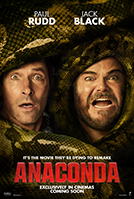
| With | Paul Rudd, Jack Black, Steve Zahn, Thandiwe Newton, Daniela Melchior, Selton Mello |
| Runtime | 99 minutes |
| Release | 2025-12-25 |
| Rating | 5/10 |
The film is not a reboot but an original comedy inspired by the cult franchise Anaconda. Doug and Griff are childhood friends who have always shared a slightly crazy dream: to make their own remake of their favorite film, the cult classic Anaconda. In the midst of a midlife crisis, they finally decide to take the plunge and find themselves filming in the heart of the Amazon. But the dream quickly turns into a nightmare when a real giant anaconda appears and turns their already chaotic set into a deadly trap. The movie they've been dying to make? It's going to be truly deadly...
The review
By Mulder 2025-12-31
The new version of Anaconda arrives with a concept that, on paper, seems almost too good to be true: a meta comedy in which a group of forty-somethings disappointed with life decide to shoot a low-budget remake of the 1997 film Anaconda, the very film that marked an entire generation, starring Jennifer Lopez, Ice Cube, and a dripping Jon Voight who ends up being spat out by the snake while winking at the camera. With Jack Black, Paul Rudd, Steve Zahn, and Thandiwe Newton led by director Tom Gormican, supported by screenwriter Kevin Etten, all the ingredients were there for a scathing satire on nostalgia, the Hollywood IP machine, and the midlife crisis. However, despite a few flashes of wit and amusing ideas, the film too often settles for floating like a digital snake without weight or threat.
At the center of the story is Doug McAllister (Jack Black), a former aspiring filmmaker turned wedding videographer in Buffalo, stuck in what his boss cruelly and ironically calls a B, or even B+ life. His best friend from childhood, Ronald Griff Griffin (Paul Rudd), tried his luck in Hollywood, only to end up stuck at a career level where a four-episode arc on a show like S.W.A.T. is considered a high point. Alongside them are drifting cameraman Kenny Trent (Steve Zahn), who proclaims himself Buffalo sober (meaning he still drinks alcohol, but only beer, wine, and a few light spirits), and Claire Simons (Thandiwe Newton), a recently divorced mother and former heroine of their teenage films, who carries a mixture of fatigue and nostalgia. When Ronald Griffin returns to the country and announces that he has miraculously acquired the rights to Anaconda, the four friends dive headlong back into their youthful dreams and come up with a crazy plan: to go to the Amazon, rent a boat, find a snake, and shoot The Anaconda, a homemade remake and spiritual sequel to their favorite film. The film captures quite well, at the outset, that bittersweet moment when we wonder whether to accept a comfortable but dull existence, or to dare one last hurrah for our dreams.
This is precisely where Tom Gormican's meta approach should shine. After The Unbearable Weight of Massive Talent, in which Nicolas Cage played a quirky version of himself, we could hope for a new, clever dissection of the culture of reboots and the studios' obsession with IP at any cost. Seeing Doug McAllister and Ronald Griffin debate reboots, reimaginings, and spiritual sequels, or hearing characters talk openly about rights, budgets, distributors, and franchises, is initially enjoyable, almost as if the film wanted to expose the industrial cynicism behind this kind of project. But very quickly, the discourse becomes empty: the film states what everyone already knows—Hollywood recycles everything—without ever pushing the envelope to the point of true satire. There are occasional glimpses of a more subtle idea, for example when the characters treat Jon Voight's cult scene as a shared childhood memory rather than a major plot point, but this reflection on how certain B movies become Proustian madeleines is never really explored.
That leaves the actors, who carry the film almost single-handedly. Jack Black finds some beautiful moments in the gently pathetic frustration of Doug McAllister, the guy who puts too much staging into his wedding videos and secretly dreams of becoming the white Jordan Peele because he is desperately looking for a theme for his film. Paul Rudd, as Ronald Griffin, unable to admit his lack of talent, plays an endearing loser, the actor who chews on a toothpick to “get into character” and doesn't see that he is the problem with all his auditions. Steve Zahn, as Kenny Trent, constantly on the verge of disaster, deploys a style of dazed comedy that works very well, whether he has to admit his very relative definition of sobriety or finds himself stuck in a urine-based “rescue” scene worthy of a PG-13 version of Jackass. Thandiwe Newton, as Claire Simons, deserves better than what she is given: a few nice flashes—an improvised song about snakes, a knowing glance that says more than pages of dialogue—give a glimpse of the character she could have played in a more scripted film. Around them, Selton Mello brings a real presence as a slightly shady snake handler, and Daniela Melchior, as the mysterious Ana Almeida caught up with gold traffickers, is underused, as if every time her storyline could become interesting, the film changes subject.
Where Anaconda could have stood out is obviously in its monster movie aspect. Paradoxically, however, the bigger the animal gets, the less bite the film has. The digital creature, immense and thunderous, is often filmed in the shadows or drowned out by choppy editing that seems designed more to maintain a tame PG-13 rating than to create real visceral terror. This is a far cry from the rustic but effective impact of the 1997 film directed by Luis Llosa, where the rough animatronics and dated effects contributed to the film's unintentional charm, culminating in the unforgettable image of Jon Voight being spat out, dripping wet, offering that famous wink to Jennifer Lopez and Ice Cube. Here, the rare snake attacks lack clarity, the jump scares are predictable, and above all, there is never that mixture of horror and nervous laughter that makes real creature features so enjoyable. It almost feels as if the snake, supposed to be the star of the film, always arrives too late, cuts too quickly, and disappears before leaving a trace.
The very structure of the film ends up stifling what it is trying to say about friendship, the passing of time, and shattered dreams. The best scenes are often the simplest: Doug McAllister, Ronald Griffin, Kenny Trent, and Claire Simons sitting in a diner replaying their college memories around Anaconda, remembering what they were doing when they discovered Jon Voight's wink scene, or rewatching their old amateur film The Quatch, a naive mix of fantasized Martin Scorsese and B-movie creatures. There is something very accurate here about this generation that grew up with VHS, video stores, and the possibility of remaking their favorite movies with a DV camera and friends. But as soon as the script tries to add meaning through monologues about the snake as a metaphor for our unfulfilled dreams that come back to devour us, or when it grafted the subplot of the illegal gold mine around Ana Almeida, the film loses its direction and turns into a pastiche of adventure with no clear identity, neither really satire, nor really schoolboy comedy, nor really survival.
The most ironic thing is that the film Anaconda spends a lot of time explaining that you can't make a cult film on demand, that you have to let the audience decide what they take away from it, transform and cherish over time. By trying to be a commentary on this idea, a studio comedy with big names, and a reboot of an unlikely franchise, the film ends up embodying exactly what it claims to criticize: a bland product that talks about IP, nostalgia, and genre cinema without ever really diving in. We smile at the joke about Buffalo Sober, the appearance of a more official Anaconda film boat with cameos from the old guard, and one or two jibes about the marketing of legacy sequels, but we rarely laugh, we shudder even less, and we leave remembering above all that the original, as flawed as it was, at least had the decency to sincerely try to be a real monster movie.
In the end, this film resembles those overfed snakes that can no longer move: an inflated concept, a luxury cast, a few brilliant ideas here and there, but a direction and writing that are unable to find the right balance between homage, parody, and adventure story. Jack Black, Paul Rudd, Steve Zahn, Thandiwe Newton, Selton Mello, and Daniela Melchior do their best to inject energy, melancholy, or absurdity into this journey to the Amazon, and their presence prevents the film from sinking completely into boredom. But for a feature film that aims to be a playful reflection on chasing your dreams and the endless recycling of old hits, the result remains too lukewarm, too cautious, and too inconsistent to leave a lasting impression. Between the meta comedy it promised to be and the edgy creature feature we secretly hoped for, Anaconda finds itself stuck in the middle, which is why, honestly, it can only earn a modest rating in our eyes.
Anaconda
Directed by Tom Gormican
Written by Tom Gormican, Kevin Etten
Based on Anaconda by Hans Bauer, Jim Cash, Jack Epps Jr.
Produced by Brad Fuller, Andrew Form, Kevin Etten, Tom Gormican
Starring Paul Rudd, Jack Black, Steve Zahn, Thandiwe Newton, Daniela Melchior, Selton Mello
Cinematography: Nigel Bluck
Edited by Craig Alpert, Gregory Plotkin
Music by David Fleming
Production companies: Columbia Pictures, Fully Formed Entertainment
Distributed by Sony Pictures Releasing
Release dates: December 13, 2025 (The United Theater on Broadway), December 25, 2025 (United States), December 31, 2025 (France)
Running time: 99 minutes
Seen on December 31, 2025 at UGC Le Majestic Meaux, theater 7, seat H5