

The Last Viking
Directed by Anders Thomas Jensen
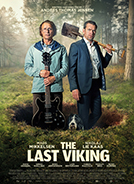
| With | Nikolaj Lie Kaas, Mads Mikkelsen, Sofie Gråbøl, Søren Malling, Bodil Jørgensen, Lars Brygmann, Kardo Razzazi, Nicolas Bro, Peter Düring |
| Runtime | 116 minutes |
| Release | Release date unknown |
| Original title | Den sidste viking |
| Rating | 8/10 |
Upon his release from prison, a bank robber sets out to find his brother, the only one who knows where the loot is hidden. But his brother, convinced he is the reincarnation of John Lennon, takes him on a journey that is as unexpected as it is improbable...
The review
By Mulder 2025-12-12
The Last Viking gives the impression that director and screenwriter Anders Thomas Jensen took inspiration from the familiar scenario of two brothers and a buried treasure, then happily poured gasoline on it until he got this explosive cocktail of black humor, family melodrama, and sudden, brutal violence, whose flavor constantly changes just when you think you've figured it out. The narrative framework speaks volumes: this animated fable about Vikings, which deals with the equality imposed by collective mutilation, is presented as a distorted fairy tale, and it sticks in your mind as a thesis rather than an eccentric garnish, because Anders Thomas Jensen isn't just trying to make you laugh, he's testing how far the idea that if everyone is broken, no one is broken can go before breaking down. Watching the film, you can't help but think of those festival screenings where the audience reacts in waves: first laughter, then a collective “oh my God,” then laughter again because you can't quite process what you've just seen. That's the kind of movie this is: it challenges you to laugh at something you think you shouldn't laugh at, then punishes you with a flash of pain that makes you swallow your laughter, and then, annoyingly and impressively, it wins your sympathy anyway.
At the center of the plot are three siblings whose emotions are as unstable as a live electrical panel. Nikolaj Lie Kaas plays Anker as a man whose entire personality has been shaped by a fight from which he never emerged unscathed: we meet him in full criminal mode, and when he finally emerges after fifteen years of incarceration, he is not redeemed, he is simply older and more desperate to believe that the universe still owes him the prize he buried. That prize, the stolen money, should be a simple MacGuffin, except that it is locked in the mind of his brother Manfred, played by Mads Mikkelsen as a wounded adult child who has reconstructed reality into something he can survive in. Manfred is now John, like John Lennon, and the film's most famous recurring gag is also its most revealing: call him Manfred and he will throw himself out of a window or a moving car with the purity of a burlesque reflex, as if language itself were a trigger directly linked to self-destruction. Bodil Jørgensen, in the role of their sister Freja, is not just the anxious one in the background: she is the film's pressure point, the person the outside world can grab and squeeze when the men sink into their own madness. If Anker is the raw engine and John the surreal and fragile weather system swirling around him, Freja is the human cost that makes the comedy dangerous rather than cute.
On paper, the plot is delightfully silly, in a good way: in order for John to remember where the money is buried, they decide they need to reunite the Beatles, recruiting other psychiatric patients who also believe they are Beatles. This is where Lars Brygmann comes in as Dr. Lothar, one of Anders Thomas Jensen's rare characters capable of expressing himself in complete sentences without sounding like he's about to bang his head against a wall, and who conveys the film's underlying ethic: don't shatter someone's illusions as if they were glass on the floor, tread carefully and see if you can guide them from within. The “group” expands with Peter Düring as Anton (a silent presence à la Ringo who becomes funny in a quiet and strangely gentle way) and Kardo Razzazi as Hamdan, a one-man identity carousel who can be Paul, George, and a handful of other personalities depending on his emotional mood. It shouldn't work. And yet, in the same scene, we understand why Jensen's approach is so unique: the humor doesn't come from pointing fingers and mocking illness, but from the logistical absurdity of trying to function in the real world when everyone's reality is slightly off, like watching a group try to assemble IKEA furniture using three different instruction manuals and a shovel. There's even that kind of micro-comedy that is purely Anders Thomas Jensen—someone telling a traumatic story while another person obsessively questions a minor inconsistency—where the laugh isn't “ha, trauma,” but oh my God, human beings are impossible.
And then there's the house: the siblings' childhood home in the woods, now converted into a guesthouse/Airbnb run by a couple who seem to have come from another genre and decided to stay. Sofie Gråbøl as Margrethe and Søren Malling as Werner are grotesque in the manner of Anders Thomas Jensen: specific, exaggerated, but strangely plausible as soon as they start talking. Their marriage is a constant passive-aggressive performance, and the film takes advantage of this to provoke awkward laughter without making them seem disposable. Werner's attempts to write a children's book echoing the Viking fable and fueling the title turn into a meta-echo of the entire film: a “children's story” that keeps getting contaminated by the ugliness of adults. From a production standpoint, the location is a gothic park: a creaky mansion, a surrounding forest, rooms that seem to remember everything the characters are trying to forget. It's the perfect arena for Anders Thomas Jensen's tonal ping-pong: one minute you have offbeat pop-culture cosplay and the zany energy of a band rehearsal, the next minute a threat appears and the atmosphere turns icy.
Because the threat does indeed appear, and it's not a metaphor. Nicolas Bro plays Flemming in the film's cruelly precise naming style—reminding us that while these people are busy negotiating their identities and trauma, the criminal world continues to turn and collect its debts. Flemming's deadline turns the film into a race against time, and this is where it becomes either thrilling or exhausting, depending on your tolerance for sudden twists and turns: Anders Thomas Jensen jumps from ridiculous gags to sudden, sickening violence, as if challenging you to pretend that these two things cannot coexist. Sometimes it's exhilarating, as if the film refuses to sugarcoat life by presenting it in a pleasant light. Sometimes it's messy, and that messiness feels less like a deliberate choice than excessive indulgence, particularly when the violence inflicted on women can be perceived as bitter rather than satirical, and when the film's gaze on Margrethe's appearance borders on something nastier than necessary. This is the main complication of The Last Viking: it is courageous, lively, and reckless, but it sometimes tramples on its own heart with its muddy boots.
Yet what keeps it coherent, what prevents it from sinking into a grotesque and petty spectacle, is the talent of the actors and the emotional thread that Anders Thomas Jensen continues to slip in through the back door. Mads Mikkelsen is the key: he accomplishes the rare feat of transforming physical comedy into character psychology, rather than clowning around. His posture, his rigid dignity, his sudden volatility, his way of making “John Lennon” seem like a coping mechanism rather than a punchline: it's a balancing act that could have turned into caricature in less skilled hands. Nikolaj Lie Kaas, for his part, gives Anker an intelligence bruised by rage: he could have been unbearable to watch, but we see the years of forced responsibility, the protection that turned into violence, the inability to admit that he needs his brother as much as he needs money. And when the film reveals these flashbacks, scenes from childhood marked by a violent father, played by Lars Ranthe, it reframes the “Viking” identity as the kind of armor you forge when you are small, frightened, and in need of a myth to take refuge in. These flashbacks are undoubtedly manipulative, of course, but they work because they don't erase the comedy; they explain why the comedy exists.
Technically, the film exudes a refined Scandinavian confidence, even when the story is deliberately off-the-wall. Sebastian Blenkov's cinematography transforms the woods into a mental map—beautiful, claustrophobic, then suddenly open—while preserving the texture and life of the manor in the darkness. Nikolaj Danielsen's art direction draws on a “Gothic joy” without falling into caricature, and Eddie Simonsen's sound design makes every fall and every punch painfully tangible, as if the film won't let you float above the consequences, even when it's hilarious. There are passages where the central act runs out of steam a little, where scenes unfold like sketches that should have been tightened up, and the finale may seem a little too neat for a film that spends so much time reveling in chaos. But even when it falters, it's the kind of faltering that comes from a filmmaker who refuses to soften the edges.
The Last Viking is both a treat and a wound: you'll laugh a lot, grimace even more, and probably walk away with a strange, unexpected tenderness for characters who spend so much time being unbearable. Anders Thomas Jensen plays a perilous game between empathy and bad taste, and even when he slips up, his attempt is so personal, so committed to the idea that broken people construct strange realities in order to survive, that it sticks in the mind longer than cleaner, safer films. It's not his most perfectly calibrated work, and some choices undoubtedly elicit negative reactions, but the combination of committed performances, bold tonal collisions, and that stubborn undercurrent of brotherly love gives it a liveliness that well-behaved films rarely have.
The Last Viking
Written and directed by Anders Thomas Jensen
Produced by Sisse Graum Jørgensen, Sidsel Hybschmann
Starring Nikolaj Lie Kaas, Mads Mikkelsen, Sofie Gråbøl, Søren Malling, Bodil Jørgensen, Lars Brygmann, Kardo Razzazi, Nicolas Bro, Peter Düring
Cinematography: Sebastian Blenkov
Edited by Anders Albjerg Kristiansen, Nicolaj Monberg
Music by Jeppe Kaas
Production companies: Zentropa, Zentropa Sweden, Film i Väst
Release dates: August 30, 2025 (Venice), October 9, 2025 (Denmark)
Running time: 116 minutes
Seen on December 12, 2025 at Max Linder Panorama