

Influencer
Directed by Kurtis David Harder (2025)
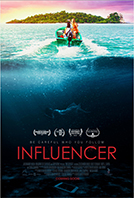
| With | Emily Tennant, Cassandra Naud, Rory J. Saper, Sara Canning |
| Runtime | 92 minutes |
| Release | 2025-05-26 |
| Rating | 8/10 |
Thailand, its dreamlike landscapes, its expatriates seeking oblivion, its mysterious disappearances.
The review
By Mulder 2025-12-11
What sets Kurtis David Harder's Influencer apart from the growing wave of social media thrillers is its refusal to follow the beaten path. Instead of delivering a simple satire mocking superficial online celebrities, Kurtis David Harder constructs an elegant psychological trap, tinged with Patricia Highsmith, drawing the viewer into a world where carefully constructed identities, hidden loneliness, and the unsettling fluidity of online personalities clash under the deceptive light of Thailand's sunny paradise. The film begins with a familiar image—an influencer smiling despite her existential exhaustion—and then quietly sharpens its blade. Madison, played by Emily Tennant, posts warm captions about spiritual awakening and “surrendering to the present moment,” but her reality is a cold void of deserted hotel pools, repetitive selfies, and a boyfriend, Ryan, played by Rory J. Saper, whose abandonment reveals the fragility of this performative lifestyle. Harder lets this unease simmer until the arrival of CW, played by Cassandra Naud, who enters the story with the energy of a savior and the gaze of a predator who has already measured her victim's limits. The first 25 minutes unfold with the elegance of a standalone short film before the credits roll like a warning shot, announcing that the film the viewer thought they were watching has just been snatched away from them.
The brilliant idea behind the screenplay by Kurtis David Harder and co-writer Tesh Guttikonda lies in the way it uses expectations as a weapon. CW initially appears as Madison's counterpoint: shy in front of the camera, down-to-earth, a woman who seems allergic to the performative glitz of the influencer world. Her prominent birthmark, treated with nuance by the actress and filmmaker, becomes a reflective surface rather than a caricatured mark of villainy—a mirror of the prejudices we project, the assumptions we make when someone refuses the glossy veneer of online polish. The film even plays with this as an anecdotal trap: when Madison kindly asks CW why she avoids photos, CW's evasive answer immediately diverts the viewer's suspicions, transforming a simple character detail into a discreet commentary on how online beauty standards distort our instincts. It's in these small, delicate reversals, these micro-moments that expose the audience as much as the characters, that Harder reveals the full skill of his thriller. CW, played by Cassandra Naud, is not a screaming psychopath or a caricatured stalker. She is meticulous, gentle, almost painfully rational. And it is precisely this disarming calm, particularly in the fireside monologue where she confesses her intention to leave Madison to die on a remote island, that makes the film's pivot so frightening.
Once the shift in perspective takes place, Influencer transforms into something more akin to a digital rewriting of The Talented Mr. Ripley, with CW entering Madison's life as easily as she slips on a silk dress. Harder relies on the unsettling simplicity of deception: a few stolen passwords, convincing deepfake montages, a phone full of pre-existing poses, and suddenly, the influencer's many followers can no longer tell the difference between the living woman and her ghost. This narrative twist is not only clever, it's also a pertinent observation about how little we really perceive in the endless scroll of curated images. When CW studies Madison's diary, the only personal item she didn't burn, she discovers a woman far more tormented and empathetic than her glossy feed suggested. This is where the film finds a depth that many social media thrillers lack. CW's interactions with her victims become tinged with ambivalence, not enough to redeem her, but enough to complicate the morality of the world she lives in. Meanwhile, Harder uses Thailand not as a glamorous getaway, but as a haunting stage: postcard-perfect beaches that hide total isolation, luxury resorts floating like artificial bubbles above a culture that none of these characters bother to understand. The lack of local presence is no accident: it's a silent condemnation of how Western influencers plunder aesthetics while remaining proudly ignorant of the world around them.
When Jessica, played by Sara Canning, enters the film (a slightly older, more jaded, and better-equipped influencer), the narrative evolves again, not through shocking escalation, but by refining the psychology underlying it. CW's manipulations become more complex, his adaptability more serpentine. Harder films these sequences with patient confidence: long passages with minimal dialogue where CW observes, calibrates, and blends into the background like a bug waiting to spread. What makes these scenes particularly disturbing is their plausibility in the digital age, where identity can be rewritten with a few clicks and edits. And just when CW seems to have mastered all the variables, Ryan arrives in Thailand, a plot twist that at first glance seems like a genre cliché, but unexpectedly brings both humor and complexity. Ryan, who starts out as a narcissistic manipulator, becomes a strangely fascinating force as he investigates Madison's disappearance. The film never redeems him, but it does something more interesting: it recognizes that even exploitative people can accidentally do the right thing when driven by guilt, ego, or curiosity. His presence unsettles CW like no one else has, revealing his flaws, impulsiveness, and illusions of control.
As the film enters its final act, Harder plays a fascinating game with the audience's sympathy. No one in Influencer is entirely innocent: not the parasitic creators who fuel their image economy, not the audience that consumes their characters, and certainly not CW, whose crimes escalate with a cold precision that borders on ritual. And yet, the film resists any simplistic moral lesson. It doesn't lecture or adopt the contemptuous cynicism of Generation X that many stories about social media fall into. Instead, it acknowledges an uncomfortable truth: online identity is both armor and vulnerability, both a source of autonomy and erasure. The predator in this story is not social media, but unchecked charisma, unacknowledged loneliness, and the terrifying ease with which we accept the surface of things as reality. This resonates particularly in a late sequence where Harder uses nothing more than a phone notification to unravel a lie, proving that the digital world can mask danger, but it can also reveal it with a simple accidental ping. Even in its most violent moments, the film remains grounded in reality, treating brutality not as spectacle but as punctuation in a story about control and self-reinvention.
By the time Influencer reaches its final image, an ending that feels both inevitable and cleverly cynical, the film reveals itself to be not only a thriller about stolen identities, but also a reminder of the frightening porosity of identity in the age of algorithms and parasocial dependence. Cassandra Naud delivers a performance that anchors it all: a chilling and composed portrayal of a woman who shifts from one persona to another as others change filters, her birthmark becoming a symbol not of monstrosity, but of the human brutality that influencers strive so hard to erase from their own images. It's a role that makes her a star in a film that could have fallen apart without her. Harder's direction, complemented by David Schuurman's sumptuous cinematography and Avery Kentis's unsettling music, elevates the subject matter to a level above the usual fare on streaming platforms: a thriller that relies on silence, disorientation, and ambiguity to do most of the work.
Influencer is less a condemnation of influencers than a study of the precariousness of life online and offline with an audience that believes it knows you. It's a tense and surprisingly elegant thriller that exceeds the expectations of the genre while embracing the pleasure of its own darkness. And while its narrative isn't flawless and sometimes strains credibility, its blend of narrative daring, sharp performances, and psychological insight makes it one of the strongest entries in the ever-expanding canon of “digital age thrillers.” For a film about superficiality, it contains an impressive amount of substance hidden just beneath the plastic smiles.
Influencer
Directed by Kurtis David Harder
Written by Tesh Guttikonda, Kurtis David Harder
Produced by Jack Campbell, Brandon Christensen, Tesh Guttikonda, Kurtis David Harder, Micah Henry
Starring Emily Tennant, Cassandra Naud, Rory J. Saper, Sara Canning
Cinematography: David Schuurman
Edited by Rob Grant, Kurtis David Harder
Music by Avery Kentis
Production companies: Octane Entertainment, Superchill
Distributed by Shudder
Release dates: October 16, 2022 (Brooklyn Horror Film Festival), May 26, 2023 (Shudder)
Running time: 92 minutes
Seen on December 11, 2025 on Prime Video