

Primate
Directed by Johannes Roberts (2026)
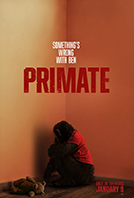
| With | Johnny Sequoyah, Jessica Alexander, Troy Kotsur |
| Runtime | 89 minutes |
| Release | 2026-01-09 |
| Rating | 9/10 |
Primate follows a group of friends whose idyllic vacation on a remote island degenerates into a brutal confrontation.
The review
By Mulder 2025-12-09
With Primate, director Johannes Roberts draws heavily on the killer animal subgenre and delivers exactly the kind of stripped-down, nocturnal experience that studios rarely dare to finance these days. Imagine Stephen King's Cujo transposed to a cliffside Hawaiian mansion, embellished with echoes of John Carpenter's siege thrillers and the unsettling chaos of the chimpanzees in Jordan Peele's Gordy's Home sequence in Nope, then condensed into 89 minutes of tension, screams, and shredded flesh. The film is uncompromising: a rabid chimpanzee named Ben turns on the family that raised him, and Primate exploits this premise as much as the major studios' R rating allows, with an enthusiasm that is both contagious and slightly deranged.
The story is refreshingly simple but cleverly constructed. Johnny Sequoyah plays Lucy, a student who reluctantly returns to her family's spectacular glass and concrete home in Hawaii after distancing herself following her mother's death. Waiting for her there are her little sister Erin, played by Gia Hunter, her father Adam, a deaf writer and workaholic, played by Troy Kotsur, and the most unusual member of the family: Ben, a chimpanzee who was once the focus of their late mother's research and has since become an honorary brother. Lucy arrives with her friends: her loyal best friend Kate (Victoria Wyant), the more hedonistic Hannah (Jessica Alexander), and Nick (Benjamin Cheng), her childhood crush, with whom she plans to spend the weekend partying by the pool while Adam is away on a book promotion tour. What no one knows is that Ben was recently bitten by a rabid animal, and that the “family member” who welcomes Lucy with familiar handshakes and a synthetic “I missed you” via a talking tablet is already counting down the hours until he becomes their tormentor.
Once the infection takes hold, Primate becomes a film focused almost exclusively on survival. After a brutally effective opening murder that establishes both the ferocity of Ben's attacks and the film's commitment to practical gore, Johannes Roberts takes the time to familiarize us with the rhythm of the household, sibling squabbles, unresolved grief, flirtations, and petty grudges before abruptly locking everyone into a scenario as conceptual as it is elementary: the only truly safe place is the pool, because chimpanzees can't swim. The infinity pool perched on the edge of a cliff becomes both a refuge and a trap, with Ben patrolling the terrace, the house, and the rocky perimeter while Lucy and her companions float in the water, running out of strength and options. Much of the middle of the film plays out like Cujo transposed to an aquatic arena, with each attempt to leave the pool to find a phone, a weapon, or a first-aid kit turning into a mini-scene. The geography of the house is always clear; you feel every desperate dash through the glass-walled hallways, every blind spot behind a door or curtain, and even though the structure eventually settles into a “get out/risk death/dive back in” rhythm, the clarity of the staging and the sheer nastiness of the twists and turns keep the suspense going.
The real star, however, is Ben himself, both in terms of his character design and his performance. Rather than relying solely on CGI, Johannes Roberts and co-writer Ernest Riera built their film around a hybrid creation: a man dressed in a meticulously designed chimpanzee suit, animated by motion specialist Miguel Torres Umba and supplemented by animatronics and selective digital work. The seams are sometimes visible, especially in certain wide shots or when the continuity of Ben's makeup and drool level falters, but the trade-off is a physical presence that feels genuinely dangerous. Ben's hunched silhouette behind frosted glass, his slow emergence from dark doorways, the way he crashes into frames with real weight—all of this contributes to the impression that this is not a video game model, but an angry animal in the same space as the actors. The talking button device he uses to communicate is an inspired touch: at first, it allows him to say tender phrases to Lucy; later, seeing those same buttons hammered to spell out threats as he stares at the children trapped in the pool gives the character a horror movie villain's intelligence that is as funny as it is disturbing.
Johnny Sequoyah anchors it all with the kind of realistic, responsive performance that a film like this absolutely needs. Lucy isn't written as a particularly complex protagonist, but Johnny Sequoyah finds credible shades of guilt, resentment, and protective instinct, especially in her scenes with Erin, played by Gia Hunter. As the situation escalates, she never descends into parody; Lucy's improvisations—practical decisions to survive her inability to completely detach herself from the memory of the “little brother” she grew up with—make the stakes far more believable than the written dialogue. Troy Kotsur, though underused, brings real texture to the character of Adam; the way Johannes Roberts sometimes shifts to his deaf perspective, cutting the soundtrack as we see Ben approaching behind him unseen, results in some of the film's most memorable and sadistic moments. Around them, Victoria Wyant, Jessica Alexander, and Benjamin Cheng embody a gallery of essentially disposable teenage archetypes. The script doesn't pretend they're anything else, but the actors play their roles without winking at the audience, which is crucial: the film may be crazy, but it doesn't try to be an ironic meme factory of “so bad it's good.”
Behind the camera, Primate is Johannes Roberts in his element, closer to the stripped-down tension of 47 Meters Down than the conventional side of Resident Evil: Welcome to Raccoon City. Working again with co-writer Ernest Riera and cinematographer Stephen Murphy, he constructs the film as an almost classic thriller set in a single location. Stephen Murphy makes wonderful use of the house's architecture, framing the elegant luxury of the cliffside mansion against the wild ocean and rocks in the distance, then slowly transforming this ambitious Airbnb fantasy into a maze of deadly zones. Long lenses flatten the space as Ben prowls the terraces, wide shots reduce humans to tiny silhouettes circling the bright rectangle of the pool, and the camera constantly scans the edges and background of the frame for signs of movement. The soundtrack and sound design rely on synths and deafening chimpanzee screams straight out of an '80s script, and it works, especially in a crowded festival theater where every false note and every impact is met with an audible wave of gasps, groans, and joyful laughter. This is a film designed to be seen in public, and it shows in the pacing of the scares.
Despite all its craftsmanship, Primate is also very clear about its priorities, and that's where some of its limitations become apparent. The emotional threads—the family's unresolved grief for the scientist mother, the ethical implications of turning a wild animal into a surrogate child, even the intriguing choice of setting a story about rabies in a supposedly rabies-free Hawaii—are introduced and then largely abandoned in favor of momentum. The implausible notoriety of how Ben contracts rabies in this environment is never really addressed, and the film seems content to simply wink at the absurdity. Similarly, the dynamic between Lucy, Erin, and Adam offers enough raw material to create something truly incisive about denial and attachment, but Johannes Roberts continues to steer clear of these darker aspects in favor of the next attack. The screenplay by Johannes Roberts and Ernest Riera also suffers from generic dialogue; once the screaming starts, the characters mostly resort to repeating functional lines and explanations. At times, the pace slows down slightly between attack sequences, and repetition sets in: there are only so many ways to stage “someone trying to escape from the pool and Ben appearing,” even with Miguel Torres Umba doing such inventive work in his costume.
Yet it's hard to deny Primate's effectiveness in the terms it sets for itself. The kills are vicious, inventive, and, most importantly, easy to understand, with an avalanche of broken ribs, shredded faces, and mutilated limbs, realized with deliciously gruesome special effects by Millennium FX. Johannes Roberts stages them with a macabre sense of burlesque, sometimes pushing the violence into such outrageous territory that nervous laughter becomes an integral part of the experience. Ben functions as much as a retro slasher icon as he does an animalistic antagonist, stalking his victims from the periphery of the frame, luring them in with deceptively calm body language, then exploding into a ferocity that would make Michael Myers think twice. This mix of tones—half serious survival horror, half absurd, gory adventure—won't appeal to everyone, and the film never quite manages to commit to either total tragedy or over-the-top camp. But as a studio-backed film aimed at Fangoria, a sort of mutant cousin to Cujo and the strange killer apes of decades past, it's strangely refreshing.
Primate is not a sophisticated horror film and doesn't try to pretend otherwise; it's a sober and brutally effective monster movie that reminds us how much fun it can be to watch, in a crowded movie theater, a life-size monster tear apart a group of well-chosen victims. The characters are shallow, the themes underdeveloped, and the logic sometimes laughable, but the direction is assured, the performances committed, and Ben is one of the most memorable creatures the genre has produced in years. As big-screen genre entertainment, it delivers on all its promises: it grabs you by the throat, drenches you in blood, and lets you go just as you start to wonder how much a rabies vaccine costs in Hawaii. Primate stands out as a vicious and popular throwback that may not reinvent the genre, but it absolutely reminds you why killer animal movies refuse to die.
Primate
Directed by Johannes Roberts
Written by Johannes Roberts, Ernest Riera
Produced by Walter Hamada, John Hodges, Bradley Pilz
Starring Johnny Sequoyah, Jessica Alexander, Troy Kotsur
Cinematography: Stephen Murphy
Edited by Peter Gvozdas
Music by Adrian Johnston
Production company: 18hz Productions
Distributed by Paramount Pictures
Release dates: September 18, 2025 (Fantastic Fest), January 9, 2026 (United States), January 21, 2026 (France)
Running time: 89 minutes
Seen on December 9, 2025 at UGC Ciné-cité Bercy, theater 33