

Vampire Hunter D
Directed by Yoshiaki Kawajiri (2021)
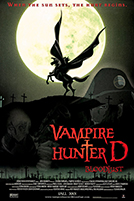
| With | Pamela Segall, John DiMaggio, Dwight Schultz, Andy Philpot |
| Runtime | 102 minutes |
| Release | 2021-09-23 |
| Original title | Banpaia hantâ D |
| Rating | 9/10 |
In a world in decline, vampires, once ruling masters, are now the prey of hunters.
The review
By Mulder 2025-12-11
Vampire Hunter D remains one of those rare animated films that are not only successful in their genre, but also a moment where animation, art, and mythical creation come together with unexpected emotional force. From D's first appearance, with his endless black hair floating like a shadow taking shape and his sharp silhouette evoking both an aristocrat and a fallen angel, the film promises to be a feast of gothic romanticism. Director Yoshiaki Kawajiri imbues this tall, emaciated dhampir with a distant attitude that borders on rock star mystique; there are moments when D's silent demeanor is more reminiscent of a melancholic musician haunted by unspeakable memories than a bounty hunter armed with a blade and unwavering determination. This duality is crucial to the film's appeal, especially as D accepts a new mission: to find the young Charlotte for a wealthy patriarch whose love is mixed with fear and prejudice. The astronomical bounty he offers reveals the violent economy of the world: after all, when a horse costs almost a small fortune, the promise of $20 million smacks as much of desperation as it does privilege.
What sets this film apart is its instinct to expand the boundaries around D without betraying his enigma. The plot is deceptively simple: D must recover Charlotte before the vampire Meier Link takes her to a future of eternal night, but it is the moral outline of the pursuit that elevates the narrative. As the chase stretches across the desolate plains of a dying Earth, the film gives free rein to sympathy. Meier, far from the decadent, predatory archetype the audience expects, shows unwavering tenderness toward Charlotte, even briefly exposing himself to the deadly light of the sun for her sake. His declaration—“I’d rather die than go anywhere without her”—strongly contradicts the assumptions the bounty hunters brought with them on their mission. The film subtly asks whether monstrosity lies in blood or in action, and in doing so, invites the viewer to reevaluate the boundaries between hunter and prey. It's a thematic richness reminiscent of how Westerns once redefined the morality of frontier justice. Indeed, the dusty panoramas and duel-worthy confrontations owe much to the iconography of Sergio Leone.
While D rides alone for long stretches of the narrative, Vampire Hunter D expands its emotional vocabulary through its ensemble. The Markus brothers traverse the desert in their armored vehicle, a family of hardened professionals whose cruelty masks a truth: they represent the very human impulse to survive in a world that has lost all structure. Among them, Leila emerges as D's most fascinating counterpoint. Initially distrustful of dhampirs, she gradually reveals the vulnerability that lies beneath her hardened exterior, and her interactions with D offer some of the film's rare moments of genuine warmth. Their difficult alliance becomes a meditation on loneliness: two warriors accustomed to standing apart from their respective worlds, now brought together by necessity and, perhaps, curiosity. The supporting characters are equally eccentric: Grove, the spectral figure who injects himself with a green serum to unleash devastating astral fury, provides a haunting counterpoint to the film's gothic tones, a tragic supernova that burns too quickly with each appearance.
One cannot talk about Vampire Hunter D without dwelling on the sheer audacity of its artistry. While the film's opening scenes suffer from somewhat rigid character design, the animation quickly becomes surprisingly complex. Vast cemeteries dissolve into dreamlike hues; water glides over stone with the reflective delicacy of a Monet still life; landscapes stretch out with a painterly sweep, offering both beauty and desolation. Yoshiaki Kawajiri and his team create an atmosphere where every frame seems to have been touched by hand, and where darkness becomes not only aesthetic, but also expressive, communicating the emptiness of a world abandoned by its vampiric nobility. The mutants employed by Meier, including a tree-dwelling shapeshifting witch and a werewolf-like brute with a jaw in its chest, feature inventive, sometimes nightmarish designs that make each encounter a mini-nightmare.
A beloved feature of the franchise, D's talkative, parasitic left hand returns with sarcastic energy, anchoring the film's operatic gravity with a touch of humor. Voiced in English by Michael McShane, the creature provides the kind of cynical commentary one might expect from a veteran sidekick, except that it inhabits D's body and mocks his fashion sense. This dynamic of bickering becomes a strangely intimate form of camaraderie, underscoring how deeply isolated D is from both humans and vampires. In a world where he is feared, mistrusted, and perpetually wandering, the only voice he hears regularly is literally attached to him—a narrative device that is both comic relief and a melancholic metaphor.
The film's crescendo takes place in the lair of Countess Carmilla, a malevolent echo of the vampiric aristocracy rendered with nightmarish grandeur. Here, Vampire Hunter D veers completely into gothic horror, evoking images of ruined castles, spectral illusions, and seductive death. These sequences are so imaginative that they eclipse the visual prowess of contemporary animated works such as Jin-Roh, Final Fantasy, or even Shrek. What is remarkable is how Kawajiri naturally blends genres—western, horror, science fiction, romance—to create a cohesive whole. There are shootouts staged like samurai duels, carriage battles that seem straight out of pulp series, and frozen, mesmerizing tableaux that reflect classic fantasy illustrations. The fusion works because the film never loses sight of its emotional core: beneath each spectacle lies a world suffering from loneliness.
In this sense, Vampire Hunter D taps into a typically Japanese sentiment: the melancholy of a society transformed too quickly by modernity. Although often associated with post-war trauma, the dystopian landscapes of anime more frequently reflect the cultural anxiety linked to technological acceleration, the fear of losing one's humanity in a world that prioritizes efficiency over essence. D's perpetual wandering, Charlotte's forbidden romance, Leila's desire for connection, and even Meier Link's challenge to his own vampiric heritage become threads in a tapestry of desire, loss, and the desperate search for meaning. It's no coincidence that the film's quietest moments—D observing from afar, Leila revisiting her past, Charlotte and Meier dreaming of a sanctuary free from judgment—resonate as powerfully as its most explosive confrontations.
Yet despite all its philosophical weight, Vampire Hunter D remains an exhilarating action epic. The choreography is fluid, the pacing relentless, and the tension maintained through clever world-building rather than simple escalation. What strikes me in particular is the confidence with which the narrative trusts its audience; motivations are not over-explained, moral boundaries are deliberately blurred, and characters behave with a consistency that reinforces the mature tone of the story. The English voice cast, notably Andrew Philpot, Wendee Lee, John Rafter Lee, Matt McKenzie, Pamela Seagall, and Julia DeMita, add texture without overshadowing the nuances of the animation. Their performances, recorded at Skywalker Ranch, contribute to the film's polished, cinematic feel and accessibility.
Seen today, Vampire Hunter D stands as one of the most accomplished animated productions of its time, a film that combines spectacle and introspection with equal conviction. Its artistic talent so far surpasses the original 1985 adaptation that the latter now seems like a mere footnote rather than a precursor. More importantly, Vampire Hunter D offers something rare in action-oriented animations: a world where beauty, brutality, and desire coexist without compromise. It is a film that deserves to be revisited, not only for its visual splendor, but also for the emotional echoes that linger long after D has resumed his solitary journey toward the horizon.
Vampire Hunter D
Written and directed by Yoshiaki Kawajiri
English adaptation by Ellen Moore, Jack Fletcher
Based on Vampire Hunter D: Demon Deathchase by Hideyuki Kikuchi
Produced by Mataichirō Yamamoto, Masao Maruyama, Takayuki Nagasawa
Starring Pamela Segall, John DiMaggio, Dwight Schultz, Andy Philpot
Director of photography: Hitoshi Yamaguchi
Editing: Harutoshi Ogata, Satoshi Terauchi, Kashiko Kimura, Yukiko Itō
Music: Marco D'Ambrosio
Production companies: Madhouse, Filmlink International, BMG Funhouse, Movic, Goodhill Vision, Softcapital
Distribution: Nippon Herald Films (Japan), Urban Vision (United States)
Release dates: July 2000 (Fantasia Fest), September 23, 2001 (United States)
Running time: 102 minutes
Seen on December 10, 2025 at Max Linder Panorama