

Sisu: Road to Revenge
Directed by Jalmari Helander (2025)
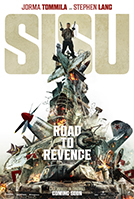
| With | Jorma Tommila, Richard Brake, Stephen Lang |
| Runtime | 89 minutes |
| Release | 2025-11-21 |
| Rating | 10/10 |
1946. Aatami Korpi returns to Karelia, a territory occupied by the Soviets, where his family was brutally murdered during the war. In their honor, he dismantles the family home and loads it onto a truck, determined to rebuild it in a safe place. When the Red Army learns of his presence, Igor Draganov, the murderer of his family, will do everything in his power to finish the job and kill the legendary former soldier. But Aatami isn't nicknamed “the man who refuses to die” for nothing...
The review
By Mulder 2025-12-11
In Sisu: Road to Revenge, writer-director Jalmari Helander once again relies on the unbridled alchemy that made the first Sisu a cult film combining gore, cruelty, and dark humor, but this time he brings something more incisive: an almost elegiac sense of personal determination underlying the carnage. While the first film drew its strength from the purity of its premise (a man, gold, and a very bad day for the Nazis), the sequel relies on a more discreet and sadder emotion. Jorma Tommila once again plays Aatami Korpi, the Immortal, a man whose every wrinkle seems carved by grief and every movement driven by elemental determination. The war is over, but its trauma lingers. His house, now located in Soviet-occupied Karelia, becomes the pivot of the story: he does not return to reclaim it, but to dismantle it, piece by piece, taking his memories across a new border, as if refusing to let history erase the last physical trace of his family. This gesture becomes the film's most daring metaphor: the idea that a house is not just a place, but a burden that one chooses to carry, even in enemy territory.
As soon as Korpi enters Soviet territory, the legend of his wartime massacres (more than 300 Soviet soldiers during the Winter War alone) resurfaces like a curse in the military archives, provoking a furious chain reaction from Moscow. This is where Stephen Lang comes in as Igor Draganov, the butcher who murdered Korpi's wife and children and who is now emerging from a Siberian prison with the sinister mission of finishing what he started. The plot is that of a classic revenge story, but Jalmari Helander treats it with a knowing wink: Draganov is less a man than a snarling embodiment of state cruelty, deployed by a treacherous KGB officer played with icy pleasure by Richard Brake, whose threats feel less like orders than omens. The film wastes no time with explanations; within ten minutes, you're immersed in vehicle attacks and ambushes staged with military precision, and you increasingly feel that Korpi's journey will be measured not in miles, but in body parts.
Jalmari Helander structures the escalation into titled chapters, using their grindhouse typography to herald the ever-increasing and bloody absurdity of Motor Mayhem to the spectacular finale on the train, and it is in these moments that his direction most closely resembles the spirit of George Miller and Spielberg's early films. There is a tactile pleasure in seeing every vehicle, every tool, every piece of wood become a potential weapon or shield. The film's most daring moments, a low-flying plane shot down by a load of wood, a tank literally knocking down a roadblock like a frightened animal, straddle the line between genius and madness. One moment, we admire the refined geography and choreography of the stunts by director of photography Mika Orasmaa; the next, we laugh in disbelief, as if Jalmari Helander had slipped an episode of Looney Tunes into a war epic. But that's where the secret magic of the franchise lies: its ability to make savagery and burlesque coexist without breaking the tone. It's a world where violence seems mythical, where pain is endured with the stoicism of a silent film icon, and where the laws of physics politely fade away when Aatami Korpi has a mission to accomplish.
Yet humor never completely erases the brutality. The violence is still as explicit as ever, with heads exploding, limbs scattered, and torsos torn apart, but a strange tenderness weaves its way through this bloody tapestry. Jalmari Helander treats Korpi's silence not as a gimmick, but as a form of mourning, allowing Jorma Tommila's silent performance to become the vehicle for everything the man cannot express. Small gestures, a pause to listen to birdsong, a tear stuck in dust and dried blood, a protective glance toward his Bedlington terrier, give the film a mythical flavor rooted in loss rather than fury. And in a magnificent moment of visual poetry, the camera pulls back on a marsh filled with unburied bodies, the landscape itself unable to digest the horrors left behind by war. The sequel never preaches, but it invites reflection: how do you rebuild a life when the ground beneath your feet has been rewritten by violence and politics?
Compared to the universally detestable Nazis of the first film, the Soviet enemies here are portrayed with more nuance. They are not morally neutral, but neither are they caricatures. Their terror often stems from incompetence, hierarchy, or blind obedience, leaving Draganov, played by Stephen Lang, as the true embodiment of evil in the story. Lang, an actor capable of projecting menace with a simple raise of his eyebrow, slips into the role with theatrical relish, even if his accent varies and his voice volume oscillates strangely between guttural roars and professorial whispers. Nevertheless, his scenes are electrifying, as the film positions him as the anti-Korpi: a man who kills without purpose, without humanity, without restraint. While Sisu is bound to memory and home, Draganov is bound to his ego and shame. Their inevitable collision feels less like a clash between a hero and a villain and more like two forces of nature colliding: one cold and destructive, the other fiery but deeply wounded.
Technically, Sisu: Road to Revenge is perhaps tighter and more paced than its predecessor. Juho Virolainen's editing makes the narrative ultra-precise and dynamic, bringing spatial clarity to each chaotic scene. The action has the rhythm of slapstick—setups, payoffs, punchlines made of blood and bone—but the aesthetic is closer to a western painted with exhaust fumes and metal shards. The music by Juri Seppä and Tuomas Wainölä is reminiscent of Ennio Morricone with its whistled motifs and brass fanfares, but it adds its own Baltic touch with guttural chants and rhythms that echo the inner rumbling of Aatami's determination. The film's soundscape becomes, unusually, one of its emotional anchors: where Korpi refuses to speak, the world around him—the wind, the engines, the barking of guns—speaks for him.
If there is anything to criticize about the film, it is its familiarity. The formula of bad boys bothering a bad old man loses some of its novelty in the second installment, and the sometimes excessive use of digital effects makes certain sequences less realistic than the concrete brutality of the first film. But even when the film borders on caricature, a certain self-awareness softens the blow. Sisu: Road to Revenge doesn't so much seek to replicate the original as to refine its spirit into something more elegant, funnier and, strangely, more sincere. The result is a sequel that doesn't surpass Sisu, but stands proudly alongside it: a bloody folk tale forged from wood, diesel, grief, and the indestructible spark of a man who refuses to disappear.
What remains after the fact is not only the delirious spectacle, but the symbolic richness of its simplest image: a man carrying the pieces of his former life across a hostile land, fighting not for gold or glory, but for the right to rebuild a home. Sisu: Road to Revenge may be a violent and scandalous wave crashing over frozen ground, but its heart beats quietly beneath the explosions. And in Jorma Tommila, Helander finds an actor capable of carrying this contradiction, a performer who can be at once a myth, a monster, and a grieving father clinging to the last shards of his past. Few modern action films dare to be so brutal, so funny, and so unexpectedly poetic.
Sisu: Road to Revenge
Written and directed by Jalmari Helander
Produced by Petri Jokiranta, Mike Goodridge
Starring Jorma Tommila, Richard Brake, Stephen Lang
Cinematography: Mika Orasmaa
Edited by Juho Virolainen
Music by Juri Seppä, Tuomas Wäinölä
Production companies: Stage 6 Films, Subzero Film Entertainment, Good Chaos
Distributed by SF Film Finland (Finland), Screen Gems (through Sony Pictures Releasing; Worldwide)
Release dates: September 21, 2025 (Fantastic Fest), November 21, 2025 (United States), December 23, 2025 (France)
Running time: 89 minutes
Seen on December 10, 2025 at Max Linder Panorama