

Hunting Season
Directed by RJ Collins (2025)
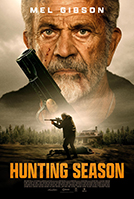
| With | Mel Gibson, Shelley Hennig, Sofia Hublitz, A.J. Buckley, Jordi Mollà, James DuMont, Rob Moran, Rocky Myers, Oliver Trevena, Jaylen Moore, Randall J. Bacon, Lola Manzini, Vladislav Lapidus, Landa, Maxim Yurov, Sarah Ann Mayer, Andrey Grouchko |
| Runtime | 93 minutes |
| Release | 2025-12-05 |
| Rating | 7/10 |
A single father is willing to do anything to protect his 13-year-old daughter from the corrupt world around her.
The review
By Mulder 2025-12-06
There is something strangely magnetic about seeing Mel Gibson reprise the role of a haunted loner, and Hunting Season relies heavily on this aura from its very first snowy images. In the role of Bowdrie, a taciturn man buried deep in the Oklahoma wilderness, Mel Gibson brings a weary gravity that feels lived rather than acted, as if the actor himself had absorbed years of hardship, prayer, and smoke while chopping wood behind his cabin. His bond with his daughter Tag, played with instinctive finesse by Sofia Hublitz, is depicted through simple rituals: hunting, cleaning fish, quiet meals punctuated by faith. This grounding becomes the emotional backbone of a thriller that deliberately takes its time. Whether or not you buy into its neo-Western philosophy, the film's opening quietly disarms you, letting its characters breathe long before bullets fly, a decision that makes the subsequent violence more poignant than spectacular.
Everything changes when Tag stumbles upon January, played by Shelley Hennig, lying bloodied by the river like a ghost washed up on the shore. From the moment Bowdrie brings her home, the atmosphere shifts: suspicion, compassion, fear, and curiosity intermingle, especially for Tag, who sees in January a reflection of the mother he barely remembers. One of the film's most memorable moments occurs during January's recovery, when Bowdrie warns his daughter to leave before he begins removing the bullets: “It's going to get pretty loud in here.” This line sums up the tone of the film and hints at Bowdrie's mysterious skills, both in healing and in hurting. Adam Hampton's screenplay does not seek to mystify Bowdrie with explanations, but rather reveals him as Tag understands him: a man shaped by a past he refuses to reveal, but which has clearly prepared him for moments like this.
The shadow hanging over January comes from Alejandro, played with unbridled exuberance by Jordi Mollà, who infuses the film with a disturbing energy that divides viewers. Some will find his performance too exaggerated, and indeed, it sometimes borders on parody: a threat with a switchblade in a bar and his incendiary temperament seem straight out of the sleaziest corners of early 2000s crime cinema. But the film uses this theatrical menace to highlight Bowdrie's quiet discipline; Alejandro is chaos incarnate, while Bowdrie is the storm that arrives only when the calculations are complete. The contrast becomes one of the film's deliberate stylistic devices, even if it sometimes risks overplaying the tone. Nevertheless, Alejandro remains a sufficiently frightening presence, and his pursuit of Jensen (played by Rocky Myers) and the young women caught in the crossfire fuels the narrative with a dark inevitability.
Director RJ Collins opts for a slow progression, a gamble that works to establish the mood, even if it sometimes slows down the film's internal rhythm. Instead of flooding the screen with incessant gunfire, he chooses to sit with the characters, observing the silence of the forest, the crackling of the fire, the unspoken questions simmering between father and daughter. To some, this restraint will seem daring; for others, it may seem too restrictive, especially when the action comes in bursts rather than sustained sequences. And yet, the film's most memorable confrontation is not a shootout, but the now-famous lawnmower interrogation scene, in which Mel Gibson taps into an ounce of his Martin Riggs-style madness. It's wild, darkly funny, and surprisingly tense, reminding us that Gibson's charisma flourishes when danger is mixed with unpredictability.
Hunting Season's neo-western DNA becomes clearer as the story unfolds: a lone protector, a silent frontier, a damsel in distress, marauding villains, and a sheriff oscillating between impotence and usefulness, played here by James DuMont. The story respects the conventions of the genre without ever trying to modernize them beyond superficial details: horses are replaced by pickup trucks, saloons by seedy bars, vast prairies by clearings. In many ways, Adam Hampton's screenplay seems less interested in reinvention than in respecting the solid narrative structure of classic survival thrillers. But what elevates this otherwise familiar tale is the film's commitment to its characters: Tag's trembling hands during his first kill, January's growing trust in the people who take her in, Bowdrie's silent fear of inviting danger into his sanctuary. Even within the film's more conventional framework, these moments resonate.
Still, the direction isn't without its flaws. RJ Collins sometimes struggles with pacing. The middle of the film in particular seems caught in a pattern of starting and stopping, building tension only to let it fall away before the suspense is fully at its peak. Some confrontations end abruptly just as the adrenaline starts to rise, creating an uneven emotional cadence that never fully capitalizes on the stakes set up by the story. The finale also feels shorter than the buildup deserves, though the violence, when it occurs, is grim and understated, feeling more like survival instinct than Hollywood choreography. Hunting Season wants you to believe that Bowdrie isn't acting out of revenge but out of necessity, and the film's pared-down brutality supports that intention. This is not an action movie for those looking for spectacle; it is a thriller based on patience, observation, and the inner collapse of a man who tries—unsuccessfully—to keep the horrors of the world outside his door.
Despite its flaws, Hunting Season is at its best when Mel Gibson and Sofia Hublitz share the screen. The father-daughter dynamic feels authentic, tinged with tenderness, fear, and the unspoken awareness that Tag is becoming someone Bowdrie may not be able to protect forever. Their quiet moments—sharing a prayer, exchanging glances after a gunshot rings out in the distance—contribute more to the film's emotional charge than any explosion of violence. Shelley Hennig, meanwhile, avoids the cliché of the helpless victim; she embodies January with instinctive resilience, and her scenes with Hublitz give the story its human momentum. Even when the film's structure falters, the actors keep it grounded in reality, reminding the audience that survival stories only matter when we truly care about the people fighting to live.
Hunting Season doesn't revolutionize the thriller genre, nor does it pretend to. It's a slice of rustic, retro America that's part neo-western, part family drama, and part survival thriller built on atmosphere, performances, and a handful of memorable scenes that capture the tension of a man forced to revisit the violence he hoped to leave behind. What it lacks in pace, it makes up for in grit and sincerity, and Mel Gibson's realistic, weathered presence ensures that the journey remains compelling even when the road gets bumpy. Viewers expecting pure action bloodbath may be disappointed, but those willing to sit back and let the film simmer will discover a work that, while imperfect, knows exactly what emotions it wants to evoke.
Hunting Season
Directed by RJ Collins
Written by Adam Hampton
Produced by Eduard Osipov, Al Bravo, Eric Brenner, Vince Jolivette, Dan Katzman, David McCalib Jr., Eduard Osipov, Michael Pizzimenti, Luke Wyckoff
Starring Mel Gibson, Shelley Hennig, Sofia Hublitz, A.J. Buckley, Jordi Mollà, James DuMont, Rob Moran, Rocky Myers, Oliver Trevena, Jaylen Moore, Randall J. Bacon, Lola Manzini, Vladislav Lapidus, Landa, Maxim Yurov, Sarah Ann Mayer, Andrey Grouchko, Vivienne Edwards
Cinematography: Brandon Cox
Edited by Magnus Häll, Håkan Karlsson
Music by Anders Niska, Klas Wahl
Production companies: Beno Films, BondIt Media Capital, Buffalo 8 Productions, CaliWood Pictures, Filmopoly, Fluffybear Media, Manzini Films, One Dollar Studio
Distributed by Samuel Goldwyn Films (United States)
Release dates: December 5, 2025 (United States)
Running time: 93 minutes
Seen on December 6, 2025