

The Shadow's Edge
Directed by Larry Yang (2025)
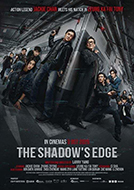
| With | Jackie Chan, Zhang Zifeng, Tony Leung Ka-fai, Ci Sha |
| Runtime | 142 minutes |
| Release | 2025-08-22 |
| Rating | 8/10 |
A mysterious gangster and his seven adopted sons manipulate and ridicule the police by hacking into the city's state-of-the-art surveillance system in order to steal a fortune in cryptocurrency. The police, now powerless, must call on a former expert who teams up with a young policewoman to whom he is linked by a secret she is unaware of. A chess game begins, in which intelligence and loyalty will be put to the test.
The review
By Mulder 2025-12-01
There is something particularly exciting about seeing Jackie Chan, now in his seventies, return to a genre he helped define. The Shadow's Edge, directed by Larry Yang, is one of those rare late career turns by a legendary actor that not only proves he still belongs on the battlefield, but also brings decades of cinematic wisdom to every punch, glare, and dance move. Set against the neon lights and dark atmosphere of modern Macau, the film opens with a spectacular cyber heist that feels like an energizing mix of Heat, Mission: Impossible, and the classic Hong Kong thrillers that defined a generation. From the very first frame, Larry Yang thinks big: drones, AI surveillance systems, cryptocurrency safes, impossible disguises, and acrobatic falls that flirt with the absurd but remain believable thanks to a tactile realism in the stunts that is lacking in most modern action films. At the heart of this thunderous opening is the mysterious mastermind, Tony Leung Ka-fai, who exudes a silent menace in the role of Shadow, a criminal legend who moves like a ghost and kills with the calm of a monk.
The story may seem familiar—a retired cop called back into service to track down an old adversary—but Larry Yang uses this premise to explore the tension between technological omniscience and old-fashioned instinct. Jackie Chan plays Wong Tak-Chung, once the police's unrivaled surveillance expert, now an aging dog walker whose observational skills remain terrifying. One of the film's most clever touches is the simple sequence where he follows his dogs' toilet habits with Sherlock Holmes-like precision, a nod to the audience to make them understand that while the body may be aging, the mind remains formidable. When Wong is reluctantly called back to help crack a robbery that is far beyond the capabilities of the police's AI-powered Sky Eye system, the clash of generations becomes the central driving force of the film. He teams up with young officer He Qiuguo, played with surprising determination and vulnerability by Zhang Zifeng, whose personal history with Wong brings an emotional dimension that pays off throughout the film.
Opposing them is Shadow's team, a group of seductive young prodigies whose technical skills border on science fiction, led with icy calculation by Tony Leung Ka-fai. Among them are twin brothers Hei Wong and Hei Mong, both played by Ci Sha, who effortlessly switches between the roles of ruthless killer and unbearably arrogant hacker. Here, the film relies more on the appeal of youth, but Larry Yang keeps things interesting by presenting Shadow as a twisted father figure, consumed by regret and convinced that training the next generation is his last meaningful act. This tension between criminals and cops—old lions guiding cubs in a world neither fully understands—gives the film an unexpected emotional dimension. Although the script sometimes collapses under the weight of too many twists and motivations, the interactions between the characters often seem richer than those of their counterparts in the same genre.
What truly elevates The Shadow's Edge, however, is its extraordinary conception of action scenes. Jackie Chan, bruised, slower, but fiercer than he has been in years, delivers a physical performance that combines the brutality of close combat with the inventive prop-based choreography that made him iconic. But this time, it's rawer, heavier, with an undeniable sense of consequence. A fight in a laundromat turns into a claustrophobic ballet of broken bones and improvised weapons. A bullet-riddled ambush is staged with visceral clarity. A parachute jump from the Macau Tower feels exhilaratingly realistic. Then comes the confrontation in a cramped tea room between Jackie Chan and Tony Leung Ka-fai, one of the most brutally intimate fight scenes of their careers. Seeing Leung—who reportedly trained for a year to master the precise knife movements—slice through his opponents' henchmen before facing Jackie Chan is pure cinematic bliss. This isn't just a fight, it's two titans reminding the world why they are irreplaceable.
What surprised us most, however, was how effectively Larry Yang leverages suspense in the quiet moments. One of the most memorable sequences shows Wong and Shadow sharing a deceptively calm dinner, every movement laden with suspicion, every line carrying a double meaning. Another takes place in an elevator, a slow-burn exercise in tension where the two characters test each other with surgical verbal strikes. These moments are reminiscent of Michael Mann's psychological chess games, showing that Larry Yang isn't just delivering a spectacle; he's looking for atmosphere, mood, and careful escalation. Even when the editing becomes hyperactive or the narrative gets tangled in its own threads, the film never loses its grip on the viewer, as it constantly alternates between adrenaline and paranoia.
Yet the film is not without its flaws. The almost magical use of computer hacking in the script sometimes pushes credibility to its limits, creating convenient plot twists that feel more like shortcuts than earned advances. The young actors, though charismatic, sometimes find themselves caught up in melodramatic subplots that slow down the pace and dilute the fierce duel between Wong and Shadow. And at 141 minutes, the story borders on tedious, especially when it explains the internal politics of Shadow's gang or relies on sentimental flashbacks related to Wong's past mistakes. Yet even these weaker moments are offset by the strength of the performances, particularly Jackie Chan's weary but still dangerous aura and Tony Leung Ka-fai's Shakespearean gravitas.
In terms of direction, Larry Yang shows remarkable progress. His deep affection for old-school Hong Kong thrillers blends surprisingly well with modern stories about cybercrime. While the rapid editing can test your patience, the visual language of the action is always legible, dynamic, and emotionally charged. Larry Yang knows how to film his actors, especially Jackie Chan, whom he frames with a mixture of respect and realism, adapting the choreography to the star's physical limitations without diminishing its impact. There is even a clear thematic thread about tradition versus innovation, reminding us that intuition, experience, and human instinct still matter in an age when algorithms promise omniscience but rarely deliver it.
The Shadow's Edge stands out as both a triumphant return for Jackie Chan and a powerful showcase for Tony Leung Ka-fai, who together elevate this thriller to one of the most surprising action films of the year. It may be uneven, sometimes overloaded and sometimes too fascinated by its own technological gadgets, but its high points are exceptional, especially when the film strips away the noise and focuses on two veterans eyeing each other like wolves. With breathtaking stunts, memorable confrontations, and a sense of cinematic artistry that honors the past while embracing the present, this is Jackie Chan's most exciting project since The Foreigner. And judging by its ending, the story isn't over; frankly, we'd be delighted to see a sequel to this film.
The Shadow's Edge (捕風追影)
Written and directed by Larry Yang
Based on Eye in the Sky by Yau Nai-hoi
Produced by Victoria Hon, Zhang Chao,
Starring : Jackie Chan, Zhang Zifeng, Tony Leung Ka-fai, Ci Sha
Cinematography: Qian Tiantian
Edited by Zhang Yibo
Music by Nicolas Errèra
Production companies: Hairun Pictures, iQIYI Pictures
Distributed by Tao Piao Piao (China), Edko Films (Hong Kong), CMC Pictures (United States), Space Odyssey (France)
Release dates: August 22, 2025
Seen on December 1, 2025 at Gaumont Disney Village, Theater 5, seat A18