

Being Eddie
Directed by Angus Wall (2025)
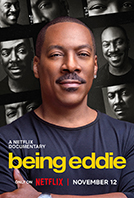
| With | Eddie Murphy, Kevin Hart, Jamie Foxx, Pete Davidson, John Landis, Chris Rock, Jerry Bruckheimer, Jerry Seinfeld, Dave Chappelle, Kenan Thompson, Tracee Ellis Ross, Tracy Morgan, Arsenio Hall, Michael Che, Jeffrey Katzenberg, Brian Grazer |
| Runtime | 103 minutes |
| Release | 2025-11-12 |
| Rating | 4/10 |
It goes without saying that there is only one Eddie Murphy. No other comedian shared the stage with Jerry Seinfeld at the age of 17 or joined the cast of Saturday Night Live right after high school. No other actor has played a cop, a doctor, and a donkey... and excelled in every area of Hollywood he's tried his hand at. Few celebrities have remained in the spotlight for more than 40 years without succumbing to the darker side of fame. Eddie Murphy possesses a rare combination of explosive charisma, ambition, raw talent, and caution, which immediately places him in a category of his own. The full extent of this is captured in I Am Eddie, directed by two-time Oscar winner Angus Wall. The documentary brings together comedy and film legends such as Dave Chappelle, Tracee Ellis Ross, Jamie Foxx, Jerry Seinfeld, Reginald Hudlin, and many others to celebrate the Oscar-nominated actor and his nearly 50-year career, during which he has broken barriers, invented new genres, and inspired several generations of talent. For the first time ever, Eddie Murphy invites the audience into his home to reflect on his breathtaking work, revealing a rich inner life that keeps this extraordinary star motivated and grounded.
The review
By Mulder 2025-11-12
Documentaries about icons such as Eddie Murphy come with an implicit promise: if the subject finally agrees to open the doors to their private world, it's because there's something worth sharing. With Being Eddie, that promise is largely broken. What Netflix offers instead is a carefully staged and sanitized tour of Eddie Murphy's home, a feature-length press kit masquerading as an introspective portrait. As a celebration of an extraordinary career, it's elegant, enjoyable, and occasionally funny; as a documentary that purports to show us what it really means to be Eddie, it's frustrating and hollow. At the end of the film, the prevailing feeling is not admiration, but disappointment, the impression of having watched a 103-minute trailer for future projects rather than a real movie.
Directed by Angus Wall, a two-time Oscar-winning editor best known for shaping David Fincher's images, the film is impeccably edited but conceptually timid. The setup is simple: we follow Eddie Murphy as he wanders around his lavish Los Angeles mansion, under a retractable glass roof that closes at the touch of a button, pausing on couches and in hallways to comment on his life while the film cuts to archival footage and interviews. This is Netflix's now familiar style—the spend time with a legend in their mansion format already applied to Sylvester Stallone and others—and it has undeniable charm. Yet the more time we spend wandering around this luxurious fortress, the more obvious it becomes that the house is also a metaphor for the film: the doors we are allowed to see are immaculate, carefully maintained, and air-conditioned, while the rooms that might be messy or uncomfortable remain locked.
The first half of Being Eddie is essentially a best-of of his career, narrated by Eddie Murphy himself. We move quickly from the Long Island kid who devoured television to the 19-year-old phenomenon on Saturday Night Live, then to the meteoric rise of 48 Hrs., Trading Places, and Beverly Hills Cop. The clips are used with algorithmic efficiency, reminding us just how incredibly charismatic Eddie Murphy was in his twenties, while an impressive parade of admirers—Dave Chappelle, Chris Rock, Jerry Seinfeld, Kevin Hart, Jamie Foxx, Tracy Morgan, Tracee Ellis Ross, Jerry Bruckheimer, Brian Grazer—take turns attesting to his genius and pioneering power. Their testimonials are affectionate and often entertaining, but the structure leaves little doubt: this is less an investigation than a lengthy tribute video with a bigger budget. The film summarizes the story everyone already knows, and whenever it touches on a subject more thorny than box office success, it politely returns to applause.
The problems become particularly glaring when Being Eddie touches on the darker or more complex aspects of Eddie Murphy's life and simply looks away. His childhood is sketched out through a few salient details—his parents' constant fighting, his father's murder, the disciplinary presence of his stepfather Vernon Lynch Jr.—but these are treated as anecdotes rather than wounds to be explored. His self-described obsessive habit of getting up several times during the night to check the gas burners is mentioned, along with an informal suggestion of undiagnosed OCD, but Eddie Murphy claims he simply stopped through sheer willpower, a statement the film never questions. The famous 1997 police stop, the public conflict over paternity, the complicated reality of having ten children with multiple partners, the way his sketches in Delirious and Raw are now perceived in a very different cultural climate: all of this is banned from the frame. What remains is a sanitized silhouette of a private life, in which Paige Butcher and a selection of smiling children appear briefly as proof of family stability, but never as individuals with their own points of view.
While the documentary hesitates to explore the darker sides of Eddie Murphy, it is quick to amplify his self-mythification. Some of the film's most striking lines are not spoken by critics or biographers, but by Eddie Murphy himself, with unwavering confidence. He positions himself as the most versatile actor in the history of cinema, even describing himself as the psychological breeding ground from which the black stars who succeeded him—from Morgan Freeman to Denzel Washington and Spike Lee—were able to flourish. It is true that his success fundamentally changed the Hollywood landscape, and the film is right to point this out. But since there is no dissenting voice, no interviewer willing to gently challenge this self-congratulation, the effect is often uncomfortable. When John Landis insightfully remarks that Eddie Murphy was too vain to participate in his own destruction, the line hits home because it seems like an outside diagnosis; when Eddie Murphy spends long stretches telling us how important Eddie Murphy is, Being Eddie starts to feel less like a portrait and more like a brand management strategy.
Ironically, the most captivating parts of the film are precisely those moments when the mask slips a little, often by accident or through editing rather than by design. The juxtaposition between Eddie Murphy's childhood ritual of checking the stove and his subsequent inability to return to stand-up comedy hints at a psychological tension that the film never fully articulates, but which remains present in the viewer's mind. The sequence in which he revisits David Spade's famous shooting star joke on SNL and describes the pain it caused decades later briefly breaks the narrative of an unflappable, cool man and reveals a deeply sensitive, even thin-skinned man who cares deeply about what others think. The behind-the-scenes footage from his return to SNL in 2019, with Eddie Murphy, Dave Chappelle, Chris Rock, and Tracy Morgan chatting quietly backstage, offers a more authentic energy than most of the staged conversations in the mansion. Even his strangely charming comparison of Ridiculousness to the cinema of Alejandro Jodorowsky, or the glimpse of a collection of ventriloquist dummies representing characters such as Richard Pryor and Bill Cosby, suggest the strange and peculiar mind of a man we are never really allowed to meet head-on.
There is also an inherent structural dishonesty to the project that is difficult to ignore. The title Being Eddie promises an exploration of identity—what it feels like to achieve that level of fame, that body, that story—but what we actually get is more like Curating Eddie: carefully selected and arranged memories to support a single, flattering thesis. The film's refusal to truly reconsider the most problematic aspects of Eddie Murphy's early work, at a time when Netflix is clearly setting the stage for his long-awaited return to the stage, leaves the whole thing with a slightly cynical aftertaste. That doesn't mean Eddie Murphy should be publicly flogged for his old jokes, but a serious documentary in 2025 can't pretend these conversations don't exist. Instead, uncomfortable topics are handled by omission, and the absence becomes a form of editorial commentary.
Being Eddie is a watchable, sometimes enjoyable film, because Eddie Murphy himself is inherently magnetic, quick-witted, and full of stories; simply sharing the air with him through the lens of a camera is valuable. The problem is that the film relies entirely on this charisma and refuses to do the harder, but more rewarding, work of context and confrontation. While recent portraits of important figures have attempted to balance adoration with genuine introspection, Being Eddie is content to be a very expensive bouquet of flowers offered to a man who, by his own admission, already loves himself deeply. As a nostalgic recap of a legendary career, it works; as a documentary intended to deepen our understanding of one of comedy's most important figures, it barely scratches the surface. For this reason, despite its refinement and a few moments of genuine interest, it feels like a missed opportunity—an elegant but empty tribute that, from a critical standpoint, failed to hold our attention.
Being Eddie
Written and directed by Angus Wall
Produced by John Davis, John Fox, Charisse M. Hewitt, Terry Leonard, Kent Kubena
Starring Eddie Murphy, Kevin Hart, Jamie Foxx, Pete Davidson, John Landis, Chris Rock, Jerry Bruckheimer, Jerry Seinfeld, Dave Chappelle, Kenan Thompson, Tracee Ellis Ross, Tracy Morgan, Arsenio Hall, Michael Che, Jeffrey Katzenberg, Brian Grazer
Cinematography: Alex Pollini
Edited by Will Znidaric
Production companies: Netflix
Distributed by Netflix
Release dates: November 12, 2025 (United States, France)
Running time: 103 minutes
Seen on November 12, 2025 on Netflix