

Good Fortune
Directed by Aziz Ansari (2025)
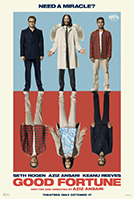
| With | Seth Rogen, Aziz Ansari, Keke Palmer, Sandra Oh, Keanu Reeves |
| Runtime | 97 minutes |
| Release | 2025-10-17 |
| Rating | 8/10 |
The angel Gabriel decides to intervene in the lives of a precarious worker and a wealthy man.
The review
By Mulder 2025-11-09
Good Fortune arrives as a conscious throwback and timely mirror, a body-swap fable and angelic intervention film inspired by the moralistic studio-era plays and highly conceptual comedies of the 1980s, but adapted to the pressures of the gig economy.Written, directed, and starring Aziz Ansari, the film follows Arj, an underemployed editor who sleeps in his car and survives on gigs for TaskSergeant, shifts at big-box stores, and meal deliveries. The catalyst is a low-ranking celestial being named Gabriel, played with disarming and impassive brilliance by Keanu Reeves (in one of his best films), who decides that preventing collisions caused by cell phone use while driving is not a sufficient goal for a heavenly life. Gabriel's brilliant idea—to temporarily swap Arj's miserable existence for the lifestyle of venture capitalist Jeff—leads to a complication that classics rarely admit: money may not solve everything, but it certainly helps overcome most obstacles. It is the unfolding of this premise that sets the pace of the film: the joke works because it is true, and the film is at its most vibrant when it refuses to sugarcoat this truth.
As a director, Aziz Ansari oscillates between affectionate pastiche and the specificity of the present. We sense the influence of Frank Capra and Preston Sturges in the film's conviction that small gestures matter, but the texture is that of Los Angeles in 2025: parking tickets that multiply like Kafkaesque vines, app notes used as weapons of punishment, and the silent humiliation of waiting in line for someone else's viral pastry. The visual vocabulary plays on contrasts. Director of photography Adam Newport-Berra composes sharp, elevated shots around the glass box of the Hollywood Hills, while keeping street-level scenes cramped and fluorescent, and editor Daniel Haworth cuts with the ease of a sitcom at one moment and dreamy whimsy at another. This lighthearted yet anxious tone is supported by Carter Burwell's catchy music, which deliberately plays the “comfort” card in the face of images that are anything but comforting. It's an intentional friction: a lullaby set against a backdrop of insomnia.
The performances triangulate this tone. Jeff, played by Seth Rogen, starts out as a caricatured technophile—rare Porsche, cold evangelism, breathtaking watch collection—then settles into something more interesting once the exchange breaks his isolation. The best part of the film allows Jeff to absorb the indignities he once externalized: star ratings, managers watching the clock, calculating bathroom breaks that only workers know. On the other side, Keke Palmer transforms Elena, a unionized artisan with a sense of organization, into the moral gyroscope of the story. She is sometimes asked to convey a message rather than live it, but her consistency prevents the film from getting lost in its own cleverness. If the romance between Elena and Arj seems underdeveloped, it's because the film's center of gravity is not love, but work.
This center of gravity shifts every time Keanu Reeves enters the scene. Gabriel could have been a simple vehicle for exposition—the trench-coated guardian pushing pawns on a cosmic chessboard—but Reeves finds a mischievous and affectionate humanity in a being who knows the rules but not the people. Once Gabriel is demoted—his wings clipped by his boss Martha, played with amused authority by Sandra Oh—the thread of the angel learning to be human becomes both a comedic highlight and the film's quiet thesis. The first bite of a hamburger, the surprised smile at a milkshake, the giddy wonder at a dance floor: Keanu Reeves plays these discoveries with sincerity, without a wink, and that sincerity transforms small pleasures into small revelations. Even the recurring chicken nugget gag works because he treats it as poetry rather than a meme. It's a rare comic performance that generates warmth without a trace of smugness.
Actor Aziz Ansari shapes Arj as a character with raw nerves and rationalizations, a man whose empathy wanes as his comfort increases, a choice that is both honest and a little scary. When Arj refuses to return to his old life, the film resists the temptation to moralize. It lets the fantasy take hold: yes, wealth neutralizes pain; no, it does not create purpose. This tension between what money can heal and what it cannot touch seems to be the film's true dialogue with its ancestors. While It's a Wonderful Life championed community values when the meter was in the red, Good Fortune sets a meter that stays in the red no matter how hard you try, and questions the very meaning of “value” when housing is a luxury item. A brief visionary sequence in which Gabriel foresees Arj's likely future—bottles of urine, pet bills, family compromises—does not come across as an edifying tale, but as a bureaucratic prophecy. The moral calculus has changed; the film knows it.
Daniel Haworth's editing sometimes favors punchlines over accumulation, and a late shift toward impossibly Hollywood joy undermines the difficult everyday life that the film otherwise sketches well. There are also moments when Elena is forced to make speeches—points the film has already made visually—and when Jeff's enlightenment comes a scene too early. But this unevenness is also part of the texture of this debut film: Aziz Ansari juggles tone, homage, and a deeply contemporary anger, and you can feel him making decisions in real time. The film stands out as an undeniable success thanks to many well-executed scenes: Arj melting into the numbing pleasures of abundance, Gabriel smoking on the sidewalk in his dishwasher's apron, Jeff learning to navigate an app from the wrong side of the dashboard.
The technical details are precise enough to be noticed without being garish. Adam Newport-Berra shifts from the bright light of Bel Air to the dark greens of warehouse floors and sodium-lit streets, mapping social classes through color temperature. Carter Burwell keeps things light until they're not; a few notes let melancholy seep in, reminding us that jokes are often defense mechanisms. Stephen McKinley Henderson's brief appearance as the revered Azrael is both a blessing and a warning: guiding others is delicate work, and shortcuts come at a cost. The art design finds its own tone, with literal glass houses, a corporate sauna that seems to have a personality, and a garage set up like a museum dedicated to expensive boredom, without ever falling into caricature.
If there is one image that crystallizes Good Fortune, it is that of Gabriel and Jeff sharing a cigarette break behind an all-you-can-eat buffet, two misplaced men comparing notes on penance. One was once invulnerable, the other untouchable. In their quiet complicity, the film finds solidarity without moralizing. Keanu Reeves gives Gabriel the gift of curiosity that never turns into condescension, and Seth Rogen lets Jeff's bravado crumble away to make room for listening. The film's argument, whispered rather than shouted, is that empathy is not a revelation; it's a muscle, and most of us are out of shape.
Admittedly, Good Fortune is a patchwork—from Wim Wenders to Frank Capra, from body-swap gags to the legend of guardian angels—but the seams are intentional. Aziz Ansari doesn't pretend to solve capitalism in 98 minutes; he stages a comedy about how we compensate, how we rationalize, and how we sometimes choose each other anyway. If the ending is a little too smooth, the film has already earned its stripes with more chaotic elements: the way a free milkshake can be perceived as a blessing, the way a union flyer can be perceived as a breath of fresh air, the way a wrong turn can still lead to a dance floor. And in the midst of it all, Keanu Reeves, playing wonder as if it were a new sense, transforms a clever idea into something almost luminous. This film is undoubtedly one of the best comedy-dramas of the year and establishes Aziz Ansari as a director to watch closely.
Good Fortune
Written and directed by Aziz Ansari
Produced by Aziz Ansari, Anthony Katagas, Alan Yang
Starring Seth Rogen, Aziz Ansari, Keke Palmer, Sandra Oh, Keanu Reeves
Cinematography: Adam Newport-Berra
Edited by Daniel Haworth
Music by Carter Burwell
Production companies: Garam Films, Oh Brudder Productions, Keep Your Head, Yang Pictures
Distributed by Lionsgate (United States)
Release dates: September 6, 2025 (TIFF); October 17, 2025 (United States)
Running time: 97 minutes
Seen on November 9, 2025 (VOD)