

Dooba Dooba
Directed by Ehrland Hollingsworth
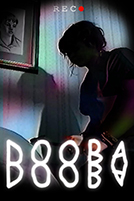
| With | Betsy Sligh, Amna Vegha, Erin O'Meara, Winston Haynes, Billy Hulsey |
| Runtime | 76 minutes |
| Release | Release date unknown |
| Rating | 8/10 |
Security cameras installed in the house film a clumsy sixteen-year-old girl terrorizing her well-meaning babysitter.
The review
By Mulder 2025-10-08
Dooba Dooba, directed by Ehrland Hollingsworth, isn't just another found footage film: it's a disconcerting and disturbing experience that grabs you by the gut with its aesthetics and unsettling intimacy. Premiered at the 2025 Screamfest festival, the film arrives wrapped in the static noise of VHS tapes and political unease, resembling a cursed relic from another era. The film follows Amna Vegha as Amna, a young babysitter hired for what should be a routine overnight job. Her employers, Wilson (Winston Haynes) and Taylor (Erin O'Meara), are desperate to leave for the evening, explaining only that their sixteen-year-old daughter, Monroe (Betsy Sligh), is fragile after witnessing her brother's murder a few years earlier. The house is equipped with cameras in every corner, and Amna must recite “dooba dooba” as she moves around so that Monroe doesn't panic when she hears unfamiliar footsteps. This absurd, almost childish phrase becomes the film's leitmotif, a distorted lullaby that becomes increasingly sinister as it is repeated.
What begins as an awkward conversation between two strangers quickly turns into a nightmare of psychological tension and surreal distortion. Ehrland Hollingsworth shoots the entire film using low-quality home security cameras and a handheld digital camera, evoking the discomfort of watching another person's nervous breakdown live. The house itself seems alive, with its incoherent layout and hallways stretching at impossible angles. As Amna explores the premises, her image appears and disappears, while excerpts from old political footage, presidential portraits, and PowerPoint slides about serial killers violently intrude on the narrative. These absurd intrusions are not meaningless: they anchor the horror in the American subconscious, a collage of authority, violence, and control that seeps into domestic life. Each crackle seems to interrupt the present, as if the house itself were haunted by the history upon which it was built.
It is the performances of the actors that make the chaos believable. Amna Vegha carries the film with a trembling sincerity that seems improvised, as if she herself did not know what was going to happen. Opposite her, Betsy Sligh delivers a fascinating and unsettling performance as Monroe, alternating with disconcerting ease between vulnerable child and manipulative host. Their dynamic reflects the tension between kindness and cruelty, care and exploitation. When Monroe mocks Amna's music career or forces her to participate in a cruel game of truth or dare, the cruelty is all the more harsh because it is cloaked in politeness. Even Winston Haynes, in his brief screen time, makes a strong impression; his casual remark about Amna Vegha's ethnic name hints at a deeper rot beneath the family's facade. Beneath its supernatural veneer, the film becomes an allegory of cultural othering and inherited prejudice, of how fear and domination can hide behind civility, surveillance, and rituals.
As the film reaches its final act, the horror becomes both literal and existential. The mysterious cries coming from the shed outside eventually erupt into violence, but the real terror lies in the collapse of meaning. The phrase “dooba dooba,” intended to be reassuring, turns into a mocking refrain, proof that language itself has lost its security. Hollingsworth's editing becomes increasingly fragmented, until the images seem to devour themselves. It's the cinematic equivalent of staring too long at a corrupted file: familiar, but abnormal in a way that feels dangerous. There is no clear resolution, only the echo of static and the realization that the evil in Dooba Dooba is not confined to a single house: it is systemic, historical, and endless.
Dooba Dooba seems destined to become a cult film, not because it explains itself, but because it refuses to do so. Like Kyle Edward Ball's Skinamarink or Christian Tafdrup's Speak No Evil, it leaves viewers searching for meaning long after the credits roll. Ehrland Hollingsworth has created a film that rejects refinement, coherence, and comfort in favor of something raw and unforgettable: a horror story about surveillance, guilt, and the danger of pretending we are safe simply because we say the right words. Dooba Dooba doesn't want to scare you for one night. It wants to live rent-free in your subconscious, whispering that absurd phrase to you until it no longer seems absurd at all.
Dooba Dooba
Written and directed by Ehrland Hollingsworth
Produced by Joshua Sonny Harris, Ehrland Hollingsworth, Michelle Sabella Sligh, Amna Vegha
Starring Betsy Sligh, Amna Vegha, Erin O'Meara, Winston Haynes, Billy Hulsey
Cinematography: David Wright
Production companies: Black Widow Productions, New Hope Studios
Release dates: TBD
Running time: 76 minutes
Seen on October 8, 2025 (Screamfest 2025 press screener)