

Shed
Directed by Steven J. Mihaljevich
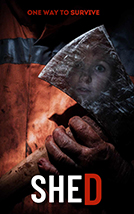
| With | Jason Robert Lester, John Jarratt, Mani Shanks |
| Runtime | 84 minutes |
| Release | Release date unknown |
| Rating | 7/10 |
On Christmas Eve, a strange and disturbed man, who has lost all reason to live, embarks on a murderous rampage and kills a family in cold blood. As he begins to take possession of the family's belongings, he is unaware that there is one more member of the family: Mia, a curious and courageous 10-year-old girl who accidentally found herself locked in the farm shed while playing hide and seek. Mia must survive in the shed for several days, without food or water, until someone comes to get her. But that person is none other than the dying man, and the two characters must come face to face. What follows is a thrilling game of cat and mouse, mixing despair, revenge, and incredible endurance.
The review
By Mulder 2025-10-12
Shed, Steven J. Mihaljevich's latest psychological thriller, is not just another installment in an already well-exploited genre. It is a visceral confrontation with fear, loneliness, and human resilience, told through the eyes of a child forced to grow up far too quickly. While the initial premise—a young girl trapped in a cabin while a deranged killer lurks outside—could easily have resulted in predictable thrills, Steven J. Mihaljevich transforms it into something much more poetic and devastating. His approach is reminiscent of the raw realism of Wolf Creek, but filtered through a meditative prism that finds beauty even in brutality. It's horror as allegory, where every shadow and every silence carries emotional weight.
At the heart of this dark but strangely luminous tale is Mani Shanks, whose performance anchors the film's terror in painful humanity. Her character, Mia, is introduced in a deceptively innocent scene of hide-and-seek during the Christmas holidays, a moment imbued with childlike warmth before it turns into a nightmare. When Mia accidentally finds herself locked in her family's shed, Steven J. Mihaljevich traps both the character and the audience in a suffocating cocoon of terror. What begins as a simple predicament turns into a test of instinct and endurance. Mani Shanks embodies Mia with the alertness of a cornered animal, her silence speaking volumes as she learns that survival is not only a matter of courage, but also of transformation.
Opposite her, Jason Robert Lester plays the stranger whose presence transforms the bucolic Australian countryside into a landscape of existential threat. His character is not a caricatured monster, but a decaying soul, consumed by addiction and despair. Steven J. Mihaljevich's screenplay reduces dialogue to a minimum, giving meaning to movement and breath. The result is a primitive duel between two forces: innocence and corruption, creation and decay. When the stranger finally discovers Mia, the film transforms into a tense psychological battle in which words become useless. Every gesture seems ritualistic, as if the light itself were struggling to survive in the presence of something devouring.
Visually, Shane Piggott's cinematography amplifies this tension to an almost mythical level. His long collaboration with Steven J. Mihaljevich bears fruit in a palette that alternates between pictorial serenity and hideous realism. The sunlight filtering through the cracks in the shed seems almost sacred, yet fleeting, a fragile reminder of what was once pure before being tainted by violence. Each close-up of Mia's dirt-smeared face becomes a study in endurance, documenting her metamorphosis from child to survivor. The Australian landscape, often romanticized in cinema, is here both breathtaking and indifferent, a silent witness to human cruelty. Shane Piggott presents it as much as an adversary as a backdrop.
A brief but unforgettable appearance by John Jarratt injects a sudden burst of chaotic energy into the narrative, his presence echoing the emblematic threat of the Wolf Creek films, but distilled into a single searing moment. It's one of the film's rare explicit nods to genre tradition, and it works precisely because Steven J. Mihaljevich resists the temptation to turn Shed into a spectacle. His direction is disciplined, almost austere, which makes the explosions of violence all the more shocking. When it occurs, the bloodshed is neither stylized nor gratuitous: it is the eruption of something primitive, reminding us that the line between survival and savagery is very thin.
The soundtrack, composed by Ben St. Lucian Chase, is haunting in its restraint. Scattered piano notes and distant mechanical hums blend into the natural ambiance of wind and wood, amplifying the feeling of claustrophobia. This is not music that dictates emotions, but rather listens to them, drawing the viewer deeper into Mia's mind. Combined with Steven J. Mihaljevich's editing, the film's pacing mirrors the slow, irregular pulse of panic. Every second of stillness becomes an act of defiance, every breath a rebellion against despair.
What elevates Shed beyond the trappings of survival horror is its emotional honesty. This is not a story of heroism in the traditional sense, but rather a story about the raw mechanisms that keep you alive when the world is falling apart. Steven J. Mihaljevich seems fascinated by how innocence erodes in the face of brutality and how, paradoxically, hope can still flicker amid the ruins. It is telling that Mia, even after enduring unimaginable horror, retains a spark of humanity: her trauma does not consume her, it transforms her. There is a moment, fleeting but unforgettable, when she gazes at the rising sun through the slats of the shed. It is both victory and defeat condensed into a single glance. Premiered at Screamfest 2025, Shed has earned its reputation not for its spectacle, but for its suffocating intimacy.
At only 84 minutes long, this film is concise but emotionally exhausting, the kind of film that lingers in your mind like smoke after the credits roll. Steven J. Mihaljevich, in collaboration with producers Matthew Robinson and Glen Strindberg, has created an experience that combines the precision of arthouse cinema with the immediacy of horror. The result is timeless and deeply Australian, echoing a landscape that gives birth to both angels and monsters. If Shed proves anything, it's that survival horror doesn't need noise to terrify. Sometimes the quietest moments are the most memorable. Steven J. Mihaljevich has transformed a small enclosed space into a microcosm of human endurance and, in doing so, has created one of the most haunting cinematic experiences of the year. The shed becomes a symbol of confinement and rebirth, of the light that refuses to go out, no matter how long the night lasts.
Shed
Written and directed by Steven J. Mihaljevich
Produced by Steven J. Mihaljevich, Matthew Robinson, Glen Strindberg
Starring Mani Shanks, Jason Robert Lester, John Jarratt
Cinematography: Shane Piggott
Edited by Steven J. Mihaljevich
Music by Ben St Lucian Chase
Production companies: Playtime Motion Pictures
Release dates: TBD
Running time: 84 minutes
Seen on October 10, 2025 (Screamfest 2025 press screener)