

Thinestra
Directed by Nathan Hertz
| With | Mary Beth Barone, Annie Ngosi Ilonzeh, Brian Huskey, Brian Huskey, Jared Bankens, Gavin Stenhouse, Flanelle Magazine, Britt Rentschler, Norma Maldonado, Shannon Dang, Ludwig Manukian, Michelle Macedo, Melissa Macedo, Hadley Durkee, Alexander Chard, Emily Kiihnl, Alyssa Raab |
| Runtime | 101 minutes |
| Release | Release date unknown |
| Rating | 7/10 |
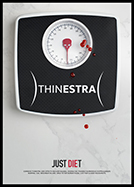
A young woman takes a new diet pill, and the fat she loses returns in the form of a bloodthirsty doppelganger.
The review
By Mulder 2025-10-09
Thinestra is already establishing itself as one of the most shocking horror films of the year. Directed by Nathan Hertz, who makes his feature film debut here, this film revisits Roger Corman's B-movie classic The Wasp Woman with a contemporary approach that combines social satire, body horror, and black comedy. Behind its outrageous concept—a diet pill that gives rise to a monstrous, cannibalistic double—lies a rare and intense reflection on the modern obsession with the perfect body and the psychological ravages of an image-obsessed society.
At the heart of this bloody tragedy is Penny, played by Michelle Macedo, a young photo retoucher who spends her days slimming down the already slender figures of models. By constantly comparing herself to these models, she ends up developing an unhealthy relationship with her own body and falls into a spiral of absurd diets and miracle solutions. Her encounter with a model who offers her a few Thinestra pills seals her fate. This illegal and unapproved treatment will certainly make her lose weight, but above all, it will cause the emergence of a nightmarish double: Penelope, played by Melissa Macedo, a predatory and cannibalistic version of Penny, born from the flesh expelled during transformations as repulsive as they are spectacular. The film then takes a visceral turn, where the quest for perfection is paid for in human flesh.
The intelligence of Thinestra lies in its ability to use metaphor without ever sacrificing its horror. Far from simply accumulating gore, Nathan Hertz constructs striking sequences that convey his heroine's inner anguish: a nightmarish ascent of a mountain of frosted donuts, guided meditations that resonate like cruel mantras, and the hallucinatory vision of her own body turning against her. There is an obvious connection here with works such as Julia Ducournau's Raw and Coralie Fargeat's The Substance, but with a more cruelly ironic tone, where every splash of blood reminds us of the flip side of a society obsessed with the illusion of perfection.
The film's dramatic force also rests on the twin performances of sisters Michelle and Melissa Macedo. The decision to cast two identical actresses in the lead role avoids the use of digital effects and reinforces the impact of the transformations. This old-fashioned, almost artisanal approach is reminiscent of the staging tricks dear to Roger Corman and offers a disturbing authenticity. But Thinestra is not limited to a parable about self-image: it also accurately explores the social and relational repercussions of eating disorders. Penny does not notice her neighbor's signs of interest, but records every hurtful remark her boss makes about her eating habits. This gap between real perception and the outside view feeds the tragic heart of the film. At the same time, Nathan Hertz maintains a keen sense of dark humor, playing on the contrast between the banality of everyday life and the grotesque excess of the transformation scenes. The result is a work that manages to remain deeply moving while embracing its gory excesses.
Backed by a solid artistic team, from Joe Wesley's cinematography to Aashish D'Mello, Joshua Raymond Lee, and Zekun Mao's editing, as well as an original soundtrack by Charlie Laffer and Tom Walley, Thinestra stands out as an ambitious and accomplished independent production. Supported by Dogplayer, Hitmakers Media, Stay Lucky Studios, and Mary Ellen Moffat, the film displays a creative energy that is rare in today's horror film landscape. By exploring the monstrosity born of an obsession with thinness and refusing to compromise in its depiction of suffering, it marks a decisive step forward in the treatment of “female monstrosity” on screen.
At the crossroads of tragedy, satire, and monster movies, Thinestra is a visceral experience that is as disturbing as it is fascinating. By combining the most grotesque fantasy with a stark social truth, Nathan Hertz and his actresses deliver a work that will undoubtedly remain one of the most memorable of this decade in the body horror genre. A film that is not afraid to make us laugh, grimace, and reflect in the same scene, and which, like its heroine, leaves no one unscathed.
Thinestra
Directed by Nathan Hertz
Written by Avra Fox-Lerner
Produced by Joshua Raymond Lee, Kelly Ann Parker
Starring Mary Beth Barone, Annie Ngosi Ilonzeh, Brian Huskey, Brian Huskey, Jared Bankens, Gavin Stenhouse, Flanelle Magazine, Britt Rentschler, Norma Maldonado, Shannon Dang, Ludwig Manukian, Michelle Macedo, Melissa Macedo, Hadley Durkee, Alexander Chard, Emily Kiihnl, Alyssa Raab
Cinematography: Joe Wesley
Edited by Aashish D'Mello, Joshua Raymond Lee, Zekun Mao
Music by Charlie Laffer, Tom Walley
Production companies: Dogplayer, Hitmakers Media, Mary Ellen Moffat, Stay Lucky Studios
Running time: 101 minutes
Viewed on October 2, 2025 (Screamfest 2025 press screener)