

Deathstalker
Directed by Steven Kostanski (2025)
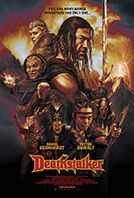
| With | Daniel Bernhardt, Patton Oswalt, Christina Orjalo, Paul Lazenby, Nina Bergman |
| Runtime | 103 minutes |
| Release | 2025-10-10 |
| Rating | 8/10 |
A warrior faces off against an evil sorcerer and other creatures...
The review
By Mulder 2025-09-20
Steven Kostanski has made a career out of turning genres into playful and bloody toys, and with Deathstalker, he takes the biggest risk of his career. Where others would have seen a forgotten relic of Roger Corman, a piece of VHS-era pulp best left in the trash, Steven Kostanski saw a chance to revive an entire subgenre with both reverence and derision. His film is less a remake than a loud, handcrafted love letter to the early 1980s sword-and-sorcery boom, when latex monsters, headbanging guitars, and unabashed camp coexisted with genuine attempts at myth-making. The result is a cinematic Frankenstein assembled from nostalgia and new tricks, and while the seams are often visible, this roughness is part of its particular charm.
At the center of this chaos is Daniel Bernhardt, long respected in genre circles as a stuntman and fight choreographer, who finally takes on a leading role that allows him to show more than just his fists. His Deathstalker is less a noble barbarian than a working-class grave robber who stumbles upon his destiny, and Daniel Bernhardt embodies him with a weary humor, as if he would rather pawn the cursed amulet that binds him to his fate than save the kingdom. This irreverence is the key to the film's best moments, anchoring the absurdity in a character who feels as exasperated as the audience by the endless parade of curses, pig-men, and geysers of blood. For once, the action star is allowed to bring wit to his physique, reminding us that Daniel Bernhardt has always been more than just a body to throw through a window.
The supporting roles embody the tonal balance Steven Kostanski was looking for. Patton Oswalt lends his voice to the little wizard Doodad, while Laurie Field provides the physical performance, an intentional mismatch reminiscent of the clumsy dubbing of 1980s imports. What could sink another production becomes a badge of honor here, a knowing wink that draws the viewer into the film's imaginary logic. Alongside them, Christina Orjalo's thief Brisbayne and Paul Lazenby's recurring villain Jotak complete a cast of thugs as broad as they are amusing. The villains declaim with Shakespearean power, while the heroes mumble like weary adventurers in a pub, and the collision of tones produces both laughter and a curious affection for the rough edges of the world.
Visually, Deathstalker is an explosion of special effects that could only come from Steven Kostanski and his team of genre craftsmen. Every frame seems coated in rubber, plaster, or buckets of fake blood. Monsters appear in stop-motion or emerge dripping from prosthetic molds, pig-faced warriors charge into the frame, and slimy swamp creatures writhe for attention. Watching the film is like stepping into a garage where imagination is limited only by the amount of foam available. In an era when digital effects have erased all imperfections, these bumpy, tactile creations remind us of the joy of seeing the seams, of knowing that behind the mask is an actor sweating to make the illusion real.
Yet Steven Kostanski's dedication to camp is a double-edged sword. For every creature-inspired gag or perfectly timed decapitation, there's a moment when the film suffers from its own deliberate absurdity. The narrative, which is little more than a Dungeons & Dragons campaign complete with side quests, sometimes drags between key scenes. Even admirers will admit that the repetitive structure of clues, monsters, and fights eventually wears thin. Still, it's hard to resist this boundless enthusiasm, especially when the fight choreography, enhanced by Daniel Bernhardt's martial pedigree, exceeds what this genre usually offers. Swords clash with choreographic rhythm, and each new opponent brings a distinct fighting style that elevates the action far beyond nostalgia.
The music underscores this joyful excess. With a soundtrack by Blitz//Berlin, flourishes by Bear McCreary, and even an original song by Slash during the credits, the soundtrack vibrates with heavy metal energy. This is no accident: the film relies as much on riffs and screams as it does on swords and sorcery. It is in a collective energy that Steven Kostanski's work takes on its full meaning: films that are not meant to be watched alone and politely, but for late nights, sticky floors, and audiences screaming at the screen.
In line with James Sbardellati's original 1983 film, Steven Kostanski's version is both a critique and a celebration. The original was cheap, mean-spirited, and, outside of VHS shelves, largely forgotten. This reboot doesn't so much seek to repair the original as to recapture the spirit of trash cinema of the era, erasing its most hideous misogyny while amplifying the gags, gore, and childlike wonder. For those who grew up with Conan the Barbarian or rented Beastmaster on VHS until it wore out, the film fills a long-unmet need. For others, its deliberate crudeness may seem exhausting, a relic of a taste they never acquired.
Deathstalker is less the story of a cursed amulet than the joy of seeing a film made by hand, with as much passion as absurdity. Steven Kostanski proves once again that he is one of the few directors willing to embrace kitsch without apology, creating films that laugh with their audience rather than at them. This film won't appeal to everyone, nor does it seek to appeal to everyone. But for those willing to experience it on its own terms, with a bucket of popcorn, a sense of humor, and perhaps a touch of bloodlust, it offers a joyful return to a time when fantasy was messier, sillier, and, in its own way, more human.
Deathstalker
Written and directed by Steven Kostanski
Produced by Pasha Patriki, Michael Paszt, Avi Federgreen, James Fler, Peter Kuplowsky, Andrew Hunt
Starring Daniel Bernhardt, Patton Oswalt, Christina Orjalo, Paul Lazenby, Nina Bergman
Cinematography: Andrew Appelle
Edited by Robert Hyland
Music by Blitz//Berlin
Production companies: Hangar 18 Media, Berserkergang Films
Distributed by Shout! Studios (United States)
Release dates: August 15, 2025 (Locarno), October 10, 2025 (United States)
Running time: 103 minutes
Seen on September 20, 2025 (press screener Fantastic Fest 2025)