
 English
The Piano Accident
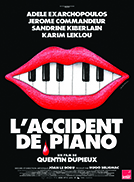
| Original title: | L'Accident de piano |
| Director: | Quentin Dupieux |
| Release: | Vod |
| Running time: | 88 minutes |
| Release date: | Not communicated |
| Rating: |
Mulder's Review
Quentin Dupieux's latest work, The Piano Accident, marks a new stage in the director's unique career, where absurd comedy collides with an almost mournful pessimism about modern society. What sets this film apart from his previous surrealist experiments is the way he channels his characteristic sense of mischief into a narrative that is both stripped down and brutally direct. While his previous films, such as Deerskin and Reality, flirted with playful ambiguity, here the filmmaker opts for a darker tone, painting a portrait of celebrity, spectacle, and human emptiness that is both claustrophobic and strangely hypnotic. It all begins with a deceptively mundane, almost grotesque premise: an accident involving a piano that should have been just another viral media stunt, but instead becomes the starting point for a disturbing descent into exposure, manipulation, and moral disintegration.
At the center of this story is Magalie, known to her followers as Magaloche, played with unsettling precision by Adèle Exarchopoulos. Dressed in orthopedic devices that she never removes for aesthetic reasons, wearing wigs and adorned with accessories that exaggerate her eccentricity, she embodies an influencer whose congenital insensitivity to pain has turned into an empire. Her videos, in which she subjects her body to increasingly absurd punishments (electrocution, boiling water, crushing under a washing machine), have racked up millions of views. However, the piano accident pushes her beyond the familiar terrain of spectacle into the frightening reality that the body, once commodified, can also betray. To see Adèle Exarchopoulos disappear into this grotesque character is to see an actress not only abandon her vanity, but also embrace the discomfort of being almost repulsive, while remaining morbidly fascinating.
Around Magalie, Quentin Dupieux orchestrates a minimalist but charged constellation of characters. There is Patrick, her handyman and assistant of ten years, played by Jérôme Commandeur, whose passivity and silent resentment make him less a confidant than a weary accomplice. Then there is Simone Herzog, a journalist played by Sandrine Kiberlain, who enters the story with icy detachment, threatening to reveal Magalie's secret if she does not grant her an interview. Their exchanges become some of the most revealing moments in the film: two hollow characters circling each other, one devouring her own image, the other feeding on the residue of scandal. Add to this constellation the oppressive fan played by Karim Leklou, and the film becomes less a play than a hall of mirrors reflecting the emptiness at the heart of celebrity culture.
Thematically, The Piano Accident delves directly into the spectacle of pain as a commodity. Quentin Dupieux tackles head-on a question that looms ominously over the social media era: what is the value of suffering when it becomes content? The piano accident itself, which could have been a laughable anecdote, anchors Seeing Magalie's broken arm turn into a commercial opportunity, the viewer is struck by the disturbing parallels between Quentin Dupieux's fiction and the very real excesses of influencer culture. The claustrophobic mountain chalet where most of the action takes place accentuates the feeling of confinement: there is no escape, only an endless orbit around a toxic star.
What sets this film apart from Quentin Dupieux's previous works is its refusal to empathize. Magalie is tyrannical, grotesque, sometimes pathetic, but rarely likable. And yet, the film never treats her cruelty as gratuitous; rather, it presents it as the product of a system that celebrates pain, rewards amorality, and devours humanity. In this sense, The Piano Accident is closer to tragedy than comedy, with laughter stuck in the throat and scenes where absurdity turns to despair. The humor is still there, but it is corrosive, hollow, almost embalmed. We laugh not because it's funny, but because the alternative would be to face the horror head-on.
Seen in the context of Quentin Dupieux's work, this film resembles a confession disguised as satire. The director, who has long avoided interviews and mocked promotional rituals, seems to project himself into Magalie's compulsive productivity and indifference to meaning. Like her, he produces relentlessly, shooting films at a frenetic pace, often without bothering to explain or justify them. The piano accident becomes more than just a plot device: it appears as a metaphorical crack in Quentin Dupieux's machinery, the moment when the frenzy of absurd production collides with a questioning of it all. Some may find this self-reflective dimension complacent, but it undeniably deepens the reading of the film as both satire and self-portrait.
One of the most striking aspects of the film is its atmosphere. While works such as Rubber and Incroyable mais vrai thrived on whimsical detours, The Piano Accident is rigid, almost clinical. The framing is sober, the editing precise, and the structure unusually linear for Quentin Dupieux: a beginning, a middle, and an end, with no narrative games to unsettle the viewer. This very discipline, however, can seem stifling. For some, it will mark a new maturity; for others, a flattening of his style, a loss of that sense of vertigo that made his early films so unpredictable. Yet this restraint conceals a particular power: the film does not seek to dazzle, but rather to corner you, forcing you to confront a society where human experience has been stripped of its substance, leaving only images and the currency of clicks.
The Piano Accident is a film that disturbs more than it entertains. It is a satire, certainly, but a satire devoid of relief, where the humor is as fragile as the ice that breaks underfoot. Adèle Exarchopoulos delivers one of her most daring performances, embodying a character who is both detestable and pitiful, while Sandrine Kiberlain and Jérôme Commandeur bring contrasting shades of cynicism and resignation. While the story sometimes lacks the unbridled inventiveness of Quentin Dupieux's most popular films, it compensates with a rare lucidity: the recognition that, in the digital age, pain is no longer private, morality is optional, and the self exists only to be consumed. It may not be his most charming or accessible work, but it is one of his most uncompromising.
The Piano Accident
Written and directed by Quentin Dupieux
Produced by Hugo Sélignac
Starring Adèle Exarchopoulos, Jérôme Commandeur, Sandrine Kiberlain, Karim Leklou
Cinematography: Quentin Dupieux
Edited by Quentin Dupieux
Music by Mr Oizo
Production companies: Chi-Fou-Mi Productions, Arte France Cinéma, Auvergne-Rhône-Alpes Cinéma
Distributed by Diaphana Distribution (France)
Release date: July 2, 2025 (France)
Running time: 88 minutes
Seen on September 17, 2025 (Fantastic Fest 2025 press screener)
Mulder's Mark: