

Nesting
Directed by Chloé Cinq-Mars
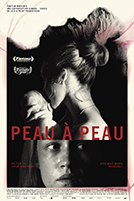
| With | Marie Bélanger, Saladin Dellers, Simon Landry-Desy, Alex Lauzon, Rose-Marie Perreault |
| Runtime | 103 minutes |
| Release | Release date unknown |
| Original title | Peau à Peau |
| Rating | 7/10 |
Haunted by her sister's horrific death, a young mother suffering from insomnia sinks into postpartum depression
The review
By Mulder 2025-09-22
Nesting (Peau à Peau), Chloé Cinq-Mars's first feature film, is a psychological thriller of rare intensity, both intimate and universal. Inspired by her own experience of unexpected postpartum depression, the director constructs a narrative that eschews clichés to venture into the gray area where motherhood becomes a terrain of loneliness and intimate terror. From the very first images, the film establishes an atmosphere that is both familiar and disturbing: that of a young mother, Pénélope, played with unsettling intensity by Rose-Marie Perreault, who discovers how loving a child can be inseparable from a deep sense of vertigo, a loss of self, and a constant fear of doing wrong.
One of the film's great strengths is its ability to blend raw realism with hallucinatory drifts. Chloé Cinq-Mars does not shy away from the most concrete details of motherhood: sleepless nights, painful cracks, physical and mental exhaustion. But she intertwines them with disturbing visions that reflect Pénélope's fragile psychological state. A nighttime walk, intended to calm her infant, turns into a horror story when she witnesses a robbery at a neighborhood grocery store. The shock is all the more unbearable because she recognizes the attacker: her own sister, Marie Bélanger. This event triggers a cascade of hallucinations and traumatic memories that interfere with her perception of the present, blurring the line between reality and nightmare.
The character of Pénélope thus takes shape before our eyes as a complex figure, both victim and perpetrator. Her sometimes reckless actions—leaving her baby alone for too long, putting him on the floor or forgetting him in a car—do not make her a bad mother, but a woman in the process of falling apart. Rose-Marie Perreault embodies this paradox with striking physicality: her cries, her moments of absence, but also her rare moments of joy, such as the moving sequence where she dances at a party before being brutally brought back to her obligations by her son's cries. Her performance illustrates how motherhood can be experienced as a succession of interrupted vital impulses, a struggle to exist beyond the child while being entirely defined by him.
The role of her partner, Gaspard, played by Simon Landry-Désy, accentuates this feeling of isolation. A musician absorbed in his evenings out and his refusal to see the gravity of the situation, he embodies that masculine presence that is both close and distant, a symbol of a society quick to judge but slow to support. Gaspard's mother, too, is of no help, preferring to reproach Penelope for her inability to feed her baby properly rather than offering her practical support. These secondary characters create an environment saturated with judgments and useless advice, pushing the young woman into a growing psychosis.
The success of Nesting (Peau à Peau) also rests on Chloé Cinq-Mars' sensory direction. Far from succumbing to the easy options of a purely realistic film or a supernatural narrative, the filmmaker opts for a hybridization of genres. The reflections, the saturated light, the insistent presence of rats that Penelope thinks she hears, and the choreographed sequences in which she seems to split in two, create an oppressive immersion. The viewer literally shares her vertigo, feeling in their own body this descent into psychosis. This visual and auditory approach, which constantly blurs the lines, makes tangible the idea that maternal isolation can lead to an altered perception of reality.
This aesthetic choice is no accident: Chloé Cinq-Mars herself has experienced this distress, and her film conveys the impossibility for a mother to ask for help without fear of being judged or even losing her child. One of the most striking lines in the film is the question Penelope asks her doctor: “Are you going to take him back?” The anxiety of not being judged capable of caring for her baby weighs heavily on her mind, preventing her from verbalizing her suffering. In this sense, the film has political significance: it reminds us that protecting children cannot be done without caring for mothers, a truth that is too often forgotten in public discourse.
It is therefore understandable why Chloé Cinq-Mars was keen to surround herself with collaborators who were equally sensitive to these issues, such as director of photography Léna Mill-Reuillard and art director Laura Nhem, who helped to create a deeply empathetic visual and sensory universe. It is no coincidence that the director had already explored fragile territories in La coupure (The Cut) and in her work as a screenwriter on Dérive (Drift). But here, the approach takes on a more intimate, almost therapeutic dimension, as it is also a story of forgiveness towards herself and reconciliation with an experience she lived through as a trauma.
Beyond its dramatic intensity, Nesting (Peau à Peau) is part of a lineage of contemporary psychological films that question the relationship between reality and perception, from Knocking to Censor. But what sets it apart is its raw sincerity, fueled by real-life experience and transposed into a fiction that speaks as much about motherhood as it does about sisterhood, as much about survival as it does about memory. While its ending may seem predictable, the essence lies elsewhere: in the journey, in Chloé Cinq-Mars's way of giving substance to invisible pain and offering it up to the collective gaze. The result is a film that haunts you long after the screening, not because of its horrific effects, but because of its emotional truth.
Nesting
Written and directed by Chloé Cinq-Mars
Produced by Nicolas Comeau, Jean-Marc Fröhle
Starring Marie Bélanger, Saladin Dellers, Simon Landry-Desy, Alex Lauzon, Rose-Marie Perreault
Cinematography:
Edited by Elric Robichon
Music by Nicolas Rabaeus
Production companies: 1976 Productions, Point Prod
Distributed by NC
Release dates: NC
Running time: 103 minutes
Seen on September 22, 2025 (press screener Fantastic Fest 2025)