

Beast of War
Directed by Kiah Roache-Turner (2025)
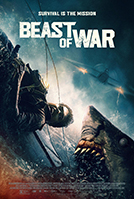
| With | Mark Coles Smith, Joel Nankervis, Sam Delich, Lee Tiger Halley, Sam Parsonson, Steve Le Marquand, Masa Yamaguchi, Lauren Grimson, Matthew Scully, Denny Bernard, Laura Brogan Browne, Jay Gallagher, Aswan Reid, Maximillian Johnson, Tristan McKinnon |
| Runtime | 87 minutes |
| Release | 2025-10-10 |
| Rating | 8/10 |
In 1942, Australian soldiers are stranded at sea. On their makeshift raft, they become prey to a great white shark.
The review
By Mulder 2025-09-20
Beast of War, directed by Kiah Roache-Turner, proves that even after decades of cinematic obsession with sharks, there are still fresh waters to explore. By anchoring his story in the very realistic context of World War II, Kiah Roache-Turner creates a survival thriller that transcends genres and is as dramatic as it is horrific. Inspired by the true and poignant story that influenced Steven Spielberg's legendary monologue about the Indianapolis in Jaws, the film immediately sets itself apart from its countless imitators by weaving a story where human conflict, colonial history, and the primal terror of the deep intersect in surprising ways. Its prologue unfolds like a classic war movie, anchoring the characters in camaraderie, prejudice, and youthful bravado before the ocean itself becomes their deadliest battlefield.
At the heart of the story is Leo, played with remarkable depth by Mark Coles Smith, whose presence lends the film both grit and emotion. Leo is not simply an archetypal soldier; he is a First Nations man burdened by trauma, the racism of his peers, and a complicated history with the sea. In an early scene, his moral strength is highlighted when he saves the timid Will, played by Joel Nankervis, from drowning during training. This moment of humanity cements Leo's role as the reluctant leader of the group, even as he is constantly targeted by Des, the venomous fanatic played with sharp cruelty by Sam Delich. Their antagonism, rooted in deep societal wounds, becomes more than just a clash of personalities; it reflects the hypocrisy of a country willing to exploit Aboriginal soldiers while denying them their basic rights. Kiah Roache-Turner uses this tension to infuse the narrative with a subtext often absent from creature films, reminding viewers that the deadliest predators are not always found in the water.
Once the soldiers' ship is decimated by Japanese fighter planes and the survivors are abandoned in the Timor Sea, Beast of War turns into a claustrophobic nightmare. The men cling to a 20-square-meter piece of debris, rationing their fish and clutching their rifles, while fog and isolation amplify their despair. Here, the artistic talent of cinematographer Mark Wareham takes center stage, draping the sea in crimson and metallic hues, evoking both gothic horror and the haunting despair of Théodore Géricault's The Raft of the Medusa. When the shark finally reveals itself, it is not just another CGI-created ghost with sharp teeth, but a full-fledged animatronic creation by Steve Boyle of Formation Effects, with scars and milky eyes that suggest a violent past. The sight of this physical beast emerging through the fog and fragmented light is thrilling in its tactile quality, a deliberate return to the tangible menace of Jaws.
Kiah Roache-Turner understands restraint. The shark is rarely overexposed, and when it attacks, it is framed in unsettling close-ups showing its grinding jaws or sudden, brutal bites that leave limbs floating in the water. These moments are particularly effective because the director takes the time to present the men as more than just disposable bait. Characters like Thompson, played by Sam Parsonson, who suffers from a head injury that clouds his judgment, or wide-eyed Will, add an extra dimension to the struggle for survival. The attacks then become not just spectacle, but also jarring punctuations in a slow descent into despair. There is even an unforgettable moment when a broken air raid siren becomes fused to the shark's fin, turning each approach into a banshee-like omen of doom. It's a macabre stroke of genius, both surreal and terrifying, that highlights Kiah Roache-Turner's talent for reinventing the conventions of the genre.
Despite its darkness, Beast of War is not without humor. In the purest Australian tradition, black humor permeates the dialogue, whether in Leo's bravado or in the sarcastic nicknames the men give their tormentor, “Shazza.” These moments of levity serve as a reminder of the absurdity of survival itself: jokes told on the brink of death, nerves on edge as bullets, sharks, and fanaticism surround them. One particularly daring sequence, in which a soldier desperately tries to improvise a way to hydrate himself, provoked bursts of laughter during festival screenings, proving that Kiah Roache-Turner has not lost his ability to mix gore and trashy humor, as he did in Wyrmwood. These confidently handled shifts in tone make the film as entertaining as it is poignant, even when blood and organs are splattering freely across the screen.
The historical context adds another dimension to the film. While shark attacks play a prominent role in the narrative, the film never lets us forget the injustice suffered by Aboriginal soldiers like Leo, who fought and shed their blood for a country that treated them as second-class citizens. In this sense, Mark Coles Smith's performance goes beyond the simple heroism typical of the genre: it sheds light on a story often obscured by colonial narratives. Seeing Leo endure, lead, and outwit both men and beasts is an act of cinematic justice, highlighting the resilience of a people denied recognition. Combined with the relentless spectacle of gore and suspense, this element elevates Beast of War from mere pulp to something resonant and enduring.
One of the film's greatest achievements is its balance. Although much of the film takes place on a simple raft in the middle of nowhere, Beast of War never feels small. Kiah Roache-Turner and editor Regg Skwarko inject dynamism into every frame, alternating between quiet moments of paranoia and sudden explosions of violence, never letting the tension dissipate. The film runs for 87 minutes, a brevity that works in its favor; it strikes quickly, hard, and without mercy, much like the shark itself. Every death matters, every sacrifice is memorable, and when the survivors fight their final battle, the audience feels every ounce of exhaustion and terror with them.
Beast of War succeeds because it dares to embrace contradictions: it is at once raw and poetic, pulp and profound, rooted in history and fantastically surreal. Kiah Roache-Turner has crafted a war movie disguised as a shark thriller—or perhaps the reverse—that refuses to treat its characters as cannon fodder. Instead, it marries the chaos of battle with the terror of the ocean, offering a nightmarish reflection on the fragility of humanity. For fans of shark movies, it's the most exciting addition to the genre since Jaws. For those drawn to stories of resilience and injustice, it's a brutal reminder that sometimes the scariest thing about the ocean isn't what swims beneath it, but what it reveals about us.
Beast of War
Written and directed by Kiah Roache-Turner
Produced by Chris Brown, Blake Northfield
Starring Mark Coles Smith, Joel Nankervis, Sam Delich, Lee Tiger Halley, Sam Parsonson, Maximillian Johnson, Tristan McKinnon, Steve Le Marquand, Masa Yamaguchi, Lauren Grimson, Matthew Scully, Denny Bernard, Laura Brogan Browne, Jay Gallagher, Aswan Reid
Cinematography: Mark Wareham
Edited by Kiah Roache-Turner, Regg Skwarko
Production companies: Bronte Pictures, Pictures in Paradise
Distributed by Well Go USA Entertainment (United States)
Release dates: October 10, 2025 (United States)
Running time: 87 minutes
Seen on September 20, 2025 (press screener Fantastic Fest 2025)