

Coyotes
Directed by Colin Minihan
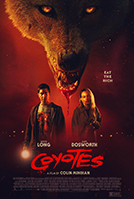
| With | Justin Long, Kate Bosworth, Mila Harris, Katherine McNamara, Brittany Allen, Keir O'Donnell, Norbert Leo Butz |
| Runtime | 91 minutes |
| Release | Release date unknown |
| Rating | 8/10 |
Trapped in their Hollywood Hills home, a family fights for survival, caught between a devastating wildfire and a pack of wild coyotes.
The review
By Mulder 2025-09-20
Colin Minihan opens the film Coyotes with a sly smile and a wink, shifting from a Hollywood prologue steeped in vanity to opening credits peppered with incendiary public service announcements, as if to warn us that the city's bubble of wealth is about to collide with the indifference of nature. The premise is deliriously simple and effective: as Santa Ana winds sweep across the Hollywood Hills and embers lick at the ridges, a pack of desperate coyotes invades a gated haven where a family has convinced itself that acreage can buy safety. Inside this sanctuary of glass and polished concrete, comic book artist Scott (Justin Long), his wife Liv (Kate Bosworth), and their daughter Chloe (Mila Harris) are holed up, already exhausted by work, parental drift, and the kind of petty resentments that tend to flare up when the power goes out and the car, despite the untrimmed branches, lies crushed in the driveway. What unfolds is a hybrid of a monster movie and a siege film that maintains a steady pace of gags and gore, alternating between tense scenes and moments of character banter, until the film finds a frenetic rhythm that feels like both a home invasion and nature striking back.
What makes the human side convincing is the energy between Justin Long and Kate Bosworth, a chemistry that allows the film to shift smoothly from criticism to solidarity. Justin Long draws on his specialty, men whose confidence evaporates when faced with a crisis, playing Scott, an unlucky improviser who keeps finding solutions that are just plausible enough to try (a homemade coyote cage, which basically looks like a shark diving suit, is an inspired piece of madness) and just stupid enough to backfire with burlesque precision. Liv, played by Kate Bosworth, is the emotional pillar of the household and discreetly occupies the heroic center of the film. She is the one who watches the storms and the neighbors and understands that the enemy is not only on the lawn. Their daughter, played with a spark of irony by Mila Harris, boils with generational contempt, then pierces it with flashes of courage that seem deserved rather than manufactured. Gravitating around them is a chorus of comic characters and collateral damage: Devon, the irritable exterminator, whose survivalist arrogance is embodied by Keir O'Donnell as a punchline ready to explode; Trip, the shady peacock neighbor, to whom Norbert Leo Butz breathes a hilarious mixture of bravado and fragility; and Julie, the sex worker who refuses to remain a punchline, with Brittany Allen finding warmth and timing in a role that could easily have been a malicious facade. Even the pre-credits cameo by influencer Katherine McNamara as an It Girl mythologizing herself as she walks a small dog to its fate strikes the right tone: biting, caricatural, and just credible enough to sting.
Technically, the film has more impact than its footprint, thanks to meticulous set design and deliberate camera strategies that transform the house into a maze, a trap, and ultimately a weapon. The comic book inserts—frozen images representing the characters, rendered in the style of Ben-Day dots—function both as a flourish in the film's universe and as a tonal thesis, heralding an exaggerated register where bad decisions become a kinetic grammar and timing is king. This same commitment is found in the design of the murders: we are treated to punchlines, surprising twists, and visual gags that intensify just when the film threatens to stagnate. The practical consequences are convincing, and when the film lets shadow and suggestion do most of the work, the animal threat comes into play. The pace of the editing combines with the blocking to transform ordinary domestic spaces—stairwells, long kitchens, cat flaps—into engines of suspense. You can feel the film smiling as it uses a patio grill, a fallen tree, and a garage door sensor as weapons with the same glee that a Rube Goldberg machine reserves for bowling balls and marbles.
And yet, the coyotes themselves are both the film's strength and its weakness. When we see them in motion, half-lit and leaping, they are believable enough to trigger an instinctive reaction; when the film lingers, the digital rendering becomes visible and the seams show. The faces, frozen in a perpetual grimace, can seem overly modeled and strangely shiny, inviting the kind of reflection that the filmmakers are trying to avoid: are these low-budget special effects or generative shortcuts? The film is at its best when it treats the animals as a coordinated force—eyes in the dark, claws at the threshold—relying on pack behavior and choreography rather than the fidelity of close-ups. Less would have been better. But the cartoonish aspect also has a sneaky advantage: by keeping the creatures just this side of unreal, the film frees up its comedy to be broader and its gore to be more zany without becoming sickening. That's why a “close the dog door” moment can play as both an audience joke and a structural joke, and why a late escalation—Scott confronting the pack in his absurd cage—is met with applause rather than a collapse of credibility.
Thematically, Coyote" exploits several veins without hammering any of them home. There's a pulse of ecological horror—wildfires push wildlife into human corridors; humans are then surprised when nature refuses to respect property lines—that presents the chaos of the night as a byproduct of climate-fueled feedback loops. There's also a reference to “eating the rich” that hangs in the air, less acerbic than the slogan suggests, and manifests itself primarily as a class texture: the influencer who opens the film, the neighbor in his bathrobe, rich but clueless, the luxury fortress that turns into a secure room. The screenplay by Tad Daggerhart, Nick Simon, and Daniel Meersand favors wit over sermonizing; its most striking thread is domestic, not didactic. Scott's obsession with deadlines, Liv's ignored warnings, Chloe's mortified distance... All of this builds up under the seat until the film's real argument emerges: comfort is a fragile plan, and attention is a form of love. When this clicks, “Coyotes” shifts from a simple sarcastic engine to a film that appeals to the audience, not because it discovers depth, but because it finds a solid backbone beneath the splashes.
What ultimately remains are the textures of the film: the crackling of Santa Ana winds in a dead-end street without electricity; the sound of claws on tile that transforms a designer kitchen into a killing box; the way the comic book splash panel introduction pays off a few hours later when a character we had half dismissed turns out to be important. There's a terrific gag in the middle of the film involving a grill that goes from don't do that to oh no, they did it in three well-paced stages; there's an insignificant exchange between Brittany Allen and Norbert Leo Butz that presents them as more than just pawns; and there's a moment—if you blink, you'll miss it—where Mila Harris plays embarrassment with such precision that it becomes an obstacle to survival, a small truth within a larger absurdity. Even a much-mocked device like the DIY cage pays off, because the film understands the mathematics of a midnight audience: give them something ridiculous and let the blockage highlight it. If the visual effects had matched the ingenuity of the direction, we'd be talking about a minor classic. As it stands, “Coyotes” stands out as a loud, raw film, bloody enough to satisfy, funny enough to share, and specific enough in its family heart to rise above the meme of its own premise.
Admittedly, the coyotes often look like digital ghosts, and some of the jokes are tinged with early 2000s sarcastic irony; tighter control of the frontal shots of the beasts would have greatly enhanced the scare factor. But the confidence of the film's tone—the way Colin Minihan mixes panic and gags, and trusts Justin Long, Kate Bosworth, and Mila Harris to find the humanity amid the howling—wins the day. In a year crowded with man-versus-nature films, this one remembers the cardinal rule of midnight movies: build momentum, make the audience complicit in the screams and laughter, and leave them discussing that incredible sequence that somehow worked in the parking lot. In that regard, Coyotes doesn't just survive, it bares its teeth and smiles.
Coyotes
Directed by Colin Minihan
Written by Tad Daggerhart, Nick Simon
Story by Nick Simon, Daniel Meersand, Tad Daggerhart
Produced by Nathan Klingher, Ford Corbett, Joshuah Harris, Jib Polhemus
Starring Justin Long, Kate Bosworth, Mila Harris, Katherine McNamara, Brittany Allen, Keir O'Donnell, Norbert Leo Butz
Cinematography: Bradley Stuckel
Edited by Colin Minihan
Music by Brittany Allen
Production companies: Gramercy Park Media, Source Management Production
Distributed by Aura Entertainment (United States)
Release dates: September 20, 2025 (Fantastic Fest), October 3, 2025 (United States)
Running time: 91 minutes
Seen on September 20, 2025 (press screener Fantastic Fest 2025)