

Lucky Lu
Directed by Lloyd Lee Choi
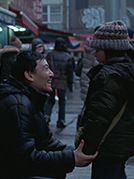
| With | Chang Chen, Fala Chen, Carabelle Manna Wei |
| Runtime | 103 minutes |
| Release | Release date unknown |
| Rating | 7/10 |
Lu, who arrived in New York from China with dreams of opening his own restaurant, quickly sees his hopes dashed, leaving him mired in debt and invisible odd jobs. One morning, his wife and daughter, whom he hasn't seen in years, join him, hoping to rebuild a life with him. So, for a few days, Lu tries to give them a moment of happiness and rekindle the light of a possible future.
The review
By Mulder 2025-09-12
Lucky Lu, the first feature by Korean-Canadian filmmaker Lloyd Lee Choi, is a quietly devastating yet deeply humane drama that had its premiere in the Directors’ Fortnight at Cannes. Much like the Italian neorealist classic Bicycle Thieves, to which it openly tips its hat, the film takes a simple premise—an immigrant delivery worker in New York loses his electric bike—and unfolds it into an unflinching portrait of labor, dignity, and survival in a city that seems to swallow people whole. Yet what distinguishes this film from both its inspirations and its contemporaries is the way Lloyd Lee Choi refuses to give in to melodrama. He grounds his story in restraint, minimalism, and raw sincerity, always respecting the humanity of his characters and, by extension, the countless real people who share their struggles.
At the center of the story is Chang Chen, delivering one of his most understated yet affecting performances to date. Known to international audiences for his collaborations with Wong Kar-wai and Ang Lee, Chang Chen embodies Lu, a Chinese immigrant who has spent five years toiling in New York as a food deliveryman. His days are marked by a relentless routine: weaving through traffic on his e-bike, handling rude customers, and stealing small moments of solitude with a cigarette. What keeps him going is the promise of reunion—his wife Fala Chen and young daughter Carabelle Manna Wei are finally joining him after years apart. He tours an apartment, records a hopeful video for them, and dares to imagine stability. But in the city that never sleeps, even that fragile thread of optimism is brutally severed. When Lu’s bike is stolen, the theft becomes more than a logistical setback—it’s a fracture in the very foundation of his American dream.
From this moment, the narrative spirals into a desperate two-day odyssey. Lu begs friends for loans, visits shady Chinatown brokers, pawns what little he owns, and even contemplates stealing another bike. Lloyd Lee Choi makes it clear that this isn’t just Lu’s story but a reflection of thousands of immigrant workers whose labor underpins the convenience of modern urban life. A line from one of Lu’s friends cuts especially deep: “This is not our home. We can only work for other people here.” It is not shouted, merely spoken, but the weight of resignation it carries resonates through the film. Unlike other portrayals of immigrant hardship that veer into poverty porn, Lloyd Lee Choi shows restraint—he neither glorifies nor exploits Lu’s pain, instead presenting it with a clarity that feels both cinematic and brutally authentic.
The cinematography by Norm Li is a key part of that authenticity. Shot on real Manhattan streets, the film strips away the postcard sheen of New York and replaces it with steel, brick, and shadows. Norm Li frames Lu through windows, alleyways, and cramped hallways, emphasizing his isolation in a city teeming with life yet devoid of warmth. In one poignant sequence, after Lu’s daughter Yaya arrives, she wanders into an open house for a multimillion-dollar brownstone, marveling at the polished opulence before quietly slipping a watch into her pocket. It’s a startlingly subtle moment, suggesting the child’s awareness of her father’s desperation and her willingness to take risks he cannot. The contrast between that gilded space and the garbage-strewn streets Yaya notices upon arrival highlights the cruel disparities immigrants confront when they step into America with dreams of reinvention.
As a character study, the film succeeds in large part because of the performances. Chang Chen conveys so much with silence—his gaunt frame, his exhausted eyes, his hunched posture, each gesture revealing a man fraying at the seams but unwilling to let his family see him broken. Opposite him, Carabelle Manna Wei delivers an intuitive performance that belies her youth. Her Yaya is playful but perceptive, sensing more than her father wants to admit, and the tenderness of their bond provides the film’s most wrenching moments. Fala Chen, though underutilized, brings grace and quiet strength to Si Yu, Lu’s wife, hinting at the sacrifices she too has endured offscreen. Together, the three form a fragile constellation of love and survival that anchors the film’s emotional core.
What gives Lucky Lu its staying power is its exploration of luck itself. For much of the film, the title feels cruelly ironic, as every attempt Lu makes to regain control slips further from his grasp. Yet in its final passages, Lloyd Lee Choi reframes luck not as financial salvation or a miraculous turnaround, but as something quieter and more enduring. Luck, in Lu’s case, becomes the embrace of his daughter, the presence of his family at his side, and the flicker of resilience that allows him to continue despite systemic indifference. In this way, the film resonates beyond its narrative—it becomes a meditation on what survival means in a world that too often equates worth with wealth.
Behind the scenes, it’s telling that no fewer than twenty-two producers and executive producers, including Forest Whitaker, were involved in bringing this modestly scaled film to life. In today’s cinematic landscape, where independent films struggle for financing and distribution, the collaborative effort to get Lucky Lu made mirrors the communal endurance of the characters it portrays. That the film emerged at Cannes, amidst a festival that thrives on thematic echoes across its sections, is fitting; Lucky Lu converses not only with classics like Bicycle Thieves but also with contemporary immigrant stories such as Shih Ching-Tsou and Sean Barker’s Take Out. Yet it does so with its own quiet defiance, refusing to let despair eclipse dignity.
Lucky Lu is not a film of triumph, nor is it one of absolute tragedy. It lingers in the in-between space where most lives unfold: in compromise, in small acts of endurance, in the bittersweet recognition that survival itself can be a form of victory. Lloyd Lee Choi’s debut suggests that while the American dream may remain elusive, the love of family and the ability to keep moving forward—bike or no bike—might just be the only luck worth holding on to. This is a film that not only shines a light on invisible lives but insists we truly see them, and in doing so, it earns a place among the most resonant immigrant dramas of recent years.
Lucky Lu (Les Lumières de New York)
Written and directed by Lloyd Lee Choi
Based on Same Old by Lloyd Lee Choi
Produced by Destin Daniel Cretton, Nina Yang Bongiovi, Asher Goldstein, Tony Yang, Ron Najor, Jeyun Munford
Starring Chang Chen, Fala Chen, Carabelle Manna Wei
Cinematography : Norm Li
Edited by Brendan Mills
Music by Charles Humnery
Production companies : Significant Productions, Cedar Road, Hisako Films, Gold House, Big Buddha Pictures Release date : May 19, 2025 (Cannes)
Running time : 103 minutes
Seen on September 12 2025 at the Deauville International Center