

Viktor
Directed by Olivier Sarbil
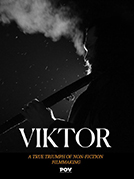
| Runtime | 89 minutes |
| Release | Release date unknown |
| Rating | 7/10 |
Viktor, a young deaf man living in Kharkiv, anxiously witnesses the early days of the Russian invasion of Ukraine. Fascinated by samurai films and nourished since childhood by stories of war, he dreams of becoming a fighter but is repeatedly rejected from enlistment. In search of meaning, Viktor tries to find his place in the heart of a war he cannot hear.
The review
By Mulder 2025-09-14
In a landscape already crowded with documentaries chronicling the devastation of the ongoing war in Ukraine, Olivier Sarbil’s Viktor stands out as an astonishingly intimate and profoundly human portrait. At once elegiac and defiant, the film frames its titular subject not as a victim of circumstance but as a man determined to define his place in a world that persistently tries to marginalize him. The fact that Viktor Korotovskyi has been Deaf since the age of five does not deter him from aspiring to serve his country. What makes the documentary compelling is not just the recounting of his struggle but the way it draws us into his inner world—visually, sonically, and emotionally—inviting us to experience war through his unique perspective.
The opening passages, set in Kharkiv as Russian forces barrel into Ukraine in February 2022, immediately set the tone. We find Viktor practicing with a katana in his backyard, observed with quiet resignation by his mother. His love of Japanese samurai philosophy, particularly Miyamoto Musashi’s The Strategy of the Samurai, feels almost quixotic, yet it is more than affectation; it is his code of living. He clings to a notion of “military spirit” instilled in him by his late father, channeling that legacy into rituals of discipline. This fusion of old-world martial tradition with the harsh reality of modern war gives the film a texture that is both poetic and unsettling. The allusion to Jim Jarmusch’s Ghost Dog is not misplaced—Viktor is cast as a modern warrior without an army, caught between performance and practice, embodying a role that society refuses to grant him in earnest.
What truly elevates Viktor is Olivier Sarbil’s eye as both director and cinematographer. His monochrome palette mirrors Viktor’s own affinity for black-and-white photography, creating a unity between subject and filmmaker that feels organic rather than imposed. The aesthetic rigor is further enhanced by the participation of producers like Darren Aronofsky, who has long explored the tension between realism and surrealism. Yet Olivier Sarbil never allows style to overtake substance; rather, the stark images deepen our understanding of Viktor’s place in this fractured world. When Viktor is finally accepted by a local unit—not as a soldier, but as a war photographer—his camera becomes both weapon and shield, a tool of documentation and survival. His images may not sell to international outlets drowning in war coverage, but within the framework of the film, they take on an indelible weight: slices of silence frozen in time.
Equally crucial to the documentary’s impact is its sound design. Handled by Nicolas Becker, Heikki Kossi, and Peter Albrechtsen—the same team behind Darius Marder’s Sound of Metal—the audio landscape immerses us in Viktor’s fractured hearing. Sounds are muted, distorted, and re-layered through unconventional methods, including the use of hearing aids and stethoscope microphones, to replicate Viktor’s perception of the world. Silence here is not emptiness; it is presence. It is his constant companion, shaping his identity as much as his isolation. This interplay between silence and war’s cacophony produces a chilling irony: soldiers often cannot hear commands on the battlefield either, yet Viktor’s deafness is used as the reason to exclude him. In one poignant sequence, Viktor comforts a soldier who has just lost his hearing, offering him words of resilience that blend seamlessly with the strains of a Ukrainian folksong. It is moments like this where the film transcends reportage and approaches something universal, a meditation on adaptation, survival, and human dignity.
Beyond the visceral elements, Viktor probes the complex social and cultural layers of Ukraine itself. Growing up in Kharkiv, Viktor’s native tongue is Russian, and while he copes through lip reading and limited Ukrainian, miscommunication often compounds his sense of displacement. In one telling moment at the frontlines, he struggles to follow his comrades’ rapid Ukrainian speech, highlighting the civil fractures that underlie the war. Such details are not mere background—they subtly reveal the centuries of linguistic and political tension in the region, woven into the very fabric of Viktor’s personal journey. This duality, being both insider and outsider, mirrors his position in the war effort itself: indispensable yet always on the margins.
The film is not without moments of uplift, though they are hard-earned. Around thirty minutes in, Viktor finally smiles—a gesture loaded with meaning after prolonged stretches of frustration and despair. The joy he finds in simply contributing, in communicating with soldiers and capturing images of resilience, is deeply affecting. Yet Olivier Sarbil resists sentimentalism. He shows us Viktor’s heartbreak when his request to officially join the fight is dismissed, despite demonstrating sharpshooting skills that surprise even seasoned trainers. His argument—that battlefield chaos renders most soldiers partially deaf anyway—falls on deaf ears, a cruel irony not lost on him or the audience. Instead, he is left to forge his own path, finding ways to serve his community through food drives, aid missions, and the documentation of ordinary people enduring extraordinary hardship.
What lingers most after Viktor is not its documentation of war but its insistence on reimagining what participation, resistance, and strength can mean. Viktor may never don the uniform he dreams of, but his role as a chronicler and compassionate presence is no less vital. His katana routines, his photographs, his tender interactions with strangers—all become extensions of his warrior spirit, reframed for a world that denies him the battlefield. In the end, Viktor’s silence becomes his strength, a means of perceiving truths that others might miss in the chaos of war.
Viktor is, therefore, both a documentary about a man and a philosophical reflection on resilience in the face of systemic exclusion. Olivier Sarbil crafts not only a story of personal struggle but also an allegory for the broader fight of Ukraine itself—undermined, underestimated, yet enduring. Through its fusion of striking visuals, inventive soundscapes, and a protagonist whose mere existence challenges conventional definitions of strength, the film emerges as one of the most vital works of non-fiction cinema in recent memory. It is not just about a man named Viktor; it is about the universality of finding purpose in a world determined to silence you.
Viktor
Directed by Olivier Sarbil
Produced by Darren Aronofsky, Dylan Golden, Brendan Naylor, Sigrid Jonsson Dyekjær, Philippe Levasseur, Olivier Sarbil
Music by Disasterpeace
Cinematography: Olivier Sarbil
Edited by Atanas Georgiev
Production companies : Protozoa Pictures, Real Lava, Newen Studios, Time Studios, Impact Partners
Running time: 89 minutes