

Lowland Kids
Directed by Sandra Winther
| Runtime | 94 minutes |
| Release | Release date unknown |
| Rating | 7/10 |
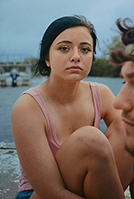
As climate change erases the Louisiana coast, the last two teenagers on Isle de Jean Charles fight to stay on an island that's been in their family home for generations.
The review
By Mulder 2025-09-14
Lowland Kids is the kind of documentary that immediately feels both intimate and universal, a portrait of a small, seemingly forgotten place that suddenly reveals itself as a microcosm of our global future. Directed by Sandra Winther, the film takes us deep into the Louisiana bayou, to Isle de Jean Charles, a patch of land that has lost almost all of its mass over the past six decades. This is not simply a story about a community facing relocation; it is a meditation on belonging, resilience, and the heartbreaking collision between tradition and climate change. What distinguishes this documentary is the way Sandra Winther avoids the didactic tone often found in environmental storytelling, instead weaving a lyrical tapestry of everyday life, shot over six years, that makes the Isle and its people feel not like statistics, but like family.
At the heart of the film are two siblings, Howard and Juliette, teenagers who lost their parents to addiction and were left in the care of their uncle Chris, a wise man bound to a wheelchair but far from diminished in presence. Their lives, which unfold amidst rivers, marshes, and skies painted with honey-colored sunsets, are marked by a kind of freedom that feels rare in today’s world. They live in a place where the border between land and water is blurred, where you can jump into the bayou and disappear into nature’s embrace. The cinematography by Andrea Gavazzi captures this sensation with a glow reminiscent of Beasts of the Southern Wild, where every frame carries both the majesty and fragility of this environment. Yet it is the children’s bond that resonates most deeply—two inseparable souls clinging to each other as the ground beneath them quite literally disappears.
What gives Lowland Kids its power is the way it situates the human story within the broader forces reshaping the world. The Isle de Jean Charles has always been vulnerable, battered by hurricanes that roll in from the Gulf. But climate change has sharpened the blows, with storms like Hurricane Ida in 2021 wreaking devastation at an intensity that now feels insurmountable. Layered over this natural violence are the scars left by the oil and gas industry. Navigation canals carved into the wetlands allowed saltwater intrusion, poisoning the soil and accelerating erosion. It’s almost tragic to realize that a community that has lived “with one foot on land and one in the water,” as Chris so evocatively puts it, now finds itself at the mercy of both human exploitation and planetary shifts. The island has lost 98% of its land mass, a number so staggering it becomes hard to imagine a future that does not involve leaving.
But leaving is never just about geography. Lowland Kids insists that Isle de Jean Charles is more than a place on a map; it is a web of relationships, traditions, and an Indigenous identity rooted in the Jean Charles Choctaw Nation. The film lingers on the sense of community that defines life here, the way people treat neighbors as kin, the unwritten rule that if someone is your father’s friend, they are your family too. It is this sense of solidarity that gives the Isle its soul, and the documentary raises a haunting question: can such spirit survive relocation? The government’s promise of federally funded new housing offers security against floods, but it also threatens to dismantle the very fabric that has held this community together for generations. Watching Howard and Juliette grapple with this reality, torn between their love of home and the inevitability of its vanishing, is to witness the quiet grief of climate displacement.
There is also something profoundly moving in how the film, despite its heavy subject, never loses sight of the magic in its characters’ lives. We see Howard fishing with ease, Juliette laughing as she speeds across the water, and Chris offering words of wisdom that anchor the children when storms—literal and metaphorical—hit hardest. These moments of lightness, often bathed in golden light, are reminders of why this land matters, of why it is worth mourning. The Isle is not just a casualty of rising seas; it is a place that has given meaning, belonging, and resilience to its people.
The film’s production history adds another layer of resonance. Sandra Winther had already explored these lives in her award-winning 2019 short, also titled Lowland Kids, and her return in feature-length form feels like a deepening rather than a repetition. With Darren Aronofsky among the producers, the project carries both artistic prestige and the potential for wider recognition, particularly in an awards season increasingly attentive to stories of environmental urgency. Yet what sets it apart from other documentaries in this space is its poetic intimacy. Lowland Kids does not overwhelm the viewer with data or policy; instead, it invites us to sit at a kitchen table, to ride a boat through flooded reeds, to listen as a young girl wonders whether the future can hold anything as beautiful as the life she knows.
Lowland Kids is not just about Isle de Jean Charles; it is about every community on the edge of vanishing, from Pacific islands to Arctic villages. But what makes it unforgettable is its refusal to let its characters become symbols. Howard, Juliette, and Chris are not statistics in a climate report; they are children navigating grief, an uncle embodying resilience, and a family that insists on dignity even in the face of erasure. Watching them, one realizes that climate change is not an abstract future threat—it is here, it is personal, and it has names and faces. That is the lasting achievement of Sandra Winther’s luminous debut: to make us feel the loss before it happens, and to remind us that what is at stake is not simply land, but love, identity, and the very possibility of belonging.
Lowland Kids
Written and directed by Sandra Winther
Produced by William Crouse
Music by Katya Mihailova
Cinematography: Andrea Gavazzi
Edited by Eva Dubovoy, Per K. Kirkegaard
Production companies : Willy Bob Films
Running time: 94 minutes