

Kim Novak’s Vertigo
Directed by Alexandre O. Philippe
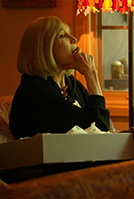
| Runtime | 77 minutes |
| Release | Release date unknown |
| Rating | 8/10 |
Explores Kim Novak's life, highlighting her role in Alfred Hitchcock's Vertigo, and her journey from stardom to a reclusive life as an artist in Oregon, using rare archival footage and Novak's own reflections.
The review
By Mulder 2025-09-06
Kim Novak’s Vertigo, directed by Alexandre O. Philippe, opens not with thunderous proclamations about cinema history but with the tremor of a voice note, the kind of private message that instantly collapses the distance between subject and spectator and signals the film’s governing concern: authenticity. At 92, Kim Novak speaks in a register that is neither defensive nor nostalgic; she is measured, wary of performance even as the camera inevitably invites it, and intent on naming the lifelong tension between being looked at and being known. The documentary’s stated object is her most totemic role in Alfred Hitchcock’s Vertigo, but its true subject is the long afterlife of being made into an image, and the stubborn work of reclaiming a self from a system built to rename, repackage, and resell it. Born Marilyn Pauline Novak to Czech parents and rebranded “Kim” by Columbia’s imperious boss Harry Cohn—who, in a telling snapshot of the era’s brutality, derided her with a racist epithet—the actress learned early that the commodity called Kim Novak was negotiable; the person behind it was not. The film turns that friction into its engine, letting Kim Novak choose the tempo as she toggles between memory and reflection, moving from studio-era demands to the psychic vertigo of playing Judy masquerading as Madeleine, a performance that required her to become, in her own words, less an actor than a “reactor,” surrendering theatrical affect in favor of a dangerous, intimate vulnerability that still reads as modern.
The documentary’s rhythm is proudly discursive—less a straight line than a spiral, appropriately—and in those coils Alexandre O. Philippe finds a companion piece to Vertigo rather than an illustrated lecture about it. He resists the forensic close-reading style that made 78/52 such a thrill ride and instead constructs a chamber piece, attentive to silences and to the way Kim Novak threads her life through her work and back again. She remembers the breakneck acceleration of the studio system, the quicksilver transition from early vehicles like Picnic and Pal Joey to the taut composure of The Man with the Golden Arm and the stranger, darker lanes that opened toward Vertigo. She also remembers the psychic drafts those films pulled on her: the misfit sensation of practicing a naturalistic, inward-facing truthfulness in a decade addicted to sheen; the way directors like Joshua Logan could perceive the crown-of-thorns burden of being “pretty,” a marketable trait that could smother the very spontaneity that made her interesting; and the sickly pressure of being costumed—literally and figuratively—into a single, saleable idea. In that light, Vertigo is both summit and wound: the rare project that allowed her to interrogate the machinery of desire from the inside, and the one that etched its questions deepest into the person who had to live with the answers.
Nothing in the film captures that paradox more potently than the rediscovery of the gray Madeleine suit, a sequence that Alexandre O. Philippe elongates to the threshold of ritual because it is one. The garment that Alfred Hitchcock insisted upon—dowdy to her at the time, emblematic of control—emerges from its box soft and unfaded, a relic that seems to have absorbed not only the oils of skin and the scent of a set but the sediment of decades of interpretation. Watching Kim Novak lift it, press it to her face, and admit, “It’s part of me,” you feel the way costumes can become second skins, not because actors confuse themselves with characters, but because certain roles expose the secret architecture of a life. Madeleine was the mask Judy was forced to wear; Judy was the woman James Stewart’s Scottie tried to remake; and Kim Novak was the performer asked by a culture to be all things and no one at once. The suit houses all of that. It is fetish object, yes, but more urgently an archive of labor and a ledger of costs, and in this coda the documentary earns its lengthening hush: film history becomes tactile, the past not a museum but a room you can still enter.
Around that talismanic scene, Alexandre O. Philippe builds a portrait that mingles the cinephile’s curiosity with an interviewer’s patience, and though his deference can drift toward indulgence—speeches allowed to spool when a sharper cut might have concentrated their power—there is a moral logic to the looseness. To compress Kim Novak too neatly would risk repeating the very miniaturization the industry performed on her. Instead, the film gives space to her idiosyncrasies and to the lateral paths by which truth arrives: the detours into her Oregon home; the menagerie of animals that anchor her days; the paintings whose spirals and weather systems feel like subconscious sequels to Vertigo’s title sequence; the acknowledgement that a later diagnosis of bipolar disorder helped her understand the identity whiplash she felt inhabiting Judy/Madeleine. Even the painful 2014 return to the Oscars stage—greeted by ageist ridicule from tabloids and a former reality-TV mogul turned politician—hovers like a footnote that does not need to be underlined: misogyny mutates but it does not retire, and the grace of her response reads here as part of the larger project of refusing to be defined by other people’s gaze.
When the conversation tightens around Vertigo, the film is at its most transfixing, because Kim Novak’s reading of Judy’s inner weather is precise and unsentimental. In split-screen breakdowns and reflective voice-over, she charts the dread of walking toward James Stewart’s embrace as toward a second annihilation, and you can sense the private calculus that produced the performance’s strange electricity: the aloof, almost lunar stillness of Madeleine set against Judy’s raw, unguarded tremors. Without that dual register, the film’s last-act revelation would be merely clever; with it, Vertigo acquires the bruised humanity that makes the ending hurt. The documentary never pretends to be a “tell-all,” and it is right not to; gossip would only shrink a mystery whose power lies in what cannot be fully extracted. What we get instead is the actor’s craft explained from inside the membrane of memory, and it’s riveting—less a behind-the-scenes dossier than a field report on how a role colonizes the nervous system and, if you are not careful, stays.
If parts of the structure feel uneven, the tonal throughline remains strong: this is a film about a woman who declined the transaction that would have prolonged her stardom at the price of her self. Leaving Hollywood was not an abdication, Kim Novak insists, but a jailbreak, and the life that followed—Big Sur, then Oregon; fires survived, a Vertigo script saved; canvases painted as an act of steadying breath—reads here as the second act she authored on her own terms. The choice also reframes her filmography. Works sometimes dismissed as glossy studio showcases now appear as scenes in a longer interrogation she was conducting about masks, desire, and control, one that culminates in Vertigo but does not end there. In this sense, Alexandre O. Philippe’s decision to include her present-tense artmaking is not a digression at all; it completes the circuit, showing the image once controlled by others returned to the hand that can finally revise it.
What lingers, after the credits and the whispered thanks to Alfred Hitchcock’s “ghost,” is not simply reverence for a classic or the pleasure of proximity to its artifacts, but the steadier light of perspective. Kim Novak is no longer the enigmatic blonde on whom men project their fantasies; she is the critic of her own myth, articulate about the forces that shaped it and unsparing about the cost of surviving it. Alexandre O. Philippe, for his part, trades the surgical scalpel for a velvet glove, and even if that gentleness sometimes blunts the edges, it allows something rare to happen on camera: a star from the waning days of the studio system reclaims her narrative without rancor, with humor, and with a ferocious insistence on meaning over myth. The gray suit may be museum-ready now, but in her arms it is a living thing, and the film that bears her name understands that the most valuable exhibits are the ones that still breathe.
Taken as cinema, Kim Novak’s Vertigo is a warm-blooded, occasionally unruly essay whose formal hesitations are outweighed by the privilege of access and the clarity of its central voice; taken as testimony, it is indispensable. It will satisfy devotees who come for the Vertigo lore—the suit, the script, the line-by-line anatomy of Judy’s heartbreak—but its deeper gift is the way it recasts that lore through the lens of survival. The actress who once shouldered the burden of being an image is, at last, the author of her own afterimage, and the documentary catches that passage with tenderness and a reporter’s ear. In the end, what the film gives back to Kim Novak—and to us—is not just a legend burnished, but a person seen.
Kim Novak’s Vertigo
Written and directed by Alexandre O. Philippe
Produced by Terri Piñon, Alexandre O. Philippe
Starring : Kim Novak
Music by Jon Hegel
Cinematography : Robert Muratore
Edited by David Lawrence
Production companies : Gull House Films, Medianoche Productions
Running time : 77 minutes
Seen on September 5 2025 at the Deauville International Center