

2000 Meters To Andriivka
Directed by Mstyslav Tchernov (2025)
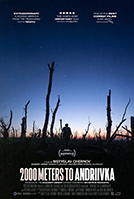
| Runtime | 106 minutes |
| Release | 2025-07-25 |
| Rating | 7/10 |
A Ukrainian platoon's mission: traverse a heavily fortified mile of forest to liberate a strategic village from Russian forces. A journalist accompanies them, witnessing the ravages of war and the growing uncertainty about its conclusion.
The review
By Mulder 2025-09-14
With 2000 Meters to Andriivka, Mstyslav Chernov once again demonstrates why he has become one of the most essential chroniclers of the ongoing war in Ukraine. After his Oscar-winning 20 Days in Mariupol, which focused on the siege of civilians trapped in a collapsing city, this new documentary shifts perspective to the front lines, embedding us directly with soldiers tasked with advancing through a perilous 2000-meter stretch of forest to retake the village of Andriivka. On paper, it is a distance that could be crossed in minutes by car or even seconds by a mortar shell, but on the ground, under constant fire, it becomes a Sisyphean journey where every meter feels purchased with blood.
The film’s strength lies in its unprecedented intimacy. Much of the footage comes from helmet-mounted cameras, GoPros strapped onto Ukrainian soldiers who advance through blasted trees, mine-strewn paths, and foxholes that could conceal either friend or foe. The result is an immersive first-person perspective that evokes the aesthetics of a video game like Call of Duty—except, as Mstyslav Chernov makes chillingly clear, this is no game. The confusion, the sudden eruptions of gunfire, and the abrupt silences broken only by breath or whispered commands create a suffocating tension. When soldiers laugh together over cigarettes one moment and are gone the next, we are reminded how fragile the line between camaraderie and catastrophe is.
Among the figures who emerge from the chaos, two in particular stand out. Fedya, the young unit leader who once worked in a warehouse, repeats with grim conviction that he came “to fight, not to serve.” His determination, even after being wounded and returning to battle, embodies the resolve of many of the men around him. His right-hand man, nicknamed Freak, is equally memorable—a 22-year-old soldier who jokes about showers and language while embodying the contradictory youthfulness of someone who should be far from the trenches. Mstyslav Chernov’s narration frequently delivers the cruel twist: many of the soldiers we come to know will not survive the coming months. This device is devastating, reminiscent of the postscript in American Graffiti, but made infinitely heavier by the knowledge that these fates are not scripted but real.
Visually, the film is stark and unforgettable. The forest leading to Andriivka looks less like nature and more like a graveyard of trees—burned trunks standing like skeletal reminders of what was once fertile land. Drone shots emphasize this haunting geography, at times showing soldiers reduced to tiny, fragile figures trudging forward in a scarred wasteland. One soldier likens the experience to “landing on a planet where everything is trying to kill you,” a description that lingers long after the film ends. The sound design, enhanced by Sam Slater’s minimalistic, throbbing score, amplifies this sense of otherworldly menace, as if even silence has been weaponized.
Yet what makes 2000 Meters to Andriivka resonate is not just the horror but the humanity glimpsed in fleeting conversations. A soldier talks about wanting to fix his home’s plumbing when he returns. Another mentions his wife’s constant worry, realizing now, under fire, how deep that worry runs. These ordinary hopes punctuate the extraordinary violence and remind us that behind every uniform is a person who once had plans far removed from battle. The inclusion of funerals—whole communities turning out to mourn fallen sons and fathers—cements this duality of personal loss and national struggle.
The documentary also confronts the futility of war with brutal honesty. By the time the brigade raises the Ukrainian flag in Andriivka, the village is nothing more than rubble. There are no homes to reclaim, no civilians to greet, only ruins and a stray cat carried away by the soldiers as the last living resident. It is a symbolic victory rather than a strategic one, quickly erased months later when Russian forces recaptured the site. This Pyrrhic quality saturates the entire film, making the soldiers’ courage all the more tragic. The audience is left questioning the meaning of sacrifice when the ground won is so quickly lost again.
What distinguishes Mstyslav Chernov’s work is his ability to make the personal universal. His commentary acknowledges the indifference of the world as the war drags on—how headlines eventually fade, how sympathy wanes, and how conflicts become background noise for distant audiences. His own position as both journalist and filmmaker is precarious; he avoids wearing identifying press gear because that would make him a priority target. Yet his presence ensures that these stories, these faces, and these sacrifices are not forgotten. His film becomes the flag raised above Andriivka, not in celebration but in remembrance.
2000 Meters to Andriivka is a brutal, necessary work of cinema. It forces us into a frontline where death can arrive in silence or thunder, and where soldiers cling to jokes, cigarettes, and fleeting dreams to survive another hour. It is both pro-war and anti-war: pro in its recognition of the necessity to defend one’s homeland, anti in its depiction of the absurd, grinding futility of battle that reduces villages to ash and men to statistics. Like Elem Klimov’s Come and See, it leaves the viewer shaken, drained, but also aware that this is what cinema must sometimes do: bear witness.
The film is not about the capture of a village but about the persistence of memory. “The war wipes out everything,” Mstyslav Chernov has said, “but the very thing that survives is memory.” 2000 Meters to Andriivka is his way of ensuring those memories endure—not as distant abstractions, but as visceral, haunting truths etched into history. It is devastating, extraordinary, and one of the most important documents of war in our time.
2000 Meters To Andriivka
Directed by Mstyslav Tchernov
Produced by Raney Aronson, Michelle Mizner, Mstyslav Chernov, Raney Aronson-Rath
Music by Sam Slater
Cinematography : Mstyslav Chernov
Edited by Michelle Mizner
Production companies :
Distributed by PBS Distribution (United States)
Release date: July 25,2025 (United States)
Running time: 106 minutes