

The problem with Apu
Directed by Michael Melamedoff (2018)
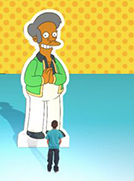
| Runtime | 49 minutes |
| Release | 2018-04-30 |
| Rating | 9/10 |
The review
By Nikayaya 2017-11-14
I was given 48 hours to review The Problem With Apu, a documentary born from the comedic mind of Hari Kondabolu; it took me 96. The film centers on the effect of stereotypical characters used in mass media and the minorities they represent, but it also highlights howeven after being first generation, third generation, or even tenth generation American born, many are still seen as foreigners.
As a first generation American I found myself nodding along to 90% of the comments. Despite the contributors being of South Asian-American descent, their experiences are almost cut and paste from the stereotype handbook. The comments became frustrating as the film progressed, listening to how wide spread misinformation is for anyone outside the standard mold in the United States. The best way to highlight this to an audience that has not experienced second hand citizenship in this country is to further explore some of the more
stand out comments. Utkarsh Ambudkar (Actor) “The Simpsons stereotyped all races, (list different groups featured) The problem is we didn’t have any other representation in this country.”
This is important in a nation where many feel global information only extends to the borders of the United States. While the US is composed of the most diverse ethnicities in the world, it still seems unwilling to accept varying cultures as much more than a punchline, or a threat. Representation, true representation for people of color is still a struggle today, as so many times the only information Americans have of differing cultures comes from stereotypes. Dr. Vivek Murthy: (US Surgeon General 2014-2017) “Stereotypes tend to have a large half life, they tend to last a while unless we are committed to, and good at, telling our own story.” Representation doesn’t just help people of color see themselves in the American landscape, it helps us understand our cultures part in the American story. Stereotypes hide away the truth, and replace it with a bias definition, all without our participation; but it’s not for lack of trying as represented in the next comment.
Aziz Ansari (Actor/Writer) “There’s this idea that okay, well, if there is four White people anybody will watch it, that’s mainstream, thats accessible; but if there is four Asian people, or four Black people, it becomes ‘this is a Black show, or this is a Black movie.’ What it boils down to, is, I guess it just boils down to, why is it that when there is a show full of White people that’s considered okay and mainstream?”
It’s not just a lack of representation that plagues American society, it’s the battle to break through and be allowed to define our own selves. The belief that shows represented by an American of color would not be as widely accepted as one with a White lead cannot be disproven because technically it has not had a chance to be tested.
Aasif Mandavi (Actor) “There’s a kind of complacency that happens in our culture like around that stuff you know, where even we start going like, ‘Oh it’s funny.’ And this is the insidiousness of racism. The person who is subjected to it or exposed is buying into it as sort of a cultural norm. ‘Oh it’s not a problem, it’s fine. What’s the big deal? You’re overreacting.’”
The internet and media is fat with dismissive comments directed towards people of color, yet ripe with indignation for perceived nationalism slights, the hypocrisy could suffocate you. Fear of standing out drives even other minorities to fall into the majority line, creating a divide that feeds into the hate driven rhetoric and pushes back the frontlines.
Dana Gould (Writer/Co-Execuitive Producer of the Simpsons) “How much do you want to tear at the fabric of the show? Do you want to pull Apu, a beloved character, out of the Kwik-EMart, a beloved setting, just for the sake of updating that character to be less anachronistic?” This thought process is founded in comfort, comfort in stereotypes. There is emotion on both sides of the argument for cultural representation, one being the cisgender white population that outnumbers our individual standings, and their comfort with boxing our cultures. The other being people of color and the resistance stereotypes cause for our ability to be truly seen, and heard, in American society. Hari Kondabolu “That’s great that he gets to choose how he wants to be portrayed, what a privilege.” In reference to white actor Hank Azaria, the voice of Apu. This is why #representationmatters.
At my last job I was talking through a radio to multiple people when my supervisor came in and asked me to tone down my accent. I had to ask him to repeat his request because I don’t have one. He repeated his request, laughed and made a poor attempt at a Charo impression. That was #myapumoment.
I know many of those that connect with Kondabolu’s film will be able to remember their own causally racist moment; unfortunately the people that would benefit the most from The Problem With Apu probably won’t even know of its existence, and that may be the best argument for why it should be watched.
Screened via TruTV October 26 2017