

Stranger Things: Tales from '85 : A Surprisingly Fun Journey Into the Past of the Upside Down
Thursday 23 April, 4:00 AM PT
Netflix’s Stranger Things: Tales from ’85 arrives with the unmistakable scent of corporate opportunism, yet dismissing it as a mere franchise afterthought would be too easy—and, more importantly, inaccurate. Set in the narrow corridor between Seasons 2 and 3 of the flagship phenomenon, the animated spin-off returns audiences to a version of Hawkins many viewers still consider the emotional sweet spot of the saga: when the Party were still children first and heroes second, when bicycles mattered more than battle plans, and when danger still felt local rather than apocalyptic. That decision alone is the series’ smartest move. By rewinding the clock to January 1985, Netflix doesn’t ask us to continue mourning the end of Stranger Things; it invites us to revisit the years when its chemistry felt effortless. There is something almost disarmingly strategic in that nostalgia-for-nostalgia approach, and yet it works more often than one might expect.
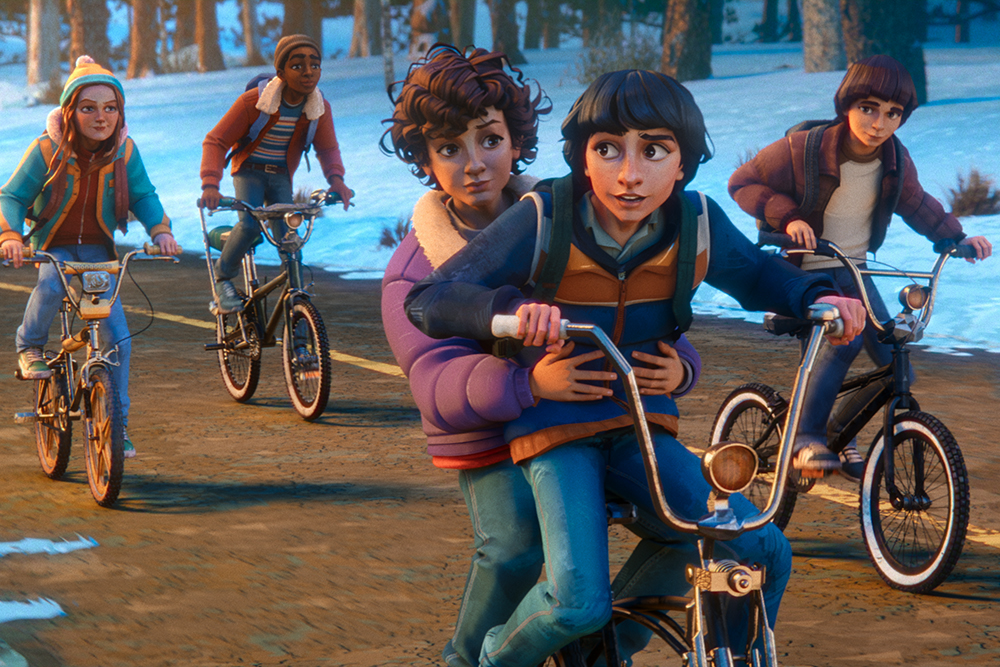
The format shift to animation proves more than cosmetic. Rather than mimic the live-action show beat for beat, the series embraces the velocity of old-school adventure cartoons: brisk episodes, cliffhangers, creatures bursting from snowbanks, improvised gadgets, frantic chases through sewers and school corridors. Flying Bark’s visuals lean modern rather than retro, with luminous neon highlights, stylized monster design and camera movements impossible in the original production’s earlier years. Hawkins in winter is a genuine novelty—icy streets, grey skies, wool hats and frozen fields give the town a fresh identity. One of the season’s quiet pleasures is simply seeing familiar locations transformed by snow. The Palace Arcade under winter light has the sort of visual charm that makes one briefly wish the main series had explored more seasonal chapters.
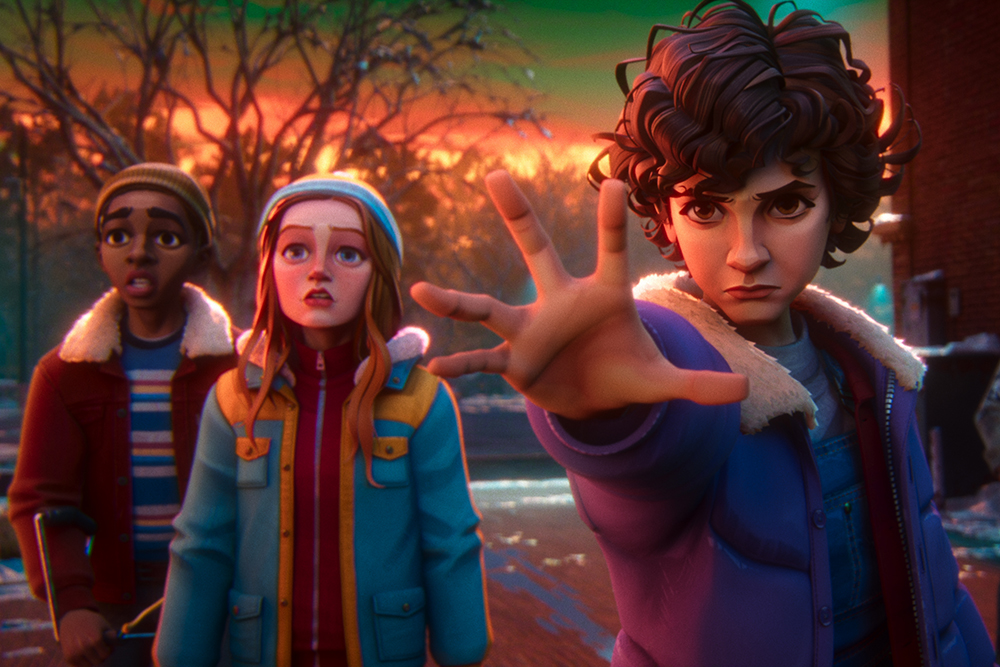
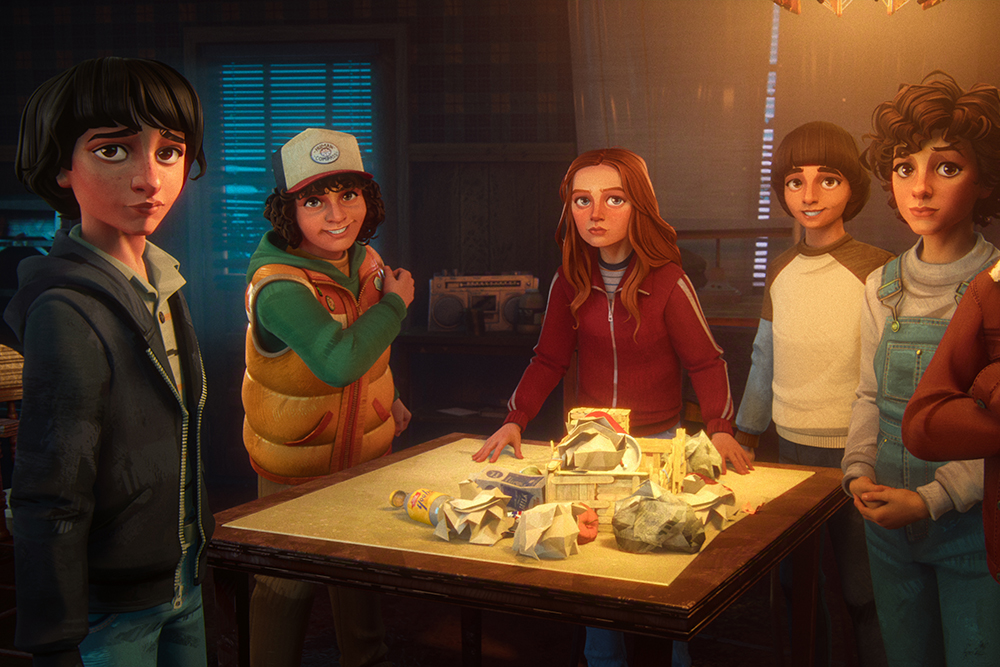
Where the show truly finds its footing is with the younger ensemble. The narrative wisely centers Eleven, Mike Wheeler, Dustin Henderson, Lucas Sinclair, Will Byers and Max Mayfield, reducing adult interference and restoring the adolescent camaraderie that later seasons sometimes buried under mythology and scale. The creation of the Hawkins Investigators Club is a neat storytelling engine: instead of monsters conveniently arriving on their doorstep, the kids actively seek trouble. That small structural tweak changes the energy of the series. It recalls the giddy logic of children who have survived the impossible once and now believe they are experts. Anyone who remembers being twelve and wildly overestimating their competence will recognize the charm immediately. Dustin Henderson, in particular, thrives in this mode, all swagger and improvisation, while Will Byers gains some welcome breathing room as a character rather than a perpetual vessel of trauma.
The recast voice ensemble deserves more credit than purists may be willing to grant. Replacing beloved live-action performers was always going to trigger suspicion, yet the new actors largely understand that imitation is not enough; they capture rhythm, insecurity, bravado and awkwardness. Several performances cleverly evoke memory without descending into parody. Jolie Hoang-Rappaport channels Max’s dry wit with impressive ease, while Braxton Quinney gives Dustin the motor-mouthed enthusiasm fans expect. Brooklyn Davey Norstedt has the hardest assignment as Eleven, whose speech patterns during this era were still evolving, but even when the dialogue falters, the emotional intent remains intact. There are moments when one forgets these are substitute voices at all—which, in this context, is the highest compliment possible.
The most debated addition is newcomer Nikki Baxter, voiced by Odessa A’zion, a punk outsider with mechanical instincts, sarcasm to spare and a backstory built on constant relocation. She is both the season’s freshest ingredient and its biggest continuity headache. On screen, Nikki works: she challenges the group dynamic, connects movingly with Will, and adds an edge midway between Max’s toughness and later-series Robin’s verbal confidence. Off screen, however, one keeps asking the unavoidable question: if she becomes this important, why has no one ever mentioned her before? It is the burden of all midquels—every emotional breakthrough comes with an asterisk. Yet Odessa A’zion sells Nikki so effectively that one almost resents canon itself for getting in the way.
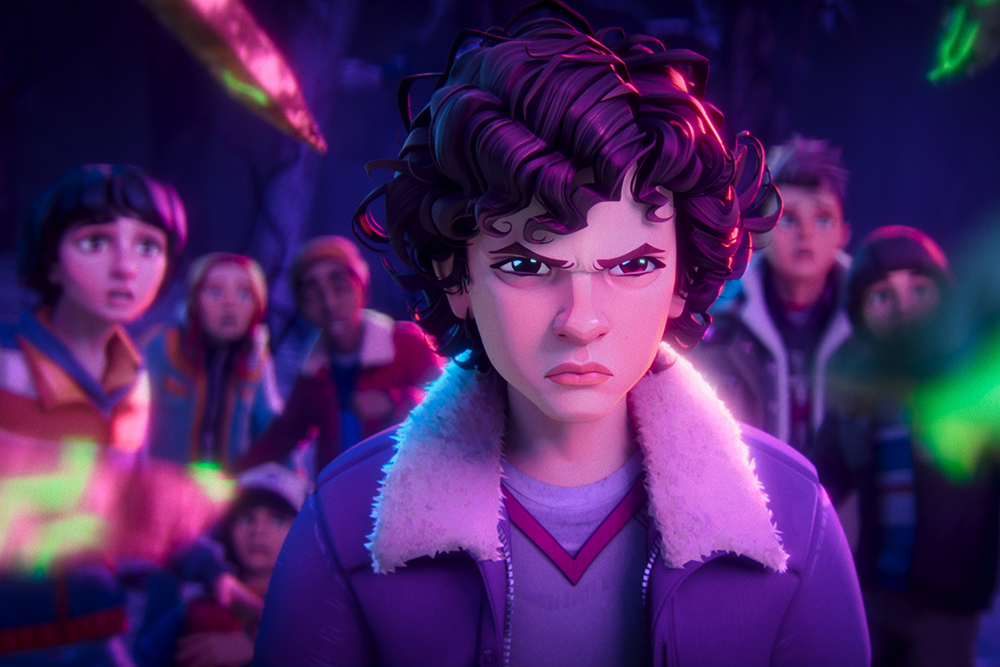
That tension between enjoyment and logic defines the season. Because viewers know where these characters end up, suspense can only go so far. No one seriously believes this winter detour will permanently damage the Party, and the scripts occasionally lean too heavily on repeat formulas: creature attack, improvised plan, chaos, Eleven raises a hand, nosebleed, temporary salvation. After several cycles, the pattern becomes visible enough to drain urgency. Likewise, the central mystery—mutating remnants tied to the Upside Down and Hawkins Lab residue—is serviceable rather than revelatory. It functions, but rarely surprises. The show is at its best not when explaining lore, but when lingering on friendships, flirtations, rivalries and the casual nonsense of kids who still think an afternoon can last forever.
There is also an interesting tonal contradiction at play. Tales from ’85 is clearly designed as a more family-friendly gateway into the franchise, yet it retains enough body-horror imagery, sharp-toothed monsters and invasion anxiety to feel darker than the label suggests. That balancing act occasionally wobbles, but it also preserves something essential: Stranger Things without menace would be empty cosplay. The spin-off understands that the original series was never only references, bikes and walkie-talkies; it was children confronting the incomprehensible. Even in softened form, that principle survives here.
Ultimately, Stranger Things: Tales from ’85 is less a vital new chapter than a surprisingly enjoyable encore. It does not expand the mythology in any meaningful way, nor does it solve the franchise’s post-finale identity crisis. What it does offer is something smaller and, perhaps now, more valuable: time spent again with these characters before adulthood, trauma and spectacle swallowed them whole. It is comfort television dressed as monster fiction, a bonus track rather than a new album. Some will see that as cynical recycling. Others will see it as a warm return to the basement where the magic began. Both readings are fair. But judged on its own terms, this animated side quest earns its place.
Synopsis :
Hawkins, winter 1985. We’re back in a town brimming with secrets, where our beloved heroes face new mysteries… and a new wave of strange phenomena.
Stranger Things: Tales from '85
Based on Stranger Things by The Duffer Brothers
Developed by Eric Robles, Jennifer Muro
Executive producers : Eric Robles, The Duffer Brothers, Dan Cohen, Shawn Levy, Hilary Leavitt
Showrunner : Eric Robles
Voices of Brooklyn Davey Norstedt, Luca Diaz, Braxton Quinney, Jolie Hoang-Rappaport, Elisha Williams, Benjamin Plessala, Odessa A'zion, Brett Gipson, Jeremy Jordan
Music by Brad Breeck
Editor : Matthew Brailey
Production companies : Upside Down Pictures, 21 Laps Entertainment, Flying Bark Productions
Network : Netflix
Release April 23, 2026
Running time : 27–32 minutes
Score : 3.5/5
Photos : Copyright Netflix