
 English
Convention - Japan Expo 2026: The festival celebrates its 25th anniversary and reaffirms its status as a leading event for Japanese culture in Europe
By Mulder, 17 march 2026
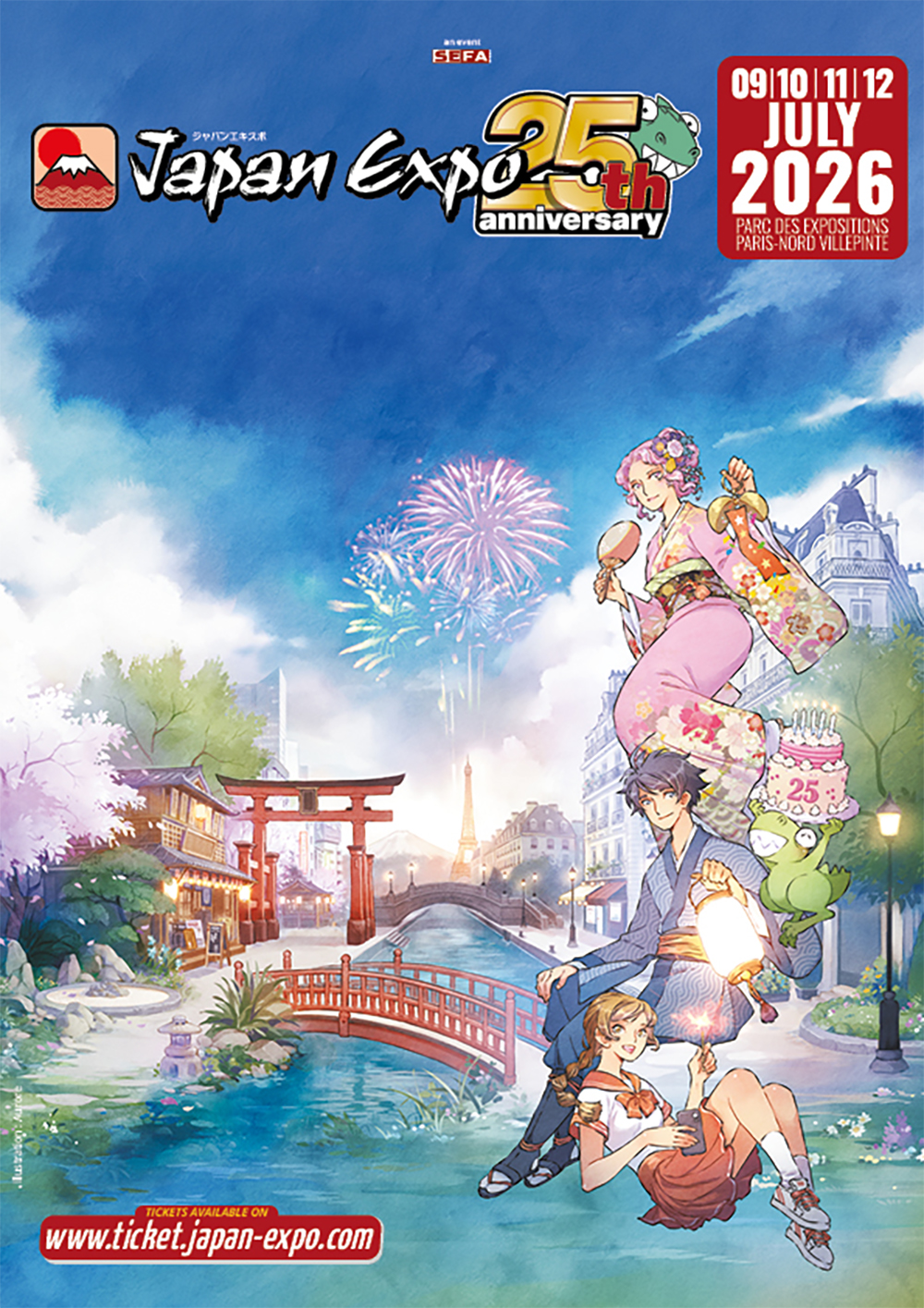
As it approaches its 25th anniversary, Japan Expo marks a new symbolic milestone in its history by announcing the creation of an official OAV celebrating the festival—a groundbreaking project that perfectly illustrates the spectacular evolution of this event, born from the passion of three enthusiasts who, over the years, have become the architects of Europe’s largest gathering dedicated to Japanese culture. Founded by Thomas Sirdey, Jean-François Dufour, and Sandrine Dufour, the festival initially bore no resemblance to the massive cultural machine capable of drawing over 200,000 visitors, and it is precisely this contrast between its humble beginnings and its current scale that gives this lively celebration its full meaning today. As Thomas Sirdey recalled, the initial idea was not to create a massive public spectacle, but simply to provide a space for expression to a community of enthusiasts who, in the late 1990s, still struggled to come together in France around a shared interest in Japan, animation, and manga—a context very different from today’s, where Japanese culture is an integral part of the European cultural landscape.
Since its first edition in 1999 and its permanent establishment at the Paris-Nord Villepinte Exhibition Center, Japan Expo has gradually established itself as a major event, to the point where it is now the third-largest French trade show in terms of daily visitors, behind the Paris Motor Show and the International Agricultural Show, with over 222,000 visitors at the 2025 Paris edition and nearly 40,000 at the Marseille edition. The scale of the program confirms this rise in prominence, with, in 2025, a total of twenty-two days of on-stage entertainment, 671 guests, 674 events spread across 35 stages, over 2,800 accredited professionals—including several hundred from abroad—as well as more than 800 exhibitors and over 560 journalists and content creators in attendance. These figures attest to an influence that extends far beyond the scope of a simple festival, establishing itself as a true cultural industry centered on manga, animation, video games, and Japanese pop culture.
In this context, the decision to produce an official animation to celebrate the festival’s 25th anniversary seems almost a natural choice, given that Japanese animation has been part of Japan Expo’s DNA since its inception, with the festival having hosted over the years some of the industry’s most prestigious directors, animators, character designers, and voice actors. The idea of creating an anime dedicated to the festival took shape when the team realized it now had close relationships with many Japanese artists, which led Jean-François Dufour to propose the project to director Nobuyoshi Habara, a renowned figure in Japanese animation, who was immediately captivated by the concept. Production was then entrusted to Eddie Mehong, who took on the project at the Rhinokino & Transdyne studio, launching a creative process that required over fourteen months of work, of artistic discussions and back-and-forth between the French and Japanese teams before culminating in this anniversary short film conceived as a tribute to all the artisans of Japanese animation.
This OAV, intended as a gift to the public as much as a symbol for the founders, offers an animated vision of the festival itself, with settings inspired by the aisles of Japan Expo—a way of transforming a real place into a fictional universe while celebrating the community that has brought it to life for a quarter of a century. The original music, composed and performed by Umi Kun, was conceived as the official 25th-anniversary theme, further reinforcing the commemorative nature of the project, which is part of a deliberate effort to mark this anniversary edition as a pivotal moment in the festival’s history. This approach also reflects a broader evolution: Japan Expo is no longer merely an event showcasing Japanese culture, but a key player capable of producing its own content related to this world—a testament to the maturity it has achieved after more than two decades of existence.
Beyond this celebration, the 2026 edition, scheduled for July 9–12, is expected to continue following the editorial vision that has built the festival’s reputation, blending iconic figures with emerging talent, conferences, signing sessions, masterclasses, and live performances, while maintaining that closeness with the public that remains one of the main reasons for its success. Since 2002, the participation of Japanese artists has become a cornerstone of the program, and this policy of constant openness has helped make Japan Expo a unique venue in Europe, capable of bringing together professionals, fans, and creators around a shared passion. Twenty-five years after its creation, the festival thus proves that it has remained true to its original spirit while achieving an international scope, and the announcement of this anniversary anime is not merely a nostalgic nod: it is confirmation that the event continues to evolve, reinvent itself, and celebrate Japanese culture with the same energy that drove its founders in the late 1990s.
(Source: press release)