 English
Movies - Nuremberg: a moving historical drama by James Vanderbilt starring Russell Crowe, Rami Malek, and Michael Shannon
By Mulder, 07 november 2025

To mark the 80th anniversary of the opening of the Nuremberg Trials, Nour Films will offer French audiences a major cinematic event with the release of Nuremberg on January 28, 2026. Directed, written, and co-produced by James Vanderbilt, already acclaimed for his screenplay for the masterpiece Zodiac, this film delves into one of the most complex and seminal chapters of the 20th century. Based on Jack El-Hai's book The Nazi and the Psychiatrist, Nuremberg combines psychological drama and historical epic to tell the story of how an American psychiatrist, Douglas Kelley, played by Rami Malek, attempted to probe the mind of evil incarnate in the person of Hermann Göring, portrayed by a charismatic and ambiguous Russell Crowe.
Presented in a world premiere in the Gala section of the Toronto International Film Festival in September 2025, Nuremberg received a four-minute standing ovation, one of the longest in the festival's history. This triumph was confirmed when it competed at the San Sebastián Film Festival, where James Vanderbilt's rigorous direction and the masterful performances of his trio of actors—Russell Crowe, Rami Malek, and Michael Shannon—were praised by critics. Distributed in the United States by Sony Pictures Classics, the film had an early release in November 2025, preceded by a special screening with a discussion between James Vanderbilt and Russell Crowe, highlighting how much the project meant to its director and lead actor.
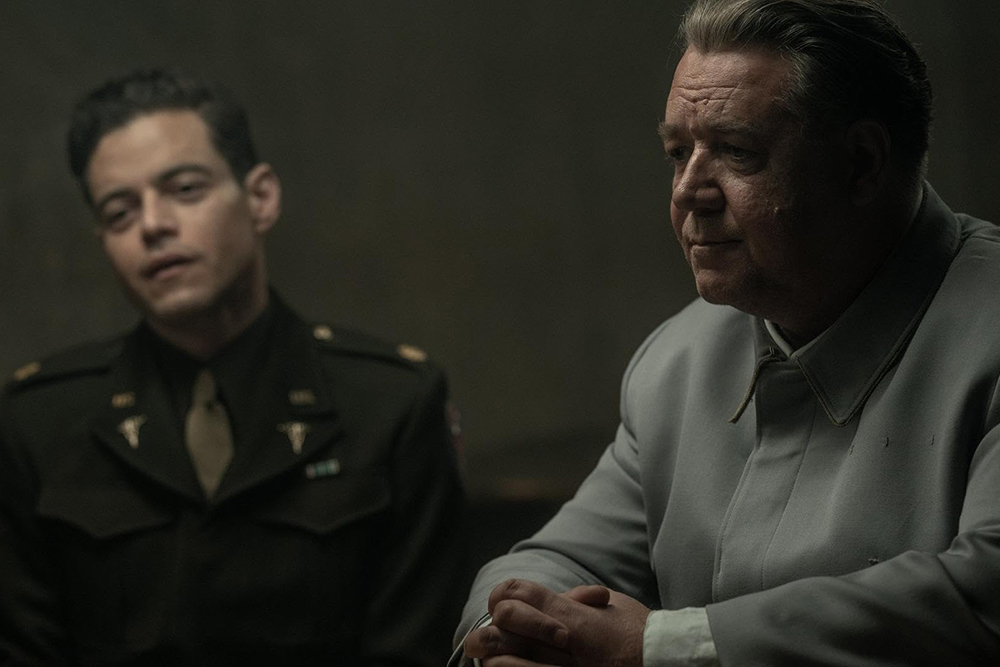
The story, which is unusually intense, opens with Hermann Göring's surrender to American troops at the end of World War II. Shortly afterwards, Judge Robert Jackson, played with precision by John Slattery, agrees to leave the US Supreme Court to become chief prosecutor in the trial of Nazi war criminals. It is in this context that military psychiatrist Douglas Kelley is sent to Germany to assess the mental health of the main defendants, including Göring, Karl Dönitz, Julius Streicher, and Rudolf Hess. The story quickly turns into a psychological duel between Kelley and Göring, a clash between reason and madness, between duty and fascination, where moral boundaries become blurred.
The strength of Nuremberg lies in its ability to combine historical reconstruction with psychological tension. James Vanderbilt's screenplay depicts Göring as manipulative, cultured, almost charming, attempting to turn every interview into a plea for his own cause. Opposite him, Rami Malek delivers a remarkably understated performance, embodying a rational man shaken by the vertigo of evil and by the intellectual closeness he feels with his subject. This ambivalence, fueled by precise direction and Tom Eagles's taut editing, makes the film a dizzying reflection on responsibility, guilt, and the very nature of justice.
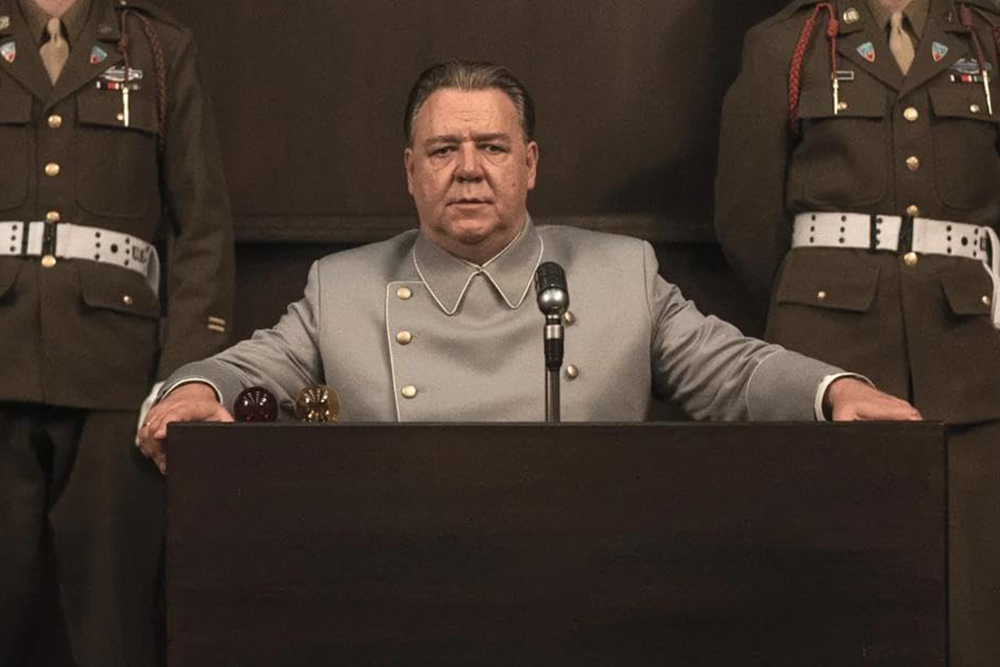
Visually, Nuremberg owes much to director of photography Dariusz Wolski, whose work with cold lighting and claustrophobic interiors is reminiscent of 1970s cinema, that of Alan J. Pakula or Sidney Lumet. The film was shot mainly in Budapest, in sets meticulously recreated to reflect the austerity of the courtroom and prison cells. Composer Brian Tyler has created a minimalist score, dominated by low strings and heavy silences, which accompany Kelley's slow moral decline. Each note seems to haunt the dialogue, underscoring the psychological tension without ever overemphasizing it.
While Nuremberg follows in the tradition of great historical films, it stands out for its intimate tone and introspective dimension. Where other works focus on the trial itself, James Vanderbilt chooses to take us behind the scenes: the doubts, dreams, and flaws of the men charged with judging the unthinkable. In many ways, the film is reminiscent of Sidney Lumet's The Verdict or Michael Mann's The Insider, where truth is won less in courtroom arguments than in the solitude of conscience. The face-off between Rami Malek and Russell Crowe, often captured in close-up, becomes a battle of ego and humanity where the line between executioner and analyst slowly crumbles.
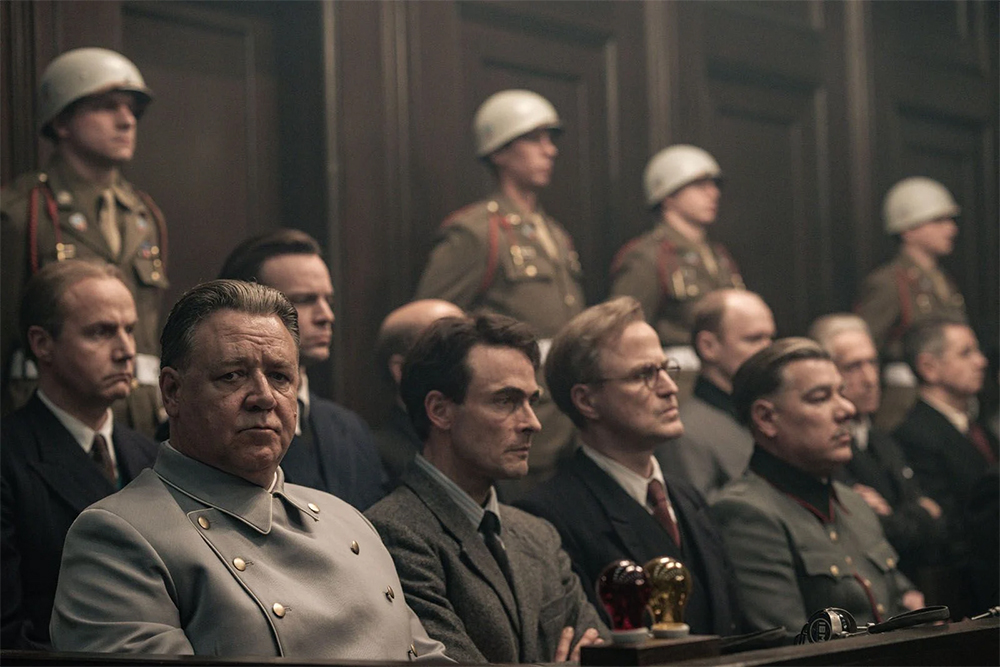
Russell Crowe's performance, unanimously praised in Toronto, is one of the most impressive of his recent career. The actor manages to humanize without ever absolving, to make Göring fascinating without glorifying him. He embodies this intellectual monster convinced of his own greatness, capable of justifying the unjustifiable while playing on the weaknesses of his interlocutor. Opposite him, Rami Malek evokes the moral fragility of a man convinced he can understand evil, before getting burned by it. As for Michael Shannon, in a more low-key but essential role, he embodies with chilling intensity Colonel Burton Andrus, guardian of the prisoners, guarantor of discipline, and silent witness to the excesses of power.
Nuremberg does not merely recount a historical episode: it questions the genesis of modern international law and, more profoundly, the very notion of universal justice. The rigor of the screenplay reminds us that the Nuremberg Trials were the first attempt to unite nations around common principles in the face of barbarism. James Vanderbilt's film succeeds in conveying this gravity while showing the intimacy of the men behind the symbols. Göring's downfall, his suicide on the eve of his execution, Kelley's disillusionment and tragic fate all combine to form a moral fresco on the human mind's inability to fully grasp absolute evil.
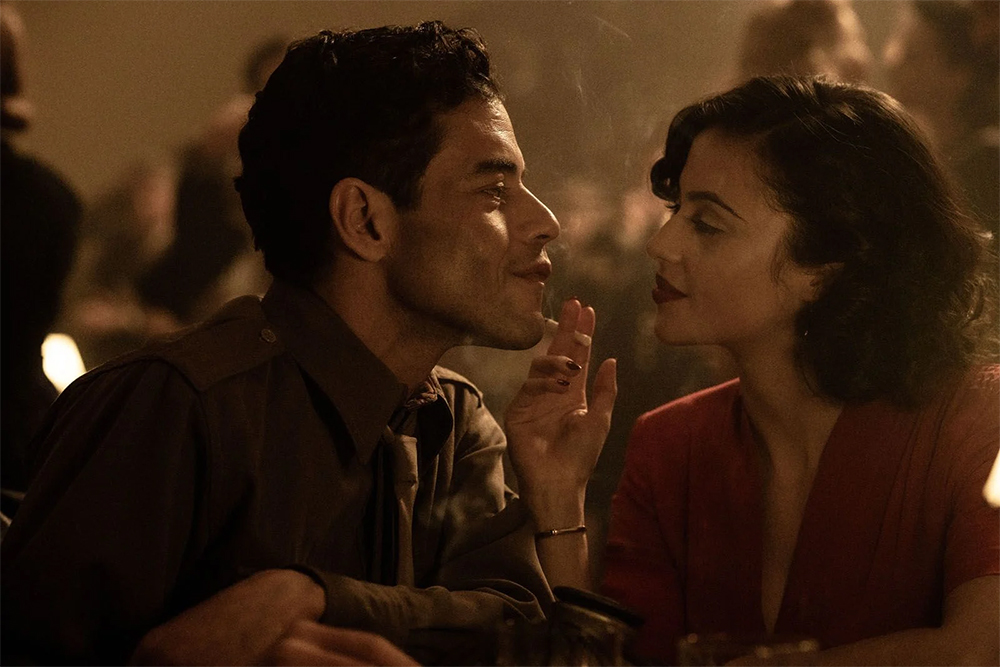
For Nour Films, the French release of Nuremberg on January 28, 2026—the eve of International Holocaust Remembrance Day—promises to be a powerful moment, both artistically and in terms of remembrance. After a record year for the company, this film marks a turning point in its commitment to promoting cinema that is popular, demanding, and steeped in memory. At a time when the world sometimes seems to be losing touch with its history, Nuremberg reminds us of the importance of remembrance and judgment. This historical drama is already shaping up to be one of the most essential events of early 2026, a film that not only recounts the past, but also speaks powerfully to the present.
Synopsis:
Nuremberg plunges us into the heart of the historic trial brought by the Allies after the fall of the Nazi regime in 1945. American psychiatrist Douglas Kelley is tasked with assessing the mental health of senior Nazi officials to determine whether they are fit to stand trial for their war crimes. But when faced with Hermann Göring, Hitler's right-hand man and master manipulator, Kelley finds himself caught up in a psychological battle that is as fascinating as it is frightening.
Nuremberg
Directed by James Vanderbilt
Written by James Vanderbilt
Based on The Nazi and the Psychiatrist by Jack El-Hai
Produced by Richard Saperstein, Bradley J. Fischer, James Vanderbilt, Frank Smith, William Sherak, Benjamin Tappan, Cherilyn Hawrysh, István Major, George Freeman
Starring Russell Crowe, Rami Malek, Leo Woodall, John Slattery, Mark O'Brien, Colin Hanks, Wrenn Schmidt, Lydia Peckham, Richard E. Grant, Michael Shannon
Director of photography: Dariusz Wolski
Editing: Tom Eagles
Music: Brian Tyler
Production companies: Bluestone Entertainment, Walden Media, Mythology Entertainment, Titan Media
Distribution: Sony Pictures Classics
Release dates: September 7, 2025 (TIFF), November 7, 2025 (United States), January 28, 2025 (France)
Running time: 148 minutes
Photos: Copyright Bluestone Entertainment