

Cannes 2026 : Sanguine Turns the Croisette Into a Visceral Nightmare of Body Horror and Social Anxiety
Thursday 14 May, 2:30 PM PT Cannes, Palais des Festivals et des Congrès de Cannes 2026-05-14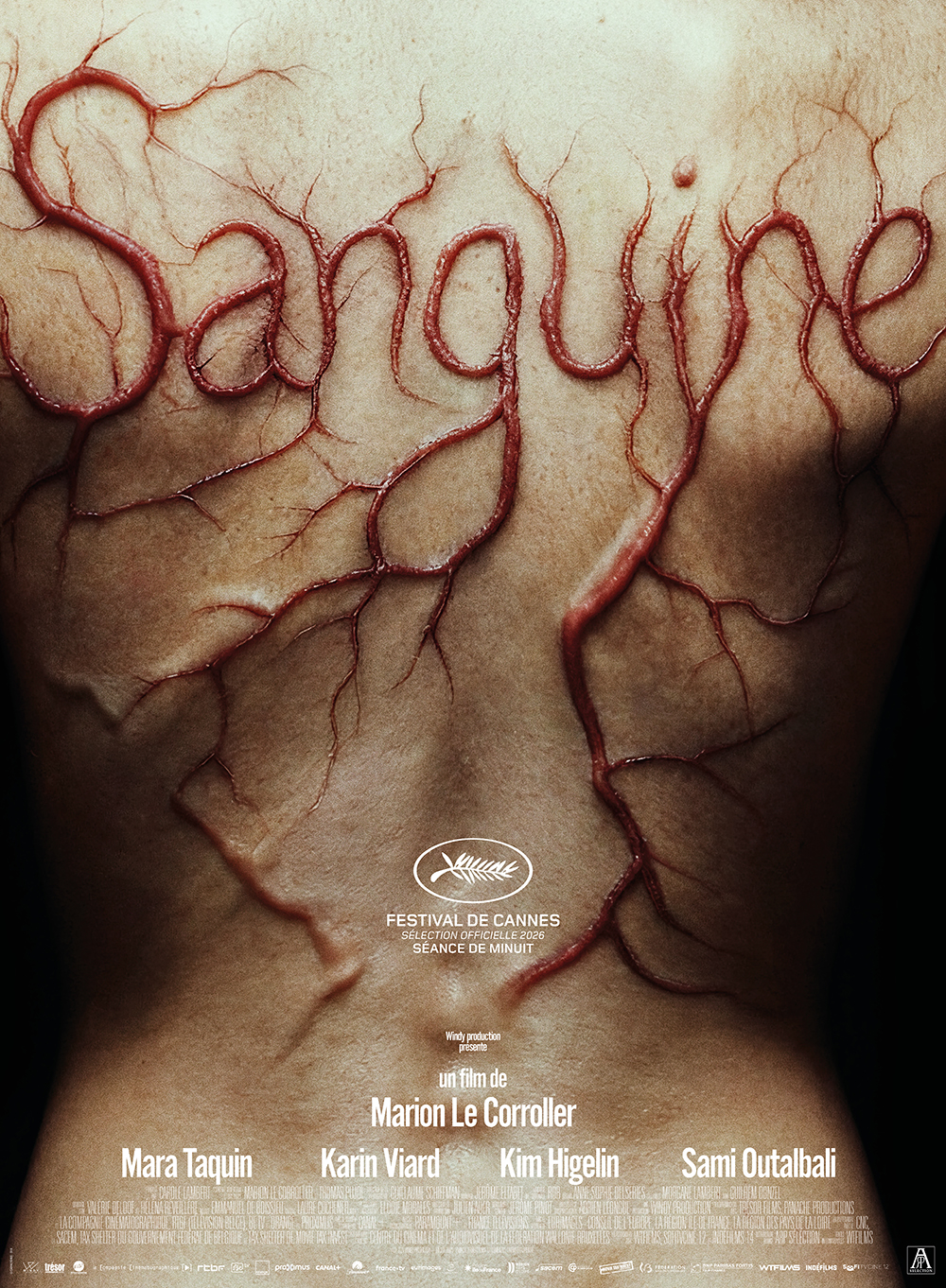
On Wednesday, May 14, 2026, the red carpet at the 2026 Cannes Film Festival was filled with a strange mix of elegance, tension, and nervous excitement surrounding Sanguine, Marion Le Corroller’s debut feature film, presented in the prestigious Midnight Screenings section. From the very first moments the crew arrived in front of the Palais des Festivals, something unusual hung in the air in Cannes. While some red-carpet arrivals can sometimes feel like highly scripted ceremonies, Sanguine’s had a more organic, almost unpredictable energy, as if the film were already infecting its surroundings even before its screening. Under the photographers’ flashes, Marion Le Corroller, flanked by Mara Taquin, Kim Higelin, Sami Outalbali, Sonia Faïdi, and producer Carole Lambert, walked forward with that mix of nervous excitement and relief characteristic of debut films arriving in Cannes with a genuine cinematic vision. Very quickly, discussions on the Croisette centered around one word: transformation. For behind its blood-soaked title and organic thriller aesthetic, Sanguine stands out above all as one of the most ambitious French genre offerings seen this year on the Croisette.
For several seasons now, French genre cinema has been undergoing a fascinating transformation, driven in particular by a new generation of female directors capable of using bodily horror to address reality with a rare directness. It’s impossible not to think of the trail blazed by Julia Ducournau or Coralie Fargeat, yet Sanguine refuses to resort to easy imitation. Marion Le Corroller’s film develops its own distinct identity, shaped by her personal experience in the world of finance before she stepped behind the camera. In her director’s statement, the filmmaker directly addresses her relationship to contemporary work, describing bodies abused by the world of labor, individuals forced to transform themselves to survive increasingly dehumanizing demands. This reflection becomes the very heart of the film, which imagines a youth literally mutating in the face of the violence of the professional system. A particularly powerful idea in the current context, as debates surrounding Generation Z, burnout, and the meaning of work now occupy a central place in both French and international public discourse.
The decision to set the plot in a hospital emergency room lends the film an almost documentary-like quality despite its fantastical framework. The synopsis follows Margot, a young intern played by Mara Taquin, as she encounters patients her own age suffering from unexplained symptoms, while her own body also begins to undergo disturbing transformations. This idea of gradual contamination—both physical and social—permeates the entire feature film. During informal conversations around the Palais after the screening, several festival-goers remarked that the film was capable of transforming contemporary anxieties into something truly visceral. The work of makeup artist Pierre-Olivier Persin, who previously garnered attention for Coralie Fargeat’s *The Substance*, plays a major role in creating this sense of visceral unease. Combined with Guillaume Schiffman’s cinematography, the film develops a clinical and sticky aesthetic that at times recalls the great body horror films of the 1980s while remaining deeply rooted in ultra-contemporary issues.
On the red carpet, the presence of Kim Higelin and Sami Outalbali also drew a great deal of attention, as the two actors embody this new generation of French cinema capable of navigating between auteur cinema, popular series, and more radical projects. Discussions surrounding the red carpet event revolved heavily around the generational nature of the project. Several young festival-goers who came to attend the midnight screening explained that they were finally waiting for “a French horror film that truly speaks to their era.” This immediate reception is far from insignificant. Whereas some recent French genre films relied primarily on visual shock, Sanguine seems to aim to provoke a more existential reaction. Marion Le Corroller poses a simple yet brutal question head-on: how far are we willing to go to transform our bodies and identities in order to adapt to the world of work?
What is particularly impressive about Sanguine is also the consistency of its director’s artistic journey. Before this debut feature film, Marion Le Corroller had already explored bodily metamorphoses in her short films Poupée fondue and Dieu n’est plus médecin. The latter already followed a young intern whose body began to “sweat blood uncontrollably,” as an obvious foreshadowing of the world of Sanguine. This thematic continuity now gives the impression of witnessing the emergence of a true genre filmmaker. And Cannes loves precisely this kind of trajectory: filmmakers who arrive with a clear, identifiable universe, and one radical enough to spark passionate debates from their very first official screening.
The midnight screening itself generated extremely lively reactions as people left the Palais. Some viewers described it as a physically grueling film, others as a terrifying satire of modern capitalism. Several foreign journalists present on the Croisette were already comparing the film to certain works of contemporary Korean cinema for its ability to blend social critique, paranoid thriller, and visceral horror. This international reception could, in fact, become a key factor in the film’s future trajectory. Produced notably by Carole Lambert, Alain Attal, Gaëtan David, and André Logie, with French distribution handled by ARP Sélection, Sanguine seems perfectly poised to reach far beyond French borders, particularly at specialized festivals and international markets eager for new faces in European genre cinema.
In the corridors of the Palais des Festivals, several conversations also returned to the project’s original title, Species, which was abandoned before its Cannes selection. This shift to Sanguine ultimately seems far more fitting, given how deeply the film appears obsessed with bodily matter—blood as a vital symbol but also as a symptom of a sick system. Even Marion Le Corroller’s direction seems constantly torn between the impulse of life and gradual decay. This contrast was also evident in the atmosphere on the red carpet: glamorous elegance on one hand, and on the other, a deeply anxious film about the physical and mental state of an entire generation.
With a runtime of 99 minutes and a French release scheduled for October 28, 2026, Sanguine could well become one of the major topics of discussion in French genre cinema in the coming months. In Cannes, the film above all confirmed one essential thing: Marion Le Corroller did not come to the Croisette simply to replicate trendy tropes. She uses body horror as a political and emotional lens, transforming anxieties related to work, performance, and collective exhaustion into a deeply sensory cinematic experience. And at a 2026 Cannes Film Festival sometimes dominated by more conventional works, this midnight screening served as a powerful reminder that genre cinema often remains one of the best ways to capture the most intimate fears of our time.
Synopsis :
Margot begins her residency in the emergency room, where she struggles to adjust. Very soon, she finds herself treating patients her own age with unexplained symptoms. The frequency of these unusual cases raises questions for her, especially as she begins to notice increasingly alarming symptoms in her own body
Sanguine
Directed by Marion Le Corroller
Written by Marion Le Corroller, Thomas Pujol
Produced by Carole Lambert, Alain Attal, Gaëtan David, André Logie
Starring Mara Taquin, Karin Viard, Kim Higelin, Sami Outalbali, Stefan Crepon, Sonia Faïdi, Mukit Abdul Hamid , Niko Ravel
Cinematography : Guillaume Schiffman
Edited by Jérôme Eltabet
Music by Rob
Production companies : Windy Production, Anga Productions, La Compagnie Cinématographique, Panache Productions, Trésor Films
Distributed by ARP Sélection (France)
Release dates : May2026 (Festival de Cannes) ; October 28 2026 (France)
Running time : 99 minutes