

Star Wars: The Mandalorian and Grogu : A Giant Grogu Lights Up the Grand Rex in Paris
Tuesday 5 May, 12:00 AM PT Paris, Le Grand Rex 2026-05-05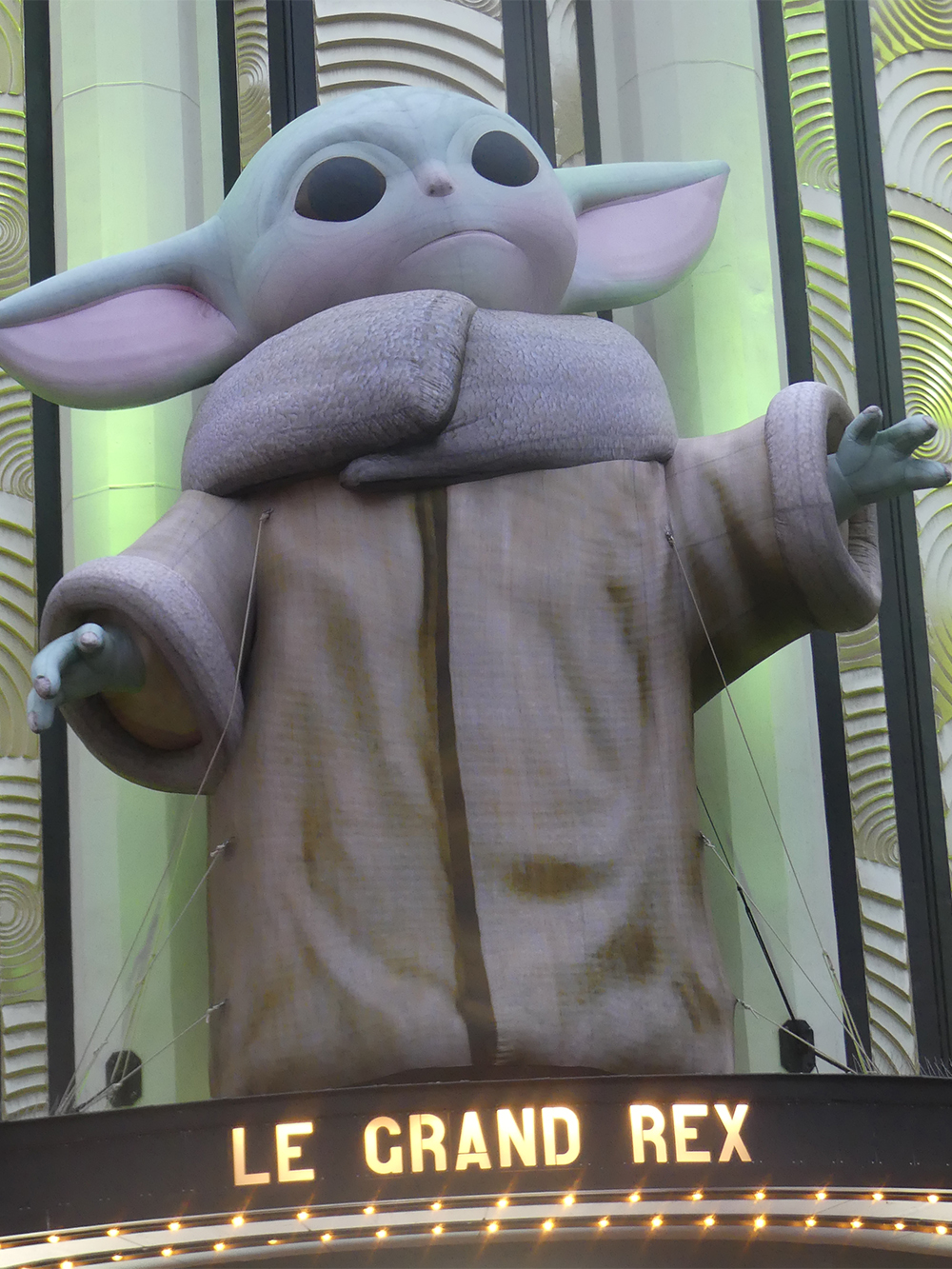
A giant Grogu taking over the facade of the Grand Rex—that’s exactly the kind of image that reminds us why certain premieres go beyond a simple screening to become, for a few hours, a true live spectacle of pop culture. For Star Wars: The Mandalorian and Grogu, the legendary Parisian cinema located at 1 Boulevard Poissonnière has once again transformed into the ideal stage for a franchise that has always understood the power of icons, silhouettes, and shared wonder. There is something almost obvious, even beautifully circular, about seeing Jon Favreau and Dave Filoni’s Clan of Two featured on the façade of a venue designed for excess, spectacle, and collective emotion: the Grand Rex has long been one of the few Parisian cinemas capable of turning an evening into an event, with rigorous security, a true stage presence, a dedicated host, and that sense of ceremony so often lacking in modern premieres. Disney’s official page confirms that Star Wars: The Mandalorian and Grogu is rated PG-13, directed by Jon Favreau, produced by Jon Favreau, Kathleen Kennedy, Dave Filoni, and Ian Bryce, and stars Pedro Pascal, Sigourney Weaver, and Jeremy Allen White, with a score by Ludwig Göransson.
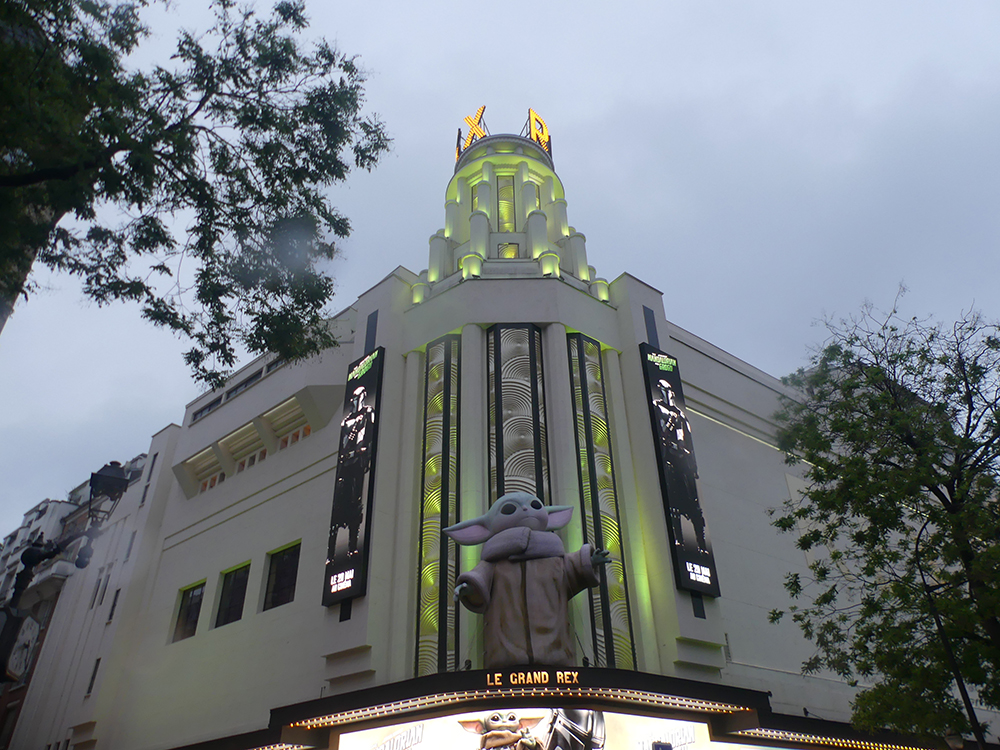
The choice of the Grand Rex is not merely decorative; it holds real symbolic significance. Opened in 1932 and renowned for its Art Deco style, the venue remains one of Europe’s most spectacular cinematic spaces, with its grand auditorium, theatrical architecture, and long tradition of exceptional premieres, concerts, and fan gatherings. Its official history notes that the Rex continues to host major cultural events, including premieres and large-scale public events, while external listings confirm the French release of Star Wars: The Mandalorian and Grogu on May 20, 2026, with a runtime of 2 hours and 12 minutes and a French synopsis centered on the fall of the Galactic Empire, the scattered Imperial warlords, and the New Republic calling upon Din Djarin and Grogu.
What makes this new chapter particularly significant is that it is not merely another chapter in the Disney+ success story, but the first Star Wars theatrical release since Star Wars: The Rise of Skywalker in 2019, ending a seven-year absence from movie theaters. This is of considerable significance, as The Mandalorian debuted on streaming in 2019 and became one of the few recent Star Wars projects to forge a genuine intergenerational connection: older fans recognized in it the spirit of the original trilogy, while younger viewers discovered in Grogu their emotional gateway into the galaxy created by George Lucas. The U.S. release scheduled for May 22, 2026, brings the film back into a traditional release window for Star Wars and positions Din Djarin and Grogu as potential movie stars following their rise on Disney+.
The Empire has fallen, Imperial warlords still threaten the galaxy, and the fledgling New Republic needs the legendary Mandalorian bounty hunter Din Djarin and his apprentice Grogu to help protect what the Rebellion fought for. This simplicity is perhaps the film’s most formidable weapon. Rather than requiring casual viewers to arrive with a complete chronology of The Mandalorian, The Book of Boba Fett, Ahsoka, Star Wars Rebels, and Star Wars: The Clone Wars in mind, the film seems to revolve around a clear cinematic promise: a warrior, a child, a dangerous galaxy, and a mission capable of speaking to both fans and newcomers alike. Official Disney materials confirm this basic premise, while the French AlloCiné listing adopts the same narrative framework for the film’s theatrical release in France.
Behind the camera, Star Wars: The Mandalorian and Grogu is also a tribute to continuity. Jon Favreau directs and co-writes with Dave Filoni and Noah Kloor, continuing the creative partnership that made The Mandalorian one of the franchise’s most successful modern expansions. David Klein handles cinematography, while Rachel Goodlett Katz and Dylan Firshein are credited with editing, and Ludwig Göransson returns to ensure musical continuity after helping define the Disney+ series’ soundtrack. This last point is no small detail: Ludwig Göransson’s themes gave Din Djarin a sonic identity that was neither an imitation of John Williams nor a rejection of classic Star Wars, but something tribal, solitary, and instantly recognizable—perfectly matching a character who is both mythical and strangely intimate.
The production itself leaves a notable industrial footprint. The California Film Commission’s list of approved projects lists *The Mandalorian and Grogu* as a Lucasfilm feature film comprising 92 days of filming, 54 actors, 500 crew members, 3,500 extras, $166,438,000 in eligible expenses, and $21,755,000 in tax credits, making this project not only a major installment in the franchise but also a large-scale California production. This is significant because Star Wars has always been associated with major international shoots and the British production infrastructure; the fact that this film is so firmly rooted in California gives this return to the big screen a different behind-the-scenes profile.
The setting of the Grand Rex adds an extra dimension to the enjoyment of movie lovers, as the venue itself was designed to create legends long before Hollywood blockbusters became a modern religion. Conceived in the early 1930s by Jacques Haïk, designed by architect Auguste Bluysen and engineer John Eberson, with façade work by Henri-Édouard Navarre and interior design by Maurice Dufrêne, the Grand Rex opened its doors on December 8, 1932, in the presence of Louis Lumière, with Henri Diamant-Berger’s *The Three Musketeers* on the program. Its facades, roofs, lobby, and decor were designated a Historic Monument by decree on October 5, 1981, and the cinema remains inseparable from the concept of the “palace of cinema” as a place where the audience does not merely watch images, but enters a dream machine.
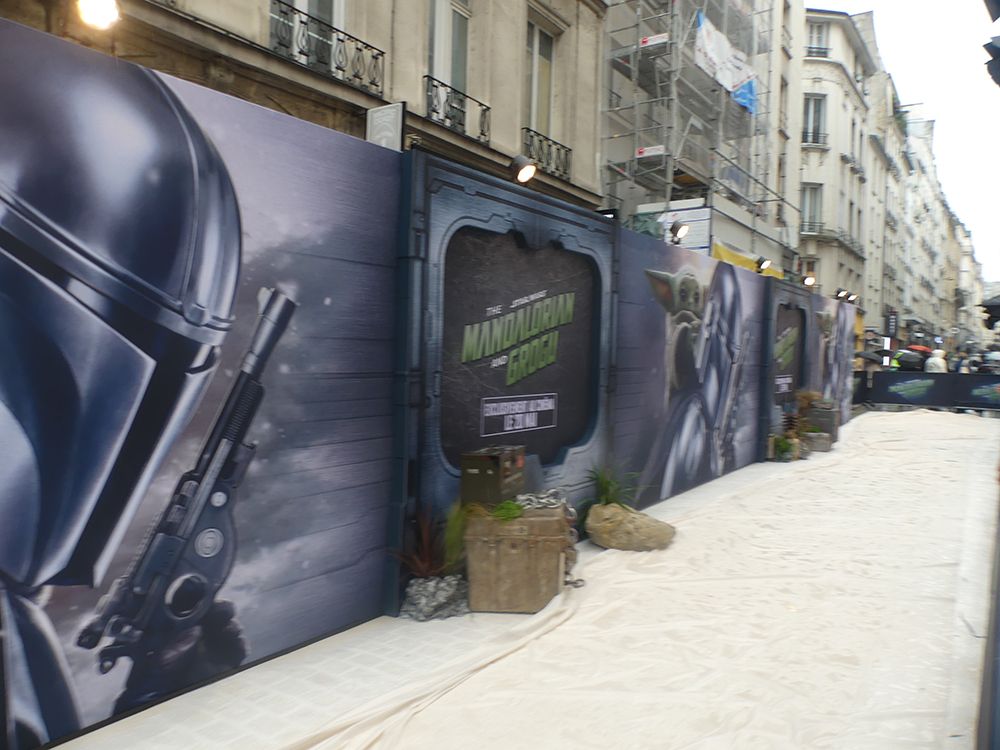
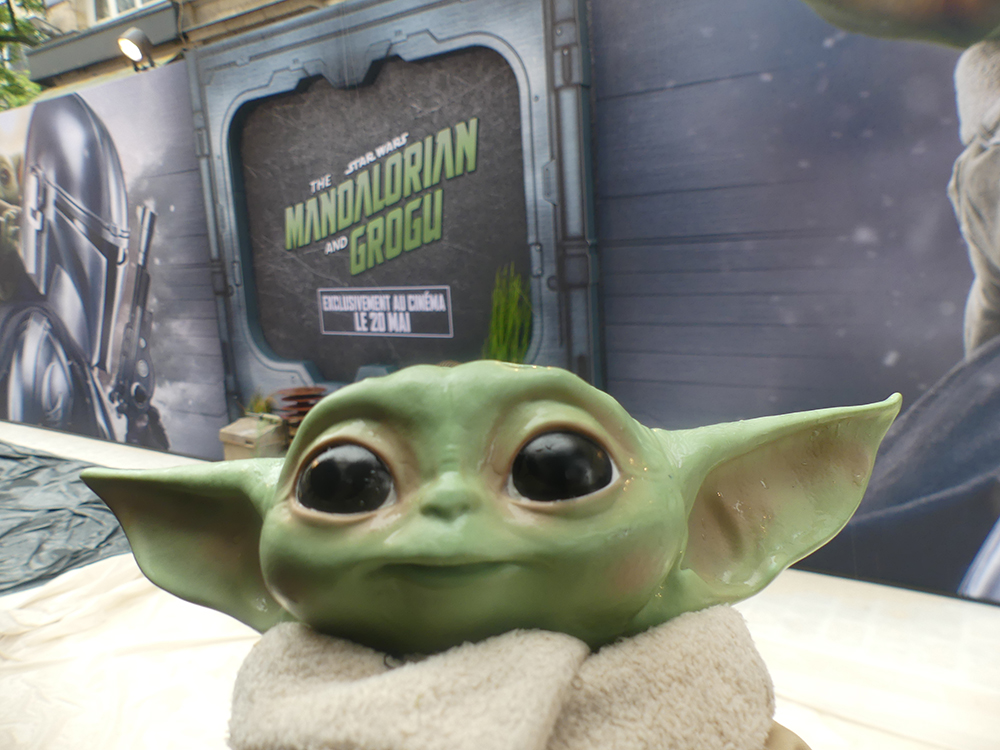
This is why seeing Grogu on the facade works so well: he is not just a mascot; he is a modern face of the silent film era, a character whose charm lies in his eyes, gestures, pauses, and the art of puppetry. In an era where franchise mechanics are over-explained, Grogu still communicates through cinema’s oldest language: expression, timing, and reaction. Press releases and images from the premiere hint at a Parisian event designed around this instant affection, and it’s easy to see why the Grand Rex is the ideal venue for it. It is in this very theater that fan communities gather for marathons, special screenings, and exclusive premieres; the theater’s recent history highlights major events featuring stars such as Dwayne Johnson, Kevin Hart, Nick Jonas, Bradley Cooper, Zach Galifianakis, Ken Jeong, Margot Robbie, Jacob Elordi, Emerald Fennell, Timothée Chalamet, and Josh Safdie, thereby reinforcing its status as one of Paris’s most reliable temples for large-scale popular cinema.
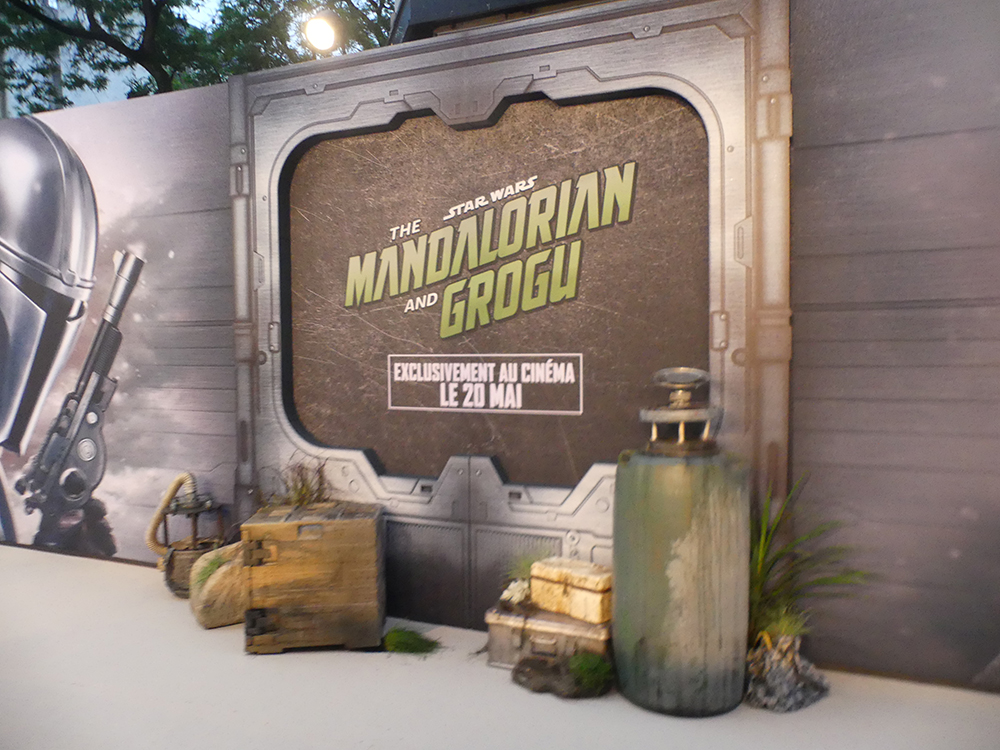
For Lucasfilm, the stakes are clear: Star Wars: The Mandalorian and Grogu must prove that the franchise can return to the big screen not by relaunching itself yet again, but by transforming an emotional connection born of streaming into a true big-screen adventure. The trailers and official videos released by Disney highlight a campaign focused on action, family appeal, spectacle, and the promise of seeing Din Djarin and Grogu on the big screen and in IMAX, while recent articles on the latest clip describe a sequence where Din Djarin and Grogu make their escape amid intense combat scenes involving AT-ATs, reminding us that the film operates on the classic scale of Star Wars rather than remaining confined to the conventions of television.
The cast also lends the project an intriguing tonal palette. Pedro Pascal reprises the role of Din Djarin, a character who has become one of the defining pop-cultural identities of his career despite the helmet that covers him. Sigourney Weaver, whose presence instantly evokes decades of science fiction history since Alien, brings a regal touch to the cast, while Jeremy Allen White brings an unexpected modern intensity to the voice role of Rotta the Hutt, a character tied to the broader Hutt mythology. Entertainment Weekly and other recent articles have also reported the surprising appearance of Martin Scorsese in the role of a four-armed Ardennian merchant, an appearance that seems almost surreal given Martin Scorsese’s longstanding public association with debates about franchise cinema, but which is also fun and perfect because Star Wars has always been at its best when it treats the galaxy as a chaotic marketplace of voices, faces, and creatures.
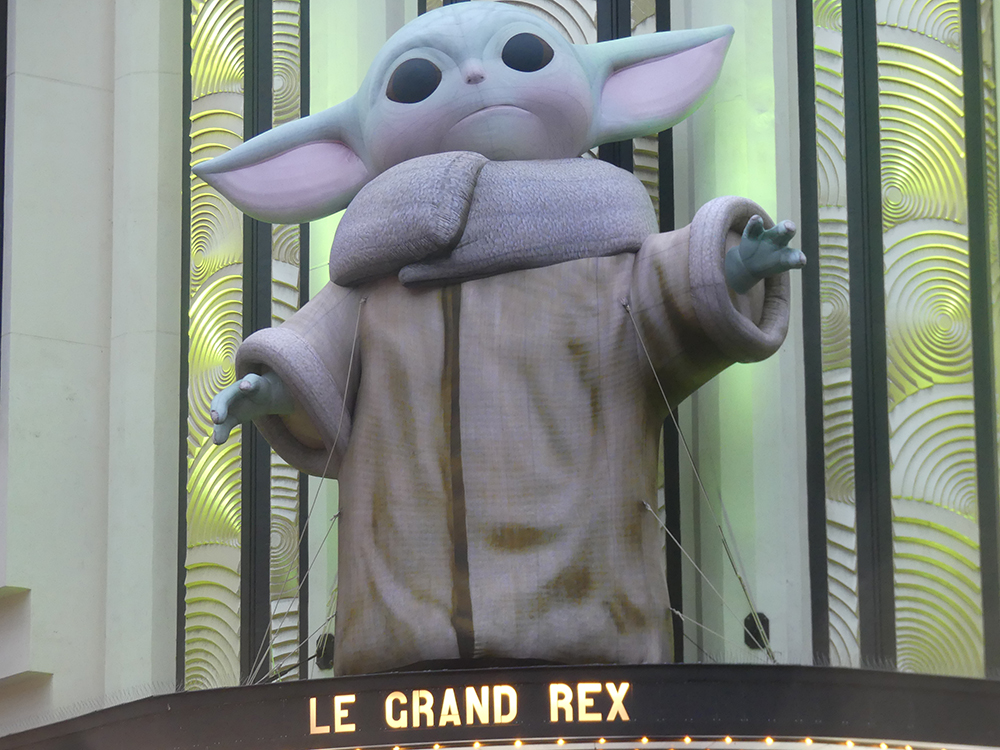
This staging of the premiere at the Grand Rex speaks volumes about what Star Wars still needs to be in 2026: not just content, not just brand management, not just a release date on a corporate calendar, but an event that gets people out of their homes and gives them the feeling of being part of a larger shared mythology. The giant Grogu on the facade is playful, certainly, but it’s also a statement of intent: after years of adventures in living rooms, Din Djarin and Grogu are returning to the kind of giant screen and collective atmosphere that made Star Wars a cultural force in the first place. At the Grand Rex, bathed in the glow of one of Paris’s most beautiful movie theater facades, this promise finds its perfect home.
Synopsis :
The fall of the evil Galactic Empire has sent the Imperial warlords scattering across the galaxy… To protect everything the Rebellion fought for, the fledgling New Republic decides to call upon the legendary Mandalorian bounty hunter Din Djarin and his young apprentice Grogu…
The Mandalorian and Grogu
Directed by Jon Favreau
Written by Jon Favreau, Dave Filoni, Noah Kloor
Based on Characters by George Lucas
Produced by Kathleen Kennedy, Jon Favreau, Dave Filoni, Ian Bryce
Starring Pedro Pascal, Jeremy Allen White, Sigourney Weaver
Cinematography : David Klein
Edited by Rachel Goodlett Katz, Dylan Firshein
Music by Ludwig Göransson
Production companies : Lucasfilm Ltd., Fairview Entertainment
Distributed by Walt Disney Studios Motion Pictures (United States)
Release date : May 22, 2026 (United States)
Running time : 132 minutes
Photos and video 4 K: Boris Colletier / Mulderville