
 English
Premiere - Anemone Paris Premiere, the Return of a Legend and the Emergence of a New Filmmaker
By Mulder, Paris, Pathe Palace, Room 1, 23 february 2026
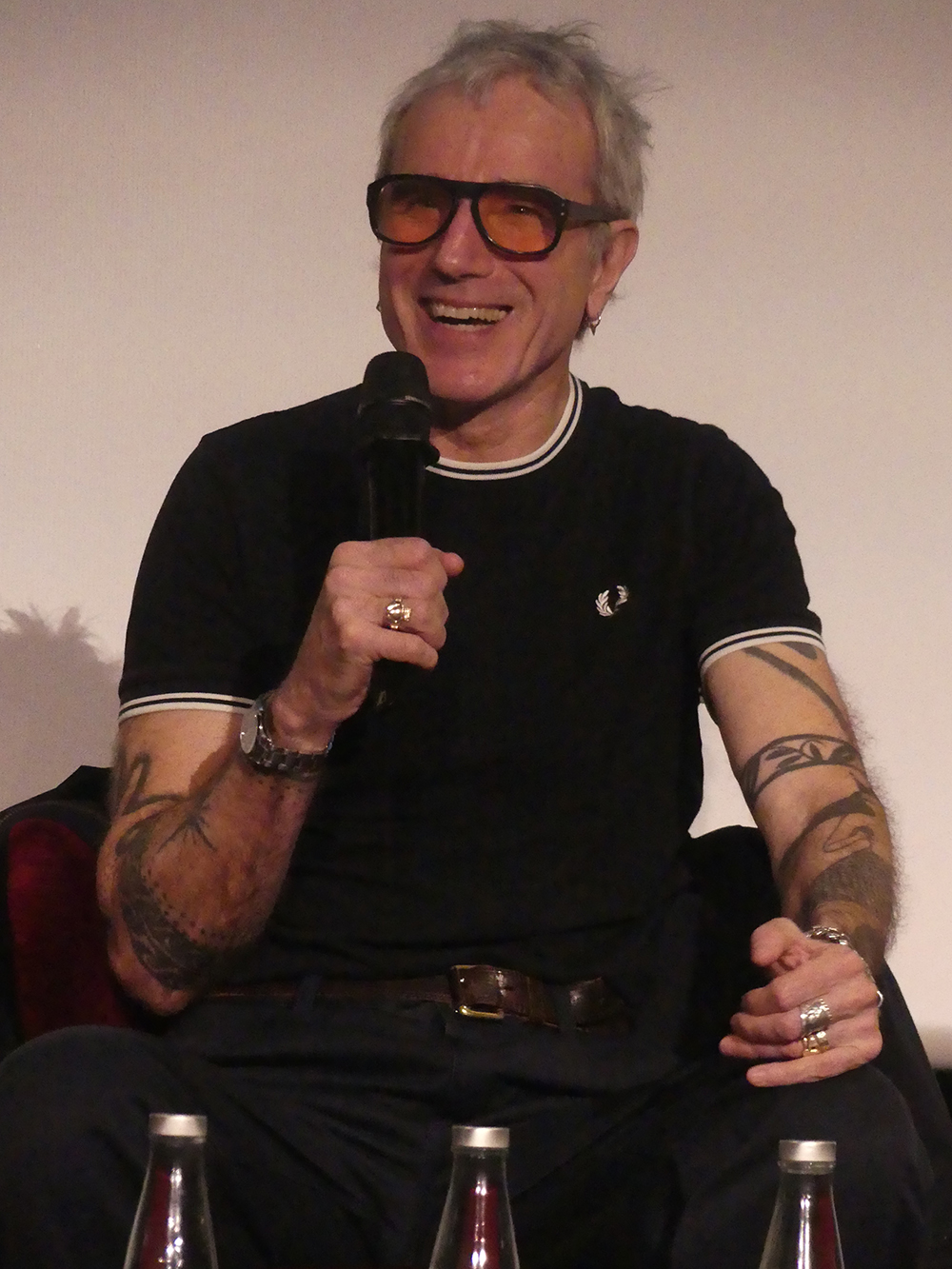
In the Pathe Palace in Paris, the premiere of Anemone unfolded as one of those genuinely rare cinematic moments, carrying an almost surreal aura given Daniel Day-Lewis’s presence on a red carpet, an occurrence that has remained exceptional since his widely publicized retirement following Phantom Thread in 2017. Our media had attended the February 23, 2026 event to capture a night defined by a striking contrast: the hushed, reverential silence inside the auditorium after the screening versus the contained excitement of an audience composed of industry professionals, journalists, and devoted cinephiles. Following the projection, Daniel Day-Lewis engaged in an extended and thoughtful conversation with journalist Thierry Chèze, reflecting with measured candor on his involvement in co-writing the screenplay, the deeply personal nature of the project, and the singular creative dynamic of being directed by his son, Ronan Day-Lewis, for whom this film marks a feature directorial debut. Far removed from the rhythms of a conventional promotional Q&A, the discussion evolved into broader reflections on trust, artistic vulnerability, and intergenerational collaboration, emphasizing how Anemone transcends the notion of a simple “comeback.”
Premiering as the opening film of the New York Film Festival on September 28, 2025, before a limited U.S. release on October 3 under the Focus Features banner, followed by nationwide expansion on October 10 and an international rollout orchestrated by Universal Pictures, Anemone quickly established itself as one of the most closely scrutinized titles of the festival season. The film not only marked Daniel Day-Lewis’s return after an eight-year absence from acting but also introduced Ronan Day-Lewis behind the camera in a gesture that was both bold and symbolically charged. Co-written by father and son, the screenplay centers on Ray Stoker, a recluse who has lived in self-imposed isolation within a remote English forest for a decade, forced to confront resurfacing trauma when his family attempts to reconnect. Themes of memory, guilt, emotional fracture, and reconstruction permeate the narrative, and while critics frequently highlighted the script’s elliptical structure and at times abstract psychological framework, there was broad consensus regarding the performances’ emotional precision and the film’s atmospheric coherence. Festival conversations often flirted with autobiographical interpretations tied to Daniel Day-Lewis’s own artistic journey, yet the film itself resists any overtly confessional reading, instead operating within a universal exploration of estrangement and reconciliation.

Principal photography began on October 1, 2024, in Manchester, unfolding in what several crew members described as a meticulous yet unexpectedly calm working environment, notably distant from the long-standing mythology surrounding Daniel Day-Lewis’s reputed intensity. Among the production anecdotes that circulated widely, one incident neatly illustrated the grounded logistical realities of filming in the United Kingdom: during location work in Handbridge, within the city of Chester, multiple vintage vehicles used as props were ticketed for parking on double yellow lines. Cheshire West and Chester Council later confirmed that permits had been issued exclusively for technical vehicles and that a request for full road closure had been denied to minimize disruption for local residents. Though minor in scale, the episode underscored a truth often obscured by the prestige of high-profile productions—namely that even films anchored by globally renowned talent remain subject to local regulations and municipal constraints, reinforcing the tangible, everyday framework within which cinema is created.
On screen, Daniel Day-Lewis delivers a performance defined by restraint, nuance, and an almost disarming fragility, favoring silences, micro-expressions, and subtle emotional shifts over demonstrative virtuosity, an approach that aligns seamlessly with Ronan Day-Lewis’s introspective directorial style. Opposite him, Sean Bean embodies a brother shaped by contained tension and unresolved conflict, while Samantha Morton brings a magnetic emotional gravity that anchors the film in a raw and organic truthfulness. This triad of performances generates a dramatic density that many critics argued compensates for the screenplay’s deliberate ambiguity. Cinematographer Ben Fordesman’s work, widely praised across early reviews, envelops the film in a tactile visual language where natural light, forest textures, and muted tonal palettes become psychological extensions of the characters themselves, oscillating between British realism and stylized interiority.

Complementing this visual identity, Bobby Krlic’s original score weaves an atmosphere of spectral minimalism, its anxious undercurrents amplifying sensations of isolation, unease, and emotional vulnerability. Produced by Dede Gardner and Jeremy Kleiner for Plan B Entertainment, the film also benefits from Jane Petrie’s costume design and Chris Oddy’s production design, both contributing decisively to the film’s sense of troubled timelessness—an aesthetic suspended between grounded reality and psychological abstraction. During the Paris premiere discussion, Daniel Day-Lewis himself emphasized how this cohesive artistic vision proved central to his decision to return to acting, framing the project not as a contradiction of past retirement but as an organic response to a uniquely meaningful creative collaboration.
With a running time of 126 minutes, Anemone positions itself within that rare category of films that invite both critical analysis and cinephile fascination, straddling the line between the return of an iconic performer and the confident emergence of a distinct new directorial voice. In Paris, the reception was marked by attentive engagement and palpable emotion, as though the audience fully recognized the exceptional convergence embodied by the evening: a legendary actor rediscovering the screen and a first-time filmmaker asserting an already singular cinematic identity.

You can discover our photos in our Flickr page
Synopsis :
It has been 10 years since Ray Stroker exiled himself to a remote forest in England, cut off from the world and his family. But when his family decides to reconnect with him, everyone's traumas resurface. After a decade of silence, the time has come for Ray to confront his secrets.
Anemone (Anemone)
Directed by Ronan Day-Lewis
Written by Ronan Day-Lewis, Daniel Day-Lewis
Produced by Dede Gardner, Jeremy Kleiner
Starring Daniel Day-Lewis, Sean Bean, Samantha Morton
Cinematography : Ben Fordesman
Edited by Nathan Nugent
Music by Bobby Krlic
Production company : Plan B Entertainment
Distributed by Focus Features (United States), Universal Pictures (International)
Release dates : September 28, 2025 (NYFF), October 3, 2025 (United States)
Running time : 126 minutes
Photos and video 4K : Boris Colletier / Mulderville