
 English
Premiere - The Testament of Ann Lee: Mona Fastvold’s Visionary Musical Enchants Paris
By Mulder, Paris, Max Linder Panorama,, 17 february 2026
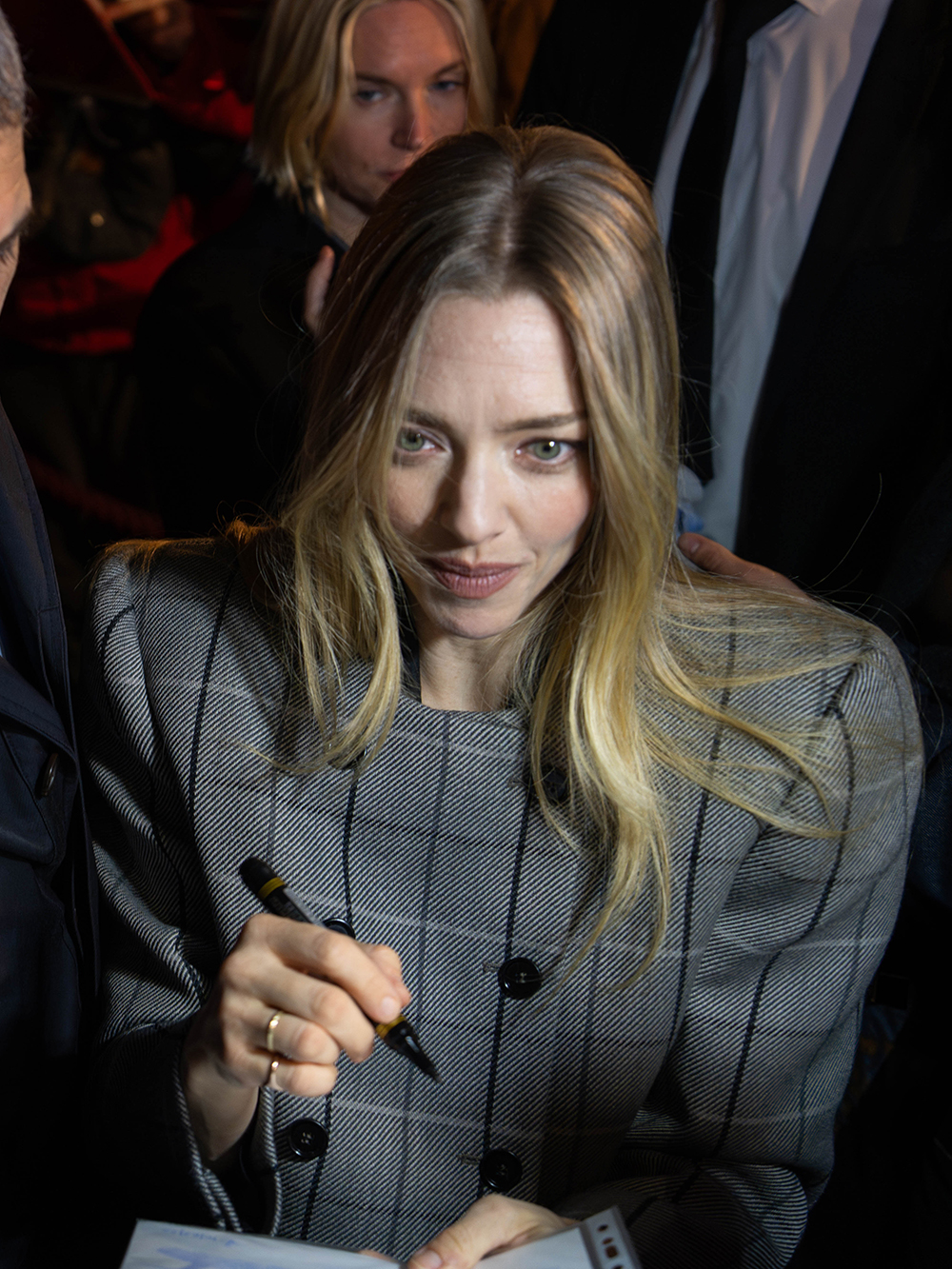
On Tuesday evening, February 17, the Max Linder Panorama hosted the Paris premiere of The Testament of Ann Lee, transforming the Grands Boulevards into a corridor of cinephile anticipation where industry guests, press, and passionate film lovers gathered to welcome one of the most singular historical works of the season, a film introduced in person by its director and co-screenwriter Mona Fastvold, alongside lead actress Amanda Seyfried and co-screenwriter Brady Corbet, whose brief but warmly received presentation immediately set the tone for a night defined by curiosity and admiration; our media was present to document the event through photography and 4K video coverage, capturing not only the red carpet elegance but also the palpable sense that audiences were about to experience a film resisting easy categorization, oscillating between epic historical drama, radical musical experiment, and spiritual fever dream.
First unveiled in the main competition of the 82nd Venice International Film Festival on September 1, 2025, where it earned a nomination for the Golden Lion, The Testament of Ann Lee has steadily built critical momentum across major festivals including Toronto, London, Chicago, and EnergaCAMERIMAGE, supported by consistently enthusiastic reactions that frequently highlighted the daring vision of Mona Fastvold and the transformative performance of Amanda Seyfried, often described by international critics as a career-best turn; distributed by Searchlight Pictures in the United States with a limited 70mm theatrical release beginning December 25, 2025 before expanding wider on January 23, 2026, and arriving in the United Kingdom on February 20, 2026, the film is scheduled for its French theatrical release on March 11, 2026 via The Walt Disney Company France, positioning it as one of the most anticipated prestige titles of the early spring calendar.

Directed by Mona Fastvold and co-written with Brady Corbet, the film recounts the extraordinary true story of Ann Lee, the 18th-century founder of the Shakers, portrayed by Amanda Seyfried in a role demanding extreme emotional, vocal, and physical commitment, supported by a cast that includes Thomasin McKenzie, Lewis Pullman, Stacy Martin, Tim Blake Nelson, and Christopher Abbott; structured in three chapters tracing Lee’s impoverished childhood in Manchester, her transatlantic migration, and the establishment of a utopian Shaker community in America, the narrative adopts an interpretative but historically anchored approach, treating Lee’s visions, convictions, and ecstatic rituals not with irony but with immersive sincerity, a creative choice repeatedly emphasized by Brady Corbet, who underscored the importance of honoring the spiritual intensity of the Shaker testimony rather than filtering it through contemporary cynicism.
The film’s production journey is itself a story of artistic audacity, with principal photography taking place primarily in Budapest, complemented by sequences shot around Hancock Shaker Village in Massachusetts and aboard the Götheborg, a full-scale replica of an 18th-century sailing vessel in Gothenburg, Sweden, where cast and crew navigated brutal weather shifts while staging complex dance-driven scenes in confined spaces; cinematographer William Rexer insisted on shooting on 35mm film stock, later blown up to 70mm, pursuing what Mona Fastvold described as a “painterly” texture inspired by Caravaggio’s chiaroscuro, a decision that not only enhanced candlelit interiors but also reinforced the tactile, period-authentic atmosphere that distinguishes the film visually, echoing the analogue discipline previously embraced by the same creative duo on The Brutalist.
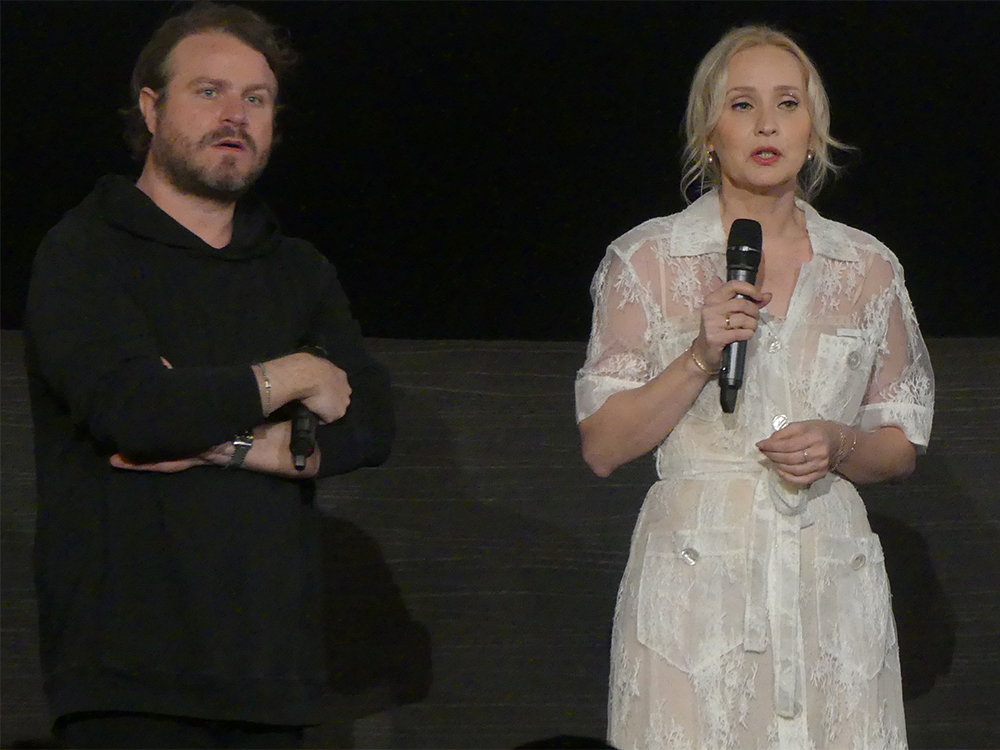
A defining element of The Testament of Ann Lee lies in its integration of movement, music, and ritual, with choreography by Celia Rowlson-Hall translating Shaker ecstatic worship into a cinematic language oscillating between raw physical release and geometric precision, mirroring Ann Lee’s transformation from spiritual turbulence to communal structure; the rehearsal process extended over months, fostering what Amanda Seyfried described as a profound collective energy on set, where dance sequences often became emotionally exhausting yet cathartic experiences, culminating in moments of spontaneous levity, including a now-memorable break where the cast and crew, still in heavy period costumes, erupted into an impromptu dance to “I’m Gonna Be (500 Miles)” by The Proclaimers.
Composer Daniel Blumberg, fresh from his Academy Award-winning work on The Brutalist, crafted a score rooted in traditional Shaker hymns, reimagined through experimental vocal textures, tuned percussion, bells, celeste, and even distorted electric guitar, producing a sonic landscape that functions as the emotional bloodstream of the film; working from pre-production through sound mixing, Daniel Blumberg collaborated closely with Mona Fastvold, recording many performances live on set and assembling a vast palette of voices inspired by glossolalia, an approach that both honors the Shakers’ ecstatic practices and pushes the boundaries of what audiences conventionally expect from a historical musical drama.
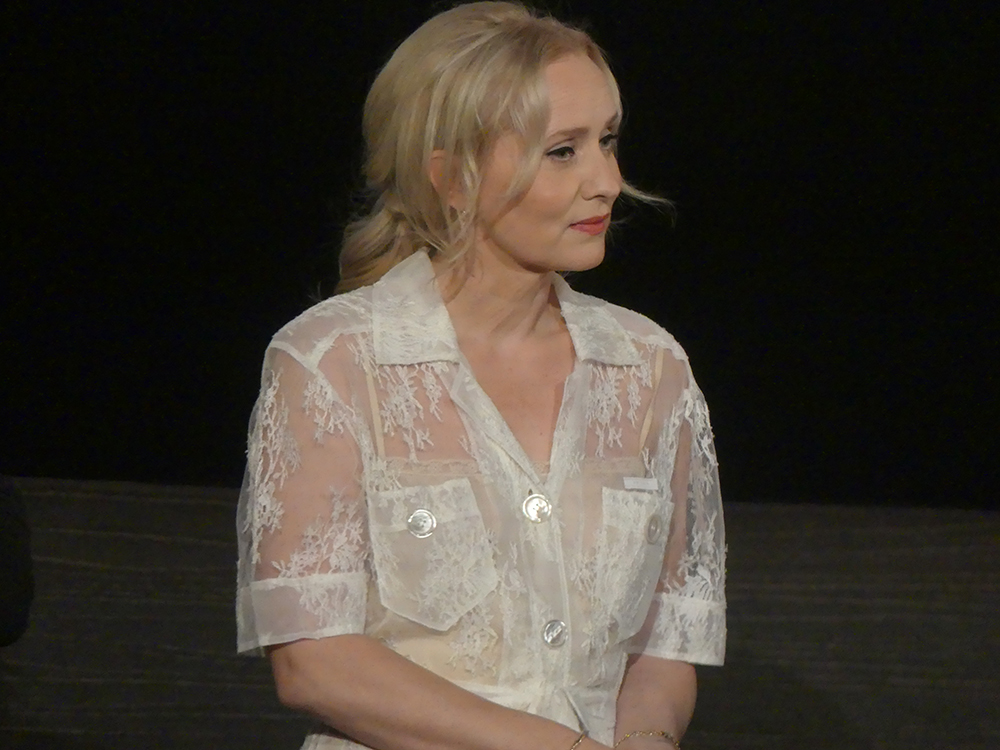
The narrative does not shy away from the harsher realities of Ann Lee’s life, including the trauma of childbirth and loss, themes Mona Fastvold chose to depict with striking directness using practical prosthetic effects, reinforcing the film’s refusal to romanticize its subject while preserving empathy for Lee’s radical spiritual and social convictions; production designer Samuel Bader, drawing inspiration from William Hogarth’s depictions of lower-class England and the austere elegance of Shaker architecture, reconstructed Manchester’s chaos and America’s disciplined simplicity through practical sets, matte paintings, and carefully selected Hungarian locations that offered both authenticity and logistical flexibility.
Beyond its cinematic achievements, The Testament of Ann Lee inevitably rekindles interest in the Shaker legacy itself, a religious movement that once counted approximately 6,000 members at its 19th-century peak but has dwindled to just three practicing adherents as of 2025, all residing at Sabbathday Lake Shaker Village in New Gloucester, Maine, the last active Shaker community in the world; this historical resonance gives the film an additional layer of poignancy, as emphasized by Mona Fastvold, who framed Ann Lee’s story as both a tribute to a forgotten female religious leader and a meditation on the universal artistic impulse to imagine, build, and believe in a different world.
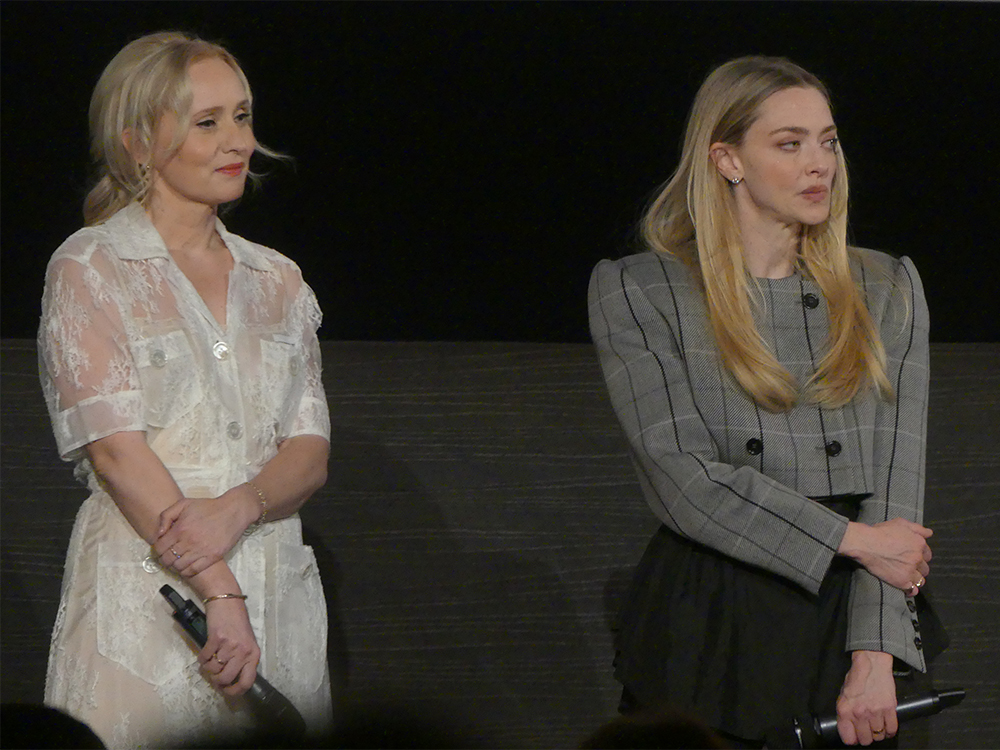
As the lights dimmed at the Max Linder Panorama, the Paris audience entered a film already celebrated for its visual grandeur, sensory intensity, and the fearless commitment of Amanda Seyfried, whose portrayal of Ann Lee has drawn awards-season recognition including Golden Globe and Critics’ Choice nominations, confirming once again her remarkable range after acclaimed performances in Mank, The Dropout, and First Reformed; the evening closed not simply as a premiere, but as the affirmation of a work that challenges, unsettles, and mesmerizes — a film that, much like its protagonist, dares to pursue transcendence without compromise.
You can discover our photos in our Flickr page : red carpet, event
Synopsis :
The fascinating and incredible true story of Ann Lee, founder of the religious cult known as the Shakers. This passionate prophetess, who preached gender equality and social justice, was adored by her followers.
The Testament of Ann Lee
Directed by Mona Fastvold
Written by Mona Fastvold, Brady Corbet
Produced by Andrew Morrison, Joshua Horsfield, Viktória Petrányi, Mona Fastvold, Brady Corbet, Gregory Jankilevitsch, Klaudia Śmieja-Rostworowska, Lillian LaSalle, Mark Lampert
Starring Amanda Seyfried, Thomasin McKenzie, Lewis Pullman, Stacy Martin, Tim Blake Nelson, Christopher Abbott
Cinematography : William Rexer
Edited by Sofía Subercaseaux
Music by Daniel Blumberg
Production companies : Kaplan Morrison, Intake Films, Mid March Media, Annapurna Pictures, FirstGen
Mizzel Media, Yintai Entertainment, ArtClass Films, Carte Blanche
Distributed by Searchlight Pictures (United States), The Walt Disney Company France (France)
Release dates : 1 September 2025 (Venice), 25 December 2025 (United States), 20 February 2026 (United Kingdom), March 11, 2026 (France)
Running time : 137 minutes
Photos red carpet : @fannyrlphotography
Photos and video 4K of the event : Boris Colletier / Mulderville