
 English
Events - Lady Diana Spencer: The Revenge Dress Comes to Musée Grévin, Between Pop Icon and Paris Ghost
By Mulder, Paris, musée Grévin, 20 november 2025

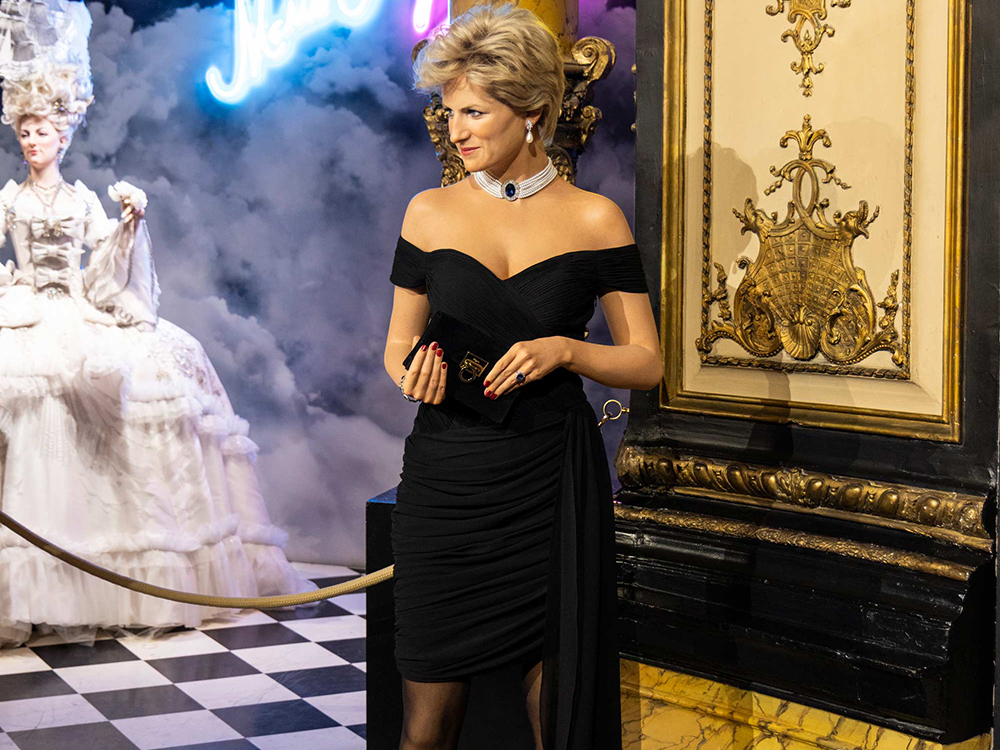
On 20 November 2025, almost twenty-eight years after her death in Paris, the Musée Grévin finally unveiled its wax figure of Diana Frances Spencer, better known as Lady Diana, Princess of Wales, and the choice of both date and costume could hardly be more symbolic. The statue shows Diana Frances Spencer in the legendary “Revenge Dress”, the short black, off-the-shoulder gown by Christina Stambolian that she wore to a charity evening at London’s Serpentine Gallery on 29 June 1994, the very night Charles III (then Prince of Wales) publicly admitted his infidelity on British television. Rather than a bridal fantasy or a humanitarian visit, Grévin has chosen the exact moment when a woman turned a marital humiliation into an act of self-reclamation, and that instantly-iconic look – bare shoulders, choker, confident stride – became a visual manifesto of resilience, endlessly cited in magazines, documentaries and on social media around the world.
The road to bringing Diana Frances Spencer into the Paris museum was long and hesitant, which makes her arrival feel even more loaded with meaning. Grévin had considered representing her before 1997, but the fatal crash at the Pont de l’Alma froze the project out of respect, the team fearing a morbid or voyeuristic reception. It was a trip to London by Grévin’s CEO Yves Delhommeau – and the shock of seeing a Diana figure tucked away under a tree at Madame Tussauds – that convinced him Paris could and should offer her a more central, dignified setting under the fashion dome of the boulevard Montmartre. There, she now stands among other fashion and culture figures like Jean Paul Gaultier, Marie Antoinette, Chantal Thomass, Aya Nakamura and Lena Situations, while Charles III and Elizabeth II remain in the more institutional heads-of-state area, a subtle curatorial choice that clearly places Diana Frances Spencer on the side of pop culture and personal emancipation rather than pure royal protocol.

Sculpted by Laurent Mallamaci and realised by the museum’s workshops, the waxwork is built almost like a freeze-frame from that Serpentine evening: the asymmetrical black dress hugging the body, the pearl choker with its dark stone, the small clutch pressed against the hip, and that unmistakable three-quarter gaze that mixes mischief, determination and a hint of defiance. The “Revenge Dress” has been told and retold so many times that it has become a cinematic sequence in itself: Diana Frances Spencer, already separated, arriving slightly late at the gala, knowing the cameras are waiting, and silently answering a televised confession with a silhouette instead of a speech. The expression “We were three in this marriage, so it was a bit crowded”, dropped a year later in the BBC’s Panorama interview, now echoes silently over the figure, as if Grévin had chosen to merge these two milestones – the dress and the confession – into a single, crystallised image of a woman reclaiming her narrative in front of a world that thought it already knew everything about her.
To stop at the style would, however, betray what Diana Frances Spencer represents, and the museum’s texts make sure to anchor the look in a richer biography: the shy girl born in 1961 at Sandringham, the young nursery assistant suddenly propelled at twenty into a royal wedding watched by hundreds of millions, the mother of Prince William and Prince Harry who insisted on hugging patients, visiting homeless shelters and walking through minefields in Angola to bring cameras where politics preferred not to look. Her work with AIDS patients in the 1980s, her public gestures toward people with leprosy or cancer, and her advocacy against anti-personnel landmines are recalled as the true backbone behind the glamorous photographs, explaining why her image still circulates so intensely on TikTok and Instagram long after the 1990s have passed. In that light, placing her in Paris – the city that mourned her so massively in 1997 – is not just a tourist attraction but a kind of narrative correction: instead of being forever associated with a tunnel and a crash, Diana Frances Spencer now also exists here as a standing, composed and powerful figure under the bright lights of a museum.
The inauguration added a literary layer to this new chapter thanks to author Christine Orban, member of the Académie Grévin, who has just published Mademoiselle Spencer with Albin Michel, a novel that slips inside Diana Frances Spencer’s mind from the childhood abandonment by her mother to the BBC confession, framing her path as a liberation through truth more than through royal titles. By reading excerpts in front of the statue, Christine Orban subtly reminded the audience that behind the famous black dress there was a child, an adolescent and a woman trying to regain control over her story in a system that constantly wrote it for her. Ultimately, this new wax figure works because it condenses all those layers – fashion, trauma, activism, myth – into a single, instantly readable image. Visitors come for the “Revenge Dress”, they stay for the feeling that Paris is finally giving Diana Frances Spencer another ending: not in the blinding flash of paparazzi in a tunnel, but in the steady light of a dome where she stands, eternally, on her own terms.
Photos : Copyright Virginie Ribaut / Musée Grévin